
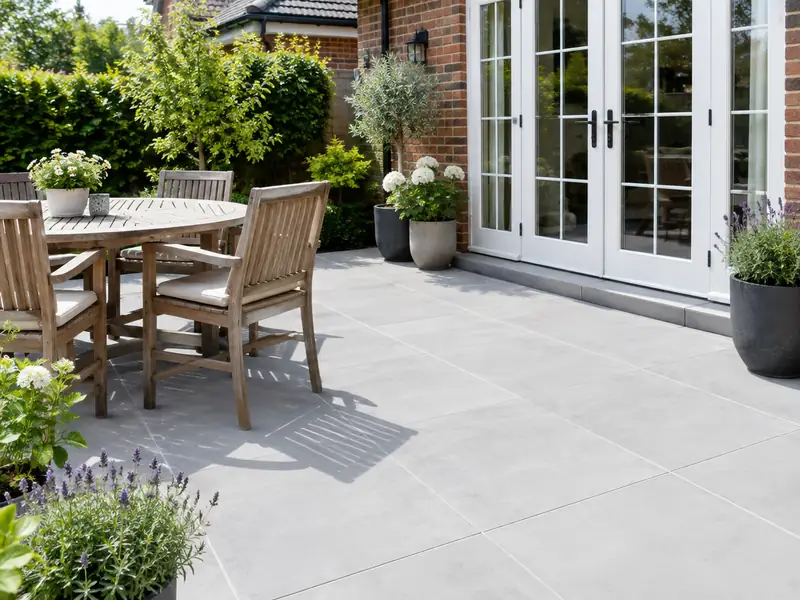
A patio is a paved outdoor area next to the house or in the garden, laid in porcelain, natural stone or concrete slabs on a compacted sub-base and mortar bed, with falls that direct rainwater away from the house.
Homeowners in Paisley usually consider a new patio for one of a few reasons: something has worn out, the house no longer suits the way they live, or they are getting it ready to sell. We visit, agree a specification and put a fixed price in writing. Most jobs like this take 3–7 days on site, and we work across Renfrewshire and Inverclyde, including Barrhead, Renfrew and Johnstone.
- Guide price
- £2,400–£5,300 inc VAT
- Time on site
- 3–7 days on site
- Postcodes
- PA1, PA2 and PA3
- Planning rules
- Scotland
- Local area
- Renfrewshire
- Survey
- Free, with a written quote
What should you budget for a new patio in Paisley?
Use the table to gauge the cost of a new patio in Paisley before we visit. Figures include VAT and are scaled for Scotland, coming out about 4% below the national guide, which gives £2,400–£5,300 overall. After a free survey, you receive a fixed written price.
| Type of job | What it usually involves | Guide in Paisley |
|---|---|---|
| Small patio or path | Around 10m² of concrete slabs or a garden path. | £950–£2,400 |
| Typical 20m² patio | Sandstone or porcelain on a full sub-base with jointing and edging. | £2,400–£5,300 |
| Large or multi-level patio | Bigger areas, steps, retaining walls or premium stone. | £5,300–£11,500 |
What moves the price up or down:
- Patio area and the amount of excavation
- Slab material, size and laying pattern
- Drainage needed to keep water away from the house
- Access for materials and removing spoil
Scope of the work
- Survey of levels, damp-proof course, drainage and access
- Excavation and removal of turf, soil or old paving
- Compacted MOT Type 1 sub-base
- Jointing with mortar or a brush-in compound
- Edging and neat cuts around drains and walls
- Site cleared, waste removed and paving cleaned
Local housing and a new patio
Paisley has sandstone tenements and terraces from its textile era, Greenock and Port Glasgow have tenements and housing climbing the hills above the Clyde, and Gourock and Kilmacolm have Victorian villas. Post-war estates and newer private housing surround the towns, and roughcast is a common finish.
Inverclyde is one of the wettest parts of lowland Scotland, and homes facing the Firth of Clyde take wind and driving rain.
If your house in Paisley fits one of these patterns, it helps us anticipate what a new patio will involve, though we always confirm the details on site.
Do you need permission in Paisley?
For anyone in Paisley, the relevant framework is Scotland's. The summary below is general, so we always contact the council about your address before putting a price in writing.
A ground-level patio does not usually need planning permission in Scotland; raised decking is limited in height under permitted development.
A building warrant is not normally needed for a patio.
Rules change and every property is different, so we check the planning history and constraints for your address before we quote.
From survey to handover
Survey and measure
It starts with a survey at the property, free of charge. We check condition, access and services, ask how you want the finished result to look, and answer any questions you have about a new patio.
Your fixed price
You get the price in writing, itemised so you can see where the money goes. As long as the specification stays the same, that is the price you pay for a new patio.
Plan and prepare
Preparation matters as much as the build. We agree access, parking and working hours with you, order materials in good time, and confirm any permissions so the job isn't held up once it starts.
Finish and handover
Work goes ahead as scheduled and you deal with one contact throughout. When the last trade leaves, we clear and clean the site, talk you through what has been done and pass on any certificates and care instructions.
What you can expect from us
Patios and paving in Paisley: questions
Can I stay at home during the work?
In most cases, yes. Most people can live at home throughout, and we plan the work to keep disruption down by protecting floors, agreeing working hours and keeping access routes clear. Bigger jobs affecting kitchens, bathrooms or heating may mean a short spell with reduced facilities, and we talk this through with you at the survey.
How much does a new patio cost?
A typical 20m² patio in sandstone or porcelain costs £2,400–£5,300, including excavation, sub-base, laying and jointing. As a guide, allow roughly £100–£220 per square metre plus fixed costs for set-up and waste. Concrete slabs cost less, while slate, granite and large-format porcelain cost more. Steps, walls and drainage add to the total. We confirm a fixed price after the survey.
Does a patio need planning permission?
Most patios do not need planning permission, but it depends on the size, height and location, your home's position, whether it is listed or in a conservation area, and which UK nation you are in. Raised patios or decking more than a small height above the ground may need permission because of overlooking. We check the position for your garden before quoting.
Which postcodes in Paisley do you cover?
We cover PA1, PA2 and PA3, along with the rest of Renfrewshire and Inverclyde. If your postcode is not listed, get in touch anyway: our coverage is UK-wide, and we can usually arrange a survey wherever you live. Enter your postcode in the guide-price tool or contact form and we will confirm.
How do I clean and look after my patio?
Most patios just need regular sweeping and an occasional wash with water and a mild patio cleaner. Porcelain is the easiest to keep clean. Natural stone benefits from a sealant to reduce staining and from prompt cleaning of spills like oil or wine. Re-point any joints that crack or wash out. Avoid high-pressure jet washing close to joints, which can damage them.
Near Paisley
Homes across PA1, PA2 and PA3 in Paisley are within our coverage, as are those in Barrhead, Renfrew and Johnstone. If you are just outside these areas, ask anyway, because we work right across the UK.