
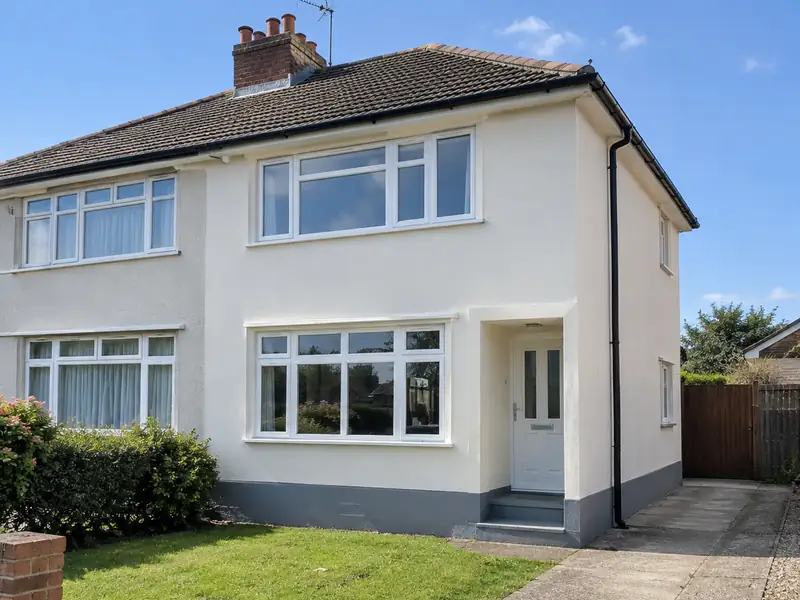
External rendering is applying a protective, weather-resistant coating to the outside walls of a house, using sand and cement, monocouche or thin-coat silicone render, to give a smooth or textured finish that protects the masonry and improves appearance.
For a homeowner in Bletchley, planning external rendering tends to begin with two questions: what will it cost, and how disruptive will it be? Our guide range is £7,800–£18,000 including VAT, and a typical job runs to 1–3 weeks on site, depending on weather. Both numbers firm up once we have seen the property, measured up and agreed exactly what is included.
- Guide price
- £7,800–£18,000 inc VAT
- Time on site
- 1–3 weeks on site, depending on weather
- Postcodes
- MK1, MK2 and MK3
- Planning rules
- England
- Local area
- Milton Keynes
- Survey
- Free, with a written quote
What should you budget for external rendering in Bletchley?
The table below shows guide prices for external rendering in Bletchley. They are based on rates in the South East, which run about 12% above the national guide, giving an overall range of £7,800–£18,000. All figures include VAT and are firmed up after a free site survey.
| Type of job | What it usually involves | Guide in Bletchley |
|---|---|---|
| Front elevation or small terrace | One elevation or a small terraced house, including scaffolding and preparation. | £3,400–£7,800 |
| Typical semi-detached | All rendered walls of a 3-bed semi in monocouche or silicone, with scaffolding. | £7,800–£18,000 |
| Detached or full strip and re-render | Larger houses, or homes needing old render removed and walls repaired first. | £17,000–£33,500 |
Expect these to shape the final quote:
- Wall area to be rendered and the height of the house
- Render system: sand and cement, monocouche or silicone
- Removing old render or pebbledash and repairing the walls
- Scaffolding, access and protection of neighbouring property
What do you get?
- Survey of walls, existing render, cracks and damp-proof course
- Removal of loose or failed render and pebbledash where needed
- Windows, doors and surfaces masked and protected
- Beads at corners, edges and above the damp-proof course
- Mesh reinforcement and base coats to suit the chosen system
- Making good around pipes, vents and fixings, and a site clean-up
What are homes like around Bletchley?
Buckinghamshire runs from Chiltern villages of brick and flint, through Metroland interwar semis around Amersham and Chesham, to Victorian terraces in High Wycombe and Aylesbury. Milton Keynes adds estates built from the 1970s onwards in brick, render and timber frame, and new housing continues to spread around its edges.
The Chiltern hills are more exposed than the vale below, and clay-with-flints soils make drainage design and footing depth worth checking early.
In Bletchley, as elsewhere in Buckinghamshire, we take the building's age and construction into account before recommending anything, because both can change what is involved in external rendering.
Do you need permission in Bletchley?
Because Bletchley falls under England's rules, the guidance below is the version relevant to you. Before sending a price, we check your property's position with the council.
In England, re-rendering or cladding a house is often allowed without planning permission, but stone, render, timber, plastic or tile cladding is not permitted development in conservation areas, and listed buildings need consent.
If you render or re-clad more than 25% of an external wall, Building Regulations usually require the wall’s insulation to be improved where that is practical, and building control should be notified.
Rules change and every property is different, so we check the planning history and constraints for your address before we quote.
From survey to handover
Survey and measure
First, someone visits your home in Bletchley to see the space, take measurements and note anything that could affect the work, such as access or the condition of what is there. There is no charge for this visit.
Quote in writing
After the survey we send a quote for external rendering that fixes the price for the scope we've agreed. If you want to change materials or scope, we revise it in writing before anything is booked.
Getting ready
Next comes planning the work itself. We set a start date that suits you, line up the right trades, and make sure any approvals for external rendering are in place before the first day on site.
The work itself
The job proceeds in the order set out in the programme, with dust and debris kept under control. Finally we tidy away, inspect the work together and pass the finished project over to you with its paperwork.
How we work
Frequently asked questions
Can you render over pebbledash or old render?
Rendering over existing pebbledash or render is sometimes possible if it is firmly bonded, but if it sounds hollow, is cracked or is coming away, it must be removed first. Covering failing render simply hides the problem until the new coat fails too. We tap-test the walls and explain whether removal is needed. Removal adds time and cost but gives a sound base.
Do I need planning permission in Bletchley?
It depends on the work, the size of the project, your property type and whether the building is listed or in a conservation area. Bletchley is in England, so England's rules apply. Many smaller jobs need no planning application, but some still need building control approval. We check what applies to your address before quoting.
What happens at the survey?
We visit your home at a time that suits you, look at the area involved, take measurements and check access, condition and any services that might be affected. We talk through what you want from external rendering, explain the options and answer questions. There is no charge and no obligation; afterwards we send a written quote.
How much does it cost to render a house?
Rendering a typical 3-bed semi costs £7,800–£18,000, including scaffolding and preparation. As a guide, allow around £60–£120 per square metre of wall plus fixed costs for scaffolding and set-up. Sand and cement is the lowest-cost system, while silicone thin-coat costs more but needs no painting. Removing old render or pebbledash first adds noticeably to the price. We confirm a fixed figure after the survey.
Which render system should I choose?
The right render depends on your walls and how much upkeep you want. Sand and cement is the lowest-cost option but needs repainting every few years. Monocouche is coloured through, so it needs no painting, and suits block and brick walls. Silicone thin-coat is flexible, water-repellent and stays cleaner, but costs more. Lime render suits older solid walls. We recommend a system after inspecting your walls.
Nearby towns
Bletchley and its MK1, MK2 and MK3 postcodes are part of our coverage. Homeowners in Milton Keynes, Leighton Buzzard and Ampthill can also book a free survey with us and receive a written price for their job.