
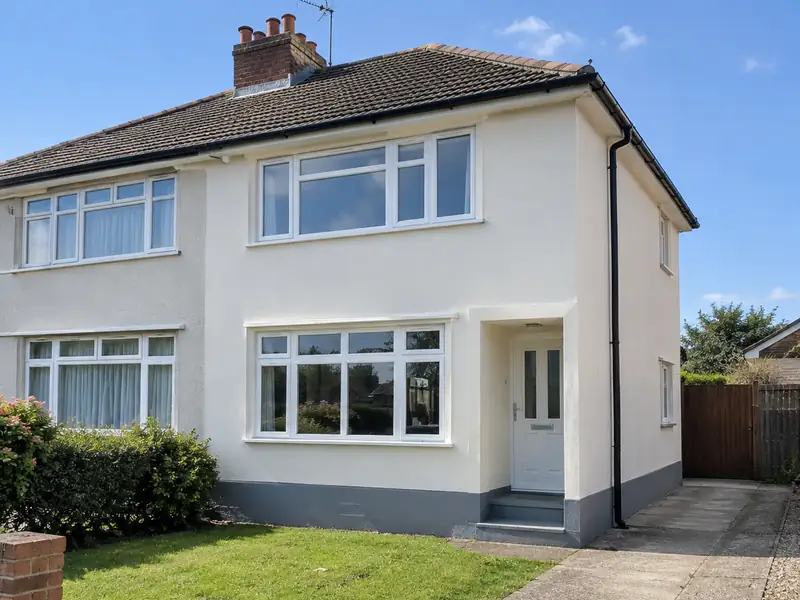
External rendering is applying a protective, weather-resistant coating to the outside walls of a house, using sand and cement, monocouche or thin-coat silicone render, to give a smooth or textured finish that protects the masonry and improves appearance.
Getting external rendering right in Falmouth starts with understanding the house you already have: its age, how it was built and what has been altered over the years. We survey first, then commit on paper to a price that holds as long as the scope stays the same. Across the South West, guide prices run at £7,100–£16,500 including VAT, and homes in Truro, Redruth and Camborne are covered too.
- Guide price
- £7,100–£16,500 inc VAT
- Time on site
- 1–3 weeks on site, depending on weather
- Postcodes
- TR11
- Planning rules
- England
- Local area
- Cornwall
- Survey
- Free, with a written quote
What should you budget for external rendering in Falmouth?
Prices for external rendering vary from house to house, but in Falmouth most projects fall within £7,100–£16,500 including VAT. That reflects costs in the South West, about 2% above the national guide. Treat the table as a budgeting aid; the written figure follows a survey we carry out for free.
| Type of job | What it usually involves | Guide in Falmouth |
|---|---|---|
| Front elevation or small terrace | One elevation or a small terraced house, including scaffolding and preparation. | £3,100–£7,100 |
| Typical semi-detached | All rendered walls of a 3-bed semi in monocouche or silicone, with scaffolding. | £7,100–£16,500 |
| Detached or full strip and re-render | Larger houses, or homes needing old render removed and walls repaired first. | £15,500–£30,500 |
The main things that change the figure:
- Wall area to be rendered and the height of the house
- Removing old render or pebbledash and repairing the walls
- Scaffolding, access and protection of neighbouring property
- Detailing around windows, bays, sills and pipes
What do you get?
- Survey of walls, existing render, cracks and damp-proof course
- Removal of loose or failed render and pebbledash where needed
- Windows, doors and surfaces masked and protected
- Beads at corners, edges and above the damp-proof course
- Mesh reinforcement and base coats to suit the chosen system
- Making good around pipes, vents and fixings, and a site clean-up
What are homes like around Falmouth?
Older Cornish homes are often built of granite or slatey local stone, with slate roofs and sometimes slate-hung walls facing the weather. Cob cottages survive in places, Truro and Falmouth keep Georgian and Victorian streets, and many towns have rendered post-war houses, bungalows and newer estates on their edges.
Cornwall faces Atlantic gales, driving rain and salt-laden air, so render, pointing and window hardware on exposed elevations need a suitably robust specification.
So when we survey a Falmouth property for external rendering, the first step is working out how it was built and what has been changed since.
Do you need permission in Falmouth?
Each UK nation sets its own consent rules, and Falmouth is in England. What follows is a plain summary; we check the specifics for your property with the council before pricing anything.
In England, re-rendering or cladding a house is often allowed without planning permission, but stone, render, timber, plastic or tile cladding is not permitted development in conservation areas, and listed buildings need consent.
If you render or re-clad more than 25% of an external wall, Building Regulations usually require the wall’s insulation to be improved where that is practical, and building control should be notified.
Rules change and every property is different, so we check the planning history and constraints for your address before we quote.
From survey to handover
Free site survey
We begin by looking at the job in person. During the free survey we discuss options, materials and budget for external rendering, and photograph or measure anything the quote needs to reflect.
Quote in writing
The quote arrives in writing, not over the phone. It covers the full scope, the finishes you've chosen, any exclusions and the payment schedule, with a fixed price tied to that specification.
Plan and prepare
Preparation matters as much as the build. We agree access, parking and working hours with you, order materials in good time, and confirm any permissions so the job isn't held up once it starts.
The work itself
The work is carried out to the agreed specification, with floors and furniture protected and the site kept tidy. At the end we clean up, walk through the finished job with you and hand over any certificates.
Why homeowners choose us
Common questions
How long will external rendering take?
On a typical home, allow 1–3 weeks on site, depending on weather. Larger projects, older buildings and extra work found once things are opened up can extend that, while simpler jobs may be shorter. Your quote includes an estimate of time on site, and your point of contact keeps you updated on the programme as the work progresses.
How do I look after silicone or monocouche render?
Through-coloured render needs little upkeep. Check it once a year for cracks or damage, especially around windows and pipes, and keep gutters clear so water does not run down the walls. If green algae appears on shaded walls, a specialist render cleaner applied with a soft brush or low-pressure wash removes it. Avoid high-pressure jet washing, which can damage the surface.
Can you combine external rendering with other work?
Yes. Because we manage several trades under one contract, we can plan external rendering alongside other work on your Falmouth home, such as new windows with rendering, or a kitchen refit with an extension. Combining jobs can reduce repeat set-up such as scaffolding, skips and access, and every element is listed and priced in the same written quote.
How much does it cost to render a house?
Rendering a typical 3-bed semi costs £7,100–£16,500, including scaffolding and preparation. As a guide, allow around £60–£120 per square metre of wall plus fixed costs for scaffolding and set-up. Sand and cement is the lowest-cost system, while silicone thin-coat costs more but needs no painting. Removing old render or pebbledash first adds noticeably to the price. We confirm a fixed figure after the survey.
Will rendering stop damp?
Render protects walls from driving rain, so it can help where rain penetration is the cause of damp. It will not cure rising damp, condensation or leaks from gutters, and on older solid walls the wrong render can trap moisture and make damp worse. We look for the cause of any damp at the survey and recommend fixing that first.
Also covering areas around Falmouth
We welcome enquiries from all TR11 postcodes in Falmouth, plus Truro, Redruth and Camborne. Each one gets the same survey at no charge and a written price fixed for the work described.