
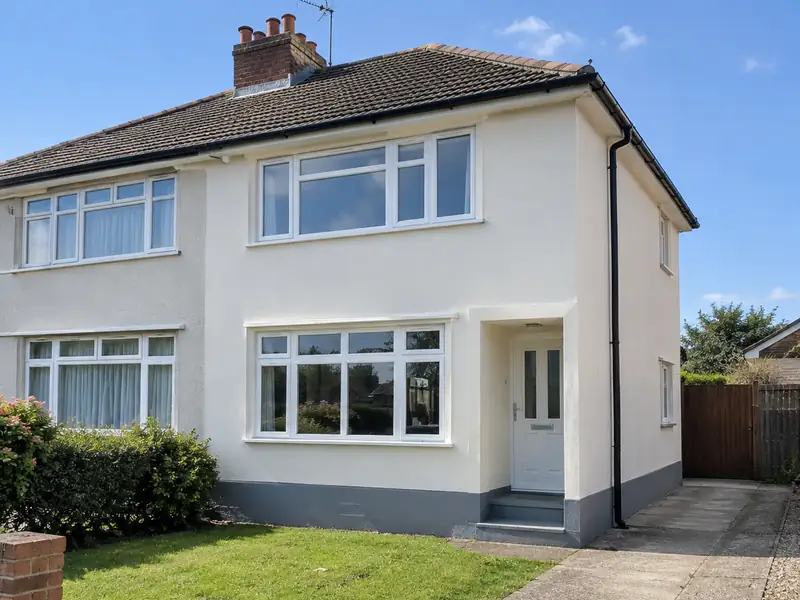
External rendering is applying a protective, weather-resistant coating to the outside walls of a house, using sand and cement, monocouche or thin-coat silicone render, to give a smooth or textured finish that protects the masonry and improves appearance.
Getting external rendering right in Antrim starts with understanding the house you already have: its age, how it was built and what has been altered over the years. We survey first, then commit on paper to a price that holds as long as the scope stays the same. Across Northern Ireland, guide prices run at £6,000–£14,000 including VAT, and homes in Ballymena, Newtownabbey and Belfast are covered too.
- Guide price
- £6,000–£14,000 inc VAT
- Time on site
- 1–3 weeks on site, depending on weather
- Postcodes
- BT41
- Planning rules
- Northern Ireland
- Local area
- County Antrim
- Survey
- Free, with a written quote
What should you budget for external rendering in Antrim?
Every figure below is a guide for external rendering in Antrim, inclusive of VAT. Regional pricing for Northern Ireland works out about 14% below the national guide, and the overall span is £6,000–£14,000. The survey costs you nothing, and after it we commit to a firm price for your specification in writing.
| Type of job | What it usually involves | Guide in Antrim |
|---|---|---|
| Front elevation or small terrace | One elevation or a small terraced house, including scaffolding and preparation. | £2,600–£6,000 |
| Typical semi-detached | All rendered walls of a 3-bed semi in monocouche or silicone, with scaffolding. | £6,000–£14,000 |
| Detached or full strip and re-render | Larger houses, or homes needing old render removed and walls repaired first. | £13,000–£26,000 |
Expect these to shape the final quote:
- Wall area to be rendered and the height of the house
- Removing old render or pebbledash and repairing the walls
- Scaffolding, access and protection of neighbouring property
- Detailing around windows, bays, sills and pipes
What’s included?
- Survey of walls, existing render, cracks and damp-proof course
- Scaffolding erected and removed, with neighbours' access agreed
- Removal of loose or failed render and pebbledash where needed
- Mesh reinforcement and base coats to suit the chosen system
- Finish coat in your chosen colour and texture
- Making good around pipes, vents and fixings, and a site clean-up
Local housing and external rendering
Belfast has long rows of red-brick Victorian terraces, Edwardian villas in the north and south of the city and large post-war estates, while towns such as Ballymena, Antrim, Larne and Carrickfergus mix terraces, semis and newer developments. Dark basalt appears in older rural buildings, and pebbledash or roughcast is a very common finish.
The north coast and glens are exposed to strong winds, salt and frequent rain, which affects render, roofline and outdoor work.
Building traditions across County Antrim also raise conservation and planning questions, so we check those for external rendering in Antrim at the survey stage.
Permissions for external rendering in Antrim
Homes in Antrim come under the regulations for Northern Ireland, summarised below. We don't rely on general rules alone: we confirm the position for your address with the council before a quote goes out.
In Northern Ireland, re-rendering is usually treated as repair, but conservation areas and listed buildings are controlled.
Significant re-cladding or external insulation should be checked with building control under the Building Regulations (Northern Ireland).
Rules change and every property is different, so we check the planning history and constraints for your address before we quote.
The four stages
Free site survey
We arrange a free site survey on a date convenient to you. We measure up, look at the existing structure and access, and discuss your plans for external rendering so the price reflects your home.
Written quote
The quote arrives in writing, not over the phone. It covers the full scope, the finishes you've chosen, any exclusions and the payment schedule, with a fixed price tied to that specification.
Getting ready
Preparation matters as much as the build. We agree access, parking and working hours with you, order materials in good time, and confirm any permissions so the job isn't held up once it starts.
On site to finish
The job proceeds in the order set out in the programme, with dust and debris kept under control. Finally we tidy away, inspect the work together and pass the finished project over to you with its paperwork.
How we work
External rendering in Antrim: questions
Can you render over pebbledash or old render?
Rendering over existing pebbledash or render is sometimes possible if it is firmly bonded, but if it sounds hollow, is cracked or is coming away, it must be removed first. Covering failing render simply hides the problem until the new coat fails too. We tap-test the walls and explain whether removal is needed. Removal adds time and cost but gives a sound base.
Do I need planning permission to render my house?
Whether rendering needs planning permission depends on how it changes the appearance, your home's location, whether it is listed or in a conservation area, and which UK nation you are in. Rendering over brick may need permission in some places, while replacing existing render like for like often does not. Listed buildings need consent. We check the position before quoting.
Can you combine external rendering with other work?
Yes. Because we manage several trades under one contract, we can plan external rendering alongside other work on your Antrim home, such as new windows with rendering, or a kitchen refit with an extension. Combining jobs can reduce repeat set-up such as scaffolding, skips and access, and every element is listed and priced in the same written quote.
Which render system should I choose?
The right render depends on your walls and how much upkeep you want. Sand and cement is the lowest-cost option but needs repainting every few years. Monocouche is coloured through, so it needs no painting, and suits block and brick walls. Silicone thin-coat is flexible, water-repellent and stays cleaner, but costs more. Lime render suits older solid walls. We recommend a system after inspecting your walls.
Can I stay at home during the work?
In most cases, yes. Most people can live at home throughout, and we plan the work to keep disruption down by protecting floors, agreeing working hours and keeping access routes clear. Bigger jobs affecting kitchens, bathrooms or heating may mean a short spell with reduced facilities, and we talk this through with you at the survey.
Near Antrim
Our coverage in Antrim includes BT41. We also travel to Ballymena, Newtownabbey and Belfast, so neighbouring addresses are looked after on exactly the same terms as those in town.