
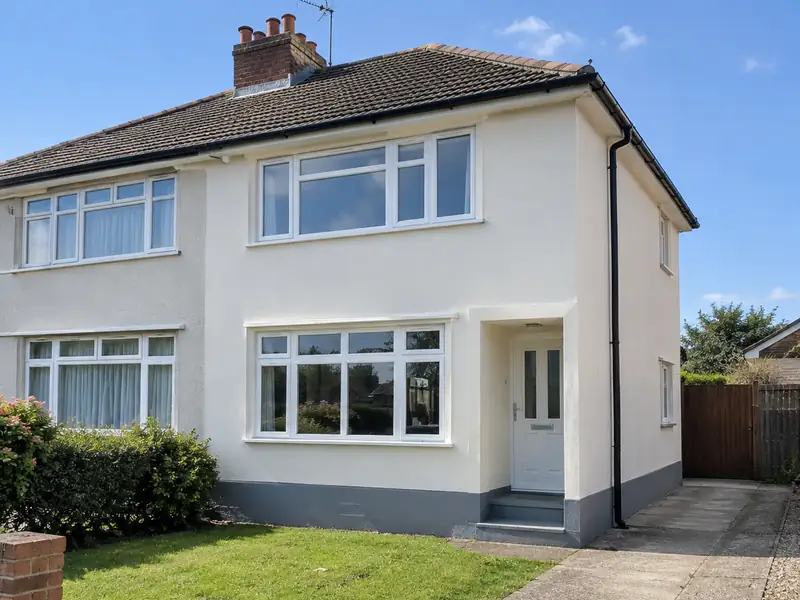
External rendering is applying a protective, weather-resistant coating to the outside walls of a house, using sand and cement, monocouche or thin-coat silicone render, to give a smooth or textured finish that protects the masonry and improves appearance.
We handle external rendering as a managed project across County Durham: one contract, one contact, and trades working to an agreed specification. Coverage includes Darlington, Hartlepool, Stockton-on-Tees and Durham and their surroundings. In England the consent rules have their own details, which we check for you. Typical prices in the North East fall within £6,300–£14,500, VAT included, and are fixed in writing after a survey.
- Guide price
- £6,300–£14,500 inc VAT
- Time on site
- 1–3 weeks on site, depending on weather
- Planning rules
- England
- Price level
- About 10% below the national guide
- Towns listed
- 12
- Survey
- Free, with a written quote
How much does external rendering cost in County Durham?
These are guide costs, not quotes. For external rendering in County Durham the range is £6,300–£14,500, VAT included, reflecting prices in the North East that are about 10% below the national guide. Once we have visited for a free survey, you get a firm figure for the scope you approve.
| Type of job | What it usually involves | Guide in County Durham |
|---|---|---|
| Front elevation or small terrace | One elevation or a small terraced house, including scaffolding and preparation. | £2,700–£6,300 |
| Typical semi-detached | All rendered walls of a 3-bed semi in monocouche or silicone, with scaffolding. | £6,300–£14,500 |
| Detached or full strip and re-render | Larger houses, or homes needing old render removed and walls repaired first. | £13,500–£27,000 |
The main things that change the figure:
- Wall area to be rendered and the height of the house
- Render system: sand and cement, monocouche or silicone
- Removing old render or pebbledash and repairing the walls
- Detailing around windows, bays, sills and pipes
What’s included?
- Survey of walls, existing render, cracks and damp-proof course
- Removal of loose or failed render and pebbledash where needed
- Windows, doors and surfaces masked and protected
- Mesh reinforcement and base coats to suit the chosen system
- Finish coat in your chosen colour and texture
- Making good around pipes, vents and fixings, and a site clean-up
Homes in County Durham
Colliery villages across County Durham are lined with brick and stone terraces, many built for mining families. Durham City has Georgian and Victorian streets, Darlington has Victorian terraces and villas, and Peterlee and Newton Aycliffe were planned as post-war new towns. Dales farmhouses in Weardale and Teesdale are stone, often under stone or slate roofs.
Colliery terraces commonly suit loft rooms, rear extensions and window replacement, and many need repointing. New-town homes often benefit from rendering or cladding upgrades and roofline renewal, while stone farmhouses may need lime work.
Winters are cold and the upland dales see snow and strong winds; former coal workings mean ground checks can be needed before building extensions.
Do you need permission in County Durham?
England, Wales, Scotland and Northern Ireland each handle planning a little differently. County Durham comes under England, covered below, and we raise any questions with the council before your quote is finalised.
In England, re-rendering or cladding a house is often allowed without planning permission, but stone, render, timber, plastic or tile cladding is not permitted development in conservation areas, and listed buildings need consent.
If you render or re-clad more than 25% of an external wall, Building Regulations usually require the wall’s insulation to be improved where that is practical, and building control should be notified.
Rules change and every property is different, so we check the planning history and constraints for your address before we quote.
From survey to handover
Free site survey
First, someone visits your home in County Durham to see the space, take measurements and note anything that could affect the work, such as access or the condition of what is there. There is no charge for this visit.
Price and scope agreed
We put everything into a written, fixed-price quote: the specification, what's excluded, staged payments and the expected time on site. Take whatever time you need to decide; there's no pressure to commit.
Plan and prepare
Once you accept, we agree start dates, order materials and deal with any planning, building control or neighbour notices the job needs. You'll know who is coming and when before work begins.
On site to finish
On site, the agreed plan is followed and any change is put in writing first. At completion we do a final clean, go through the snagging list with you and leave you with the relevant documents.
What you can expect from us
Questions about external rendering in County Durham
How long does rendering take?
Rendering a typical semi-detached house takes around one to three weeks. Scaffolding goes up first, then removal of old render, repairs, beads and mesh. Base coats need time to cure before the finish coat. Weather has a big effect, because render should not be applied in rain, frost or strong heat. We give you an expected programme with the quote.
How much will external rendering cost in County Durham?
As a guide, expect to pay £6,300–£14,500 including VAT for external rendering in County Durham. That range is adjusted for the North East, which runs about 10% below the national guide. Where your project lands depends on size, materials, access and the condition of what is already there. We confirm a fixed price in writing after a free survey of your home.
Is the price fixed?
Yes, for the specification we agree. Your written quote sets out exactly what is included at a fixed price. It only changes if you ask for something different, or if a problem the survey could not reasonably reveal later needs extra work. In either case we explain the change and confirm it in writing before going ahead.
What time of year should rendering be done?
Render needs mild, dry conditions to cure properly, so spring to early autumn is ideal. Most render systems should not be applied when frost is likely, in heavy rain or in strong direct sun, which can dry it too quickly and cause cracking. We plan the programme around the forecast and may pause work if the weather turns, which protects the finish.
Which render system should I choose?
The right render depends on your walls and how much upkeep you want. Sand and cement is the lowest-cost option but needs repainting every few years. Monocouche is coloured through, so it needs no painting, and suits block and brick walls. Silicone thin-coat is flexible, water-repellent and stays cleaner, but costs more. Lime render suits older solid walls. We recommend a system after inspecting your walls.
Towns in County Durham
Homes in all of the following County Durham towns can get a written quote for external rendering. Open a town page to see prices and the postcodes we cover.