
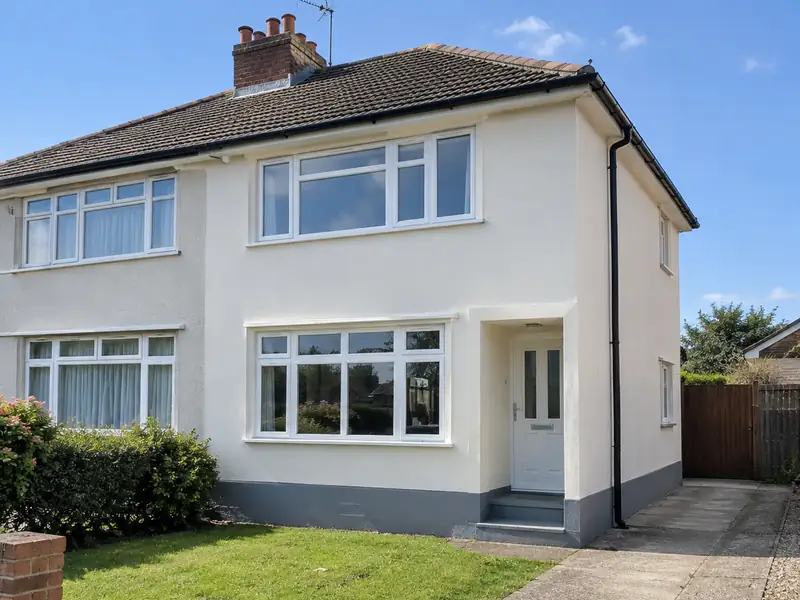
External rendering is applying a protective, weather-resistant coating to the outside walls of a house, using sand and cement, monocouche or thin-coat silicone render, to give a smooth or textured finish that protects the masonry and improves appearance.
If you live in Harlow and are weighing up external rendering, the starting point is a visit to measure up and talk through what you want, which costs nothing. We cover homes across CM17, CM18, CM19 and CM20, and a typical project of this kind in the East of England lands somewhere in the £7,400–£17,000 bracket, including VAT. The exact figure depends on size, access and the finish you choose.
- Guide price
- £7,400–£17,000 inc VAT
- Time on site
- 1–3 weeks on site, depending on weather
- Postcodes
- CM17, CM18, CM19 and CM20
- Planning rules
- England
- Local area
- Essex
- Survey
- Free, with a written quote
What should you budget for external rendering in Harlow?
Below is a breakdown of typical costs for external rendering in Harlow. Because rates in the East of England are about 5% above the national guide, the overall guide comes to £7,400–£17,000, including VAT. Size, materials and access move the figure, and a free-of-charge survey settles it.
| Type of job | What it usually involves | Guide in Harlow |
|---|---|---|
| Front elevation or small terrace | One elevation or a small terraced house, including scaffolding and preparation. | £3,200–£7,400 |
| Typical semi-detached | All rendered walls of a 3-bed semi in monocouche or silicone, with scaffolding. | £7,400–£17,000 |
| Detached or full strip and re-render | Larger houses, or homes needing old render removed and walls repaired first. | £16,000–£31,500 |
The main things that change the figure:
- Wall area to be rendered and the height of the house
- Removing old render or pebbledash and repairing the walls
- Scaffolding, access and protection of neighbouring property
- Detailing around windows, bays, sills and pipes
Scope of the work
- Survey of walls, existing render, cracks and damp-proof course
- Removal of loose or failed render and pebbledash where needed
- Beads at corners, edges and above the damp-proof course
- Mesh reinforcement and base coats to suit the chosen system
- Finish coat in your chosen colour and texture
- Making good around pipes, vents and fixings, and a site clean-up
Homes in Essex
Essex ranges from timber-framed and weatherboarded cottages in the north, some with decorative pargeting, to Victorian terraces in Colchester, Chelmsford and Southend. Basildon and Harlow were built as post-war new towns, much of the south-east has interwar suburbs and bungalows, and large new estates continue to appear around Chelmsford and Braintree.
Terraces and semis commonly suit loft conversions and rear extensions, and many bungalows can take a loft room. New-town homes often need cladding, window and roofline renewal, while timber-framed cottages call for lime plaster and repairs that respect the original frame.
Knowing the typical building types in Essex helps, but a survey of your own home in Harlow is what decides the right approach to external rendering.
Planning and building rules in Harlow
Harlow is in England, so the planning and building rules set out below are the ones that apply. We confirm the details with the council before we quote.
In England, re-rendering or cladding a house is often allowed without planning permission, but stone, render, timber, plastic or tile cladding is not permitted development in conservation areas, and listed buildings need consent.
If you render or re-clad more than 25% of an external wall, Building Regulations usually require the wall’s insulation to be improved where that is practical, and building control should be notified.
Rules change and every property is different, so we check the planning history and constraints for your address before we quote.
How does the job run?
Free site survey
First, someone visits your home in Harlow to see the space, take measurements and note anything that could affect the work, such as access or the condition of what is there. There is no charge for this visit.
Written quote
The quote arrives in writing, not over the phone. It covers the full scope, the finishes you've chosen, any exclusions and the payment schedule, with a fixed price tied to that specification.
Getting ready
Preparation matters as much as the build. We agree access, parking and working hours with you, order materials in good time, and confirm any permissions so the job isn't held up once it starts.
The work itself
The work is carried out to the agreed specification, with floors and furniture protected and the site kept tidy. At the end we clean up, walk through the finished job with you and hand over any certificates.
What you can expect from us
Common questions
How long does rendering take?
Rendering a typical semi-detached house takes around one to three weeks. Scaffolding goes up first, then removal of old render, repairs, beads and mesh. Base coats need time to cure before the finish coat. Weather has a big effect, because render should not be applied in rain, frost or strong heat. We give you an expected programme with the quote.
What happens at the survey?
We visit your home at a time that suits you, look at the area involved, take measurements and check access, condition and any services that might be affected. We talk through what you want from external rendering, explain the options and answer questions. There is no charge and no obligation; afterwards we send a written quote.
Do I need planning permission to render my house?
Whether rendering needs planning permission depends on how it changes the appearance, your home's location, whether it is listed or in a conservation area, and which UK nation you are in. Rendering over brick may need permission in some places, while replacing existing render like for like often does not. Listed buildings need consent. We check the position before quoting.
How much will external rendering cost in Harlow?
As a guide, expect to pay £7,400–£17,000 including VAT for external rendering in Harlow. That range is adjusted for the East of England, which runs about 5% above the national guide. Where your project lands depends on size, materials, access and the condition of what is already there. We confirm a fixed price in writing after a free survey of your home.
What time of year should rendering be done?
Render needs mild, dry conditions to cure properly, so spring to early autumn is ideal. Most render systems should not be applied when frost is likely, in heavy rain or in strong direct sun, which can dry it too quickly and cause cracking. We plan the programme around the forecast and may pause work if the weather turns, which protects the finish.
Also covering areas around Harlow
Coverage for Harlow spans CM17, CM18, CM19 and CM20. Close by, Hoddesdon, Bishops Stortford and Waltham Abbey are covered too, and the rest of our UK-wide area follows the same survey-then-quote process from start to finish.