
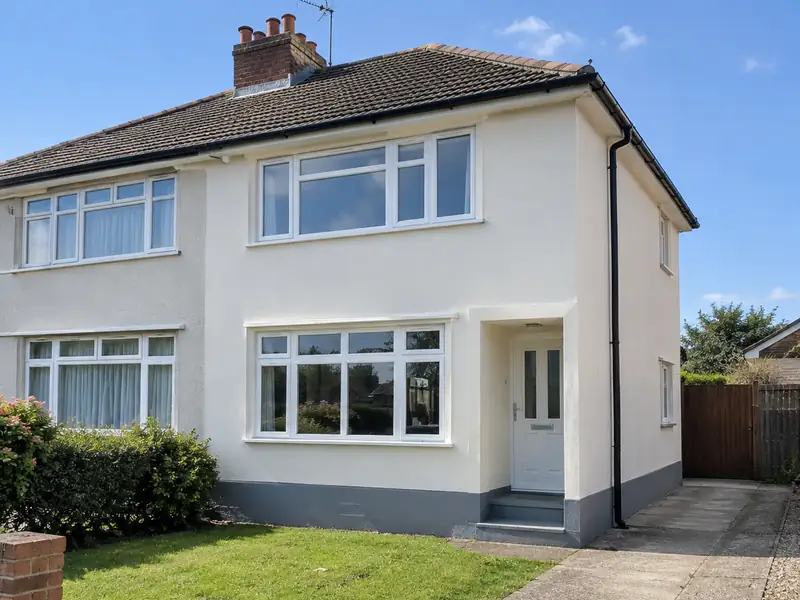
External rendering is applying a protective, weather-resistant coating to the outside walls of a house, using sand and cement, monocouche or thin-coat silicone render, to give a smooth or textured finish that protects the masonry and improves appearance.
Whatever prompted you to look into external rendering, whether wear and tear, a growing family or plans to move, we can survey your Cwmbran home and give you a price in writing. Homes in Wales typically come in at £6,400–£14,500, VAT included, for this kind of work. We also cover Pontypool, Risca and Newport, Gwent, and the same steps apply wherever you are in Gwent.
- Guide price
- £6,400–£14,500 inc VAT
- Time on site
- 1–3 weeks on site, depending on weather
- Postcodes
- NP44
- Planning rules
- Wales
- Local area
- Torfaen
- Survey
- Free, with a written quote
How much does external rendering cost in Cwmbran?
The table below shows guide prices for external rendering in Cwmbran. They are based on rates in Wales, which run about 8% below the national guide, giving an overall range of £6,400–£14,500. All figures include VAT and are firmed up after a free site survey.
| Type of job | What it usually involves | Guide in Cwmbran |
|---|---|---|
| Front elevation or small terrace | One elevation or a small terraced house, including scaffolding and preparation. | £2,800–£6,400 |
| Typical semi-detached | All rendered walls of a 3-bed semi in monocouche or silicone, with scaffolding. | £6,400–£14,500 |
| Detached or full strip and re-render | Larger houses, or homes needing old render removed and walls repaired first. | £14,000–£27,500 |
The main things that change the figure:
- Render system: sand and cement, monocouche or silicone
- Removing old render or pebbledash and repairing the walls
- Scaffolding, access and protection of neighbouring property
- Detailing around windows, bays, sills and pipes
What’s included?
- Survey of walls, existing render, cracks and damp-proof course
- Scaffolding erected and removed, with neighbours' access agreed
- Removal of loose or failed render and pebbledash where needed
- Windows, doors and surfaces masked and protected
- Finish coat in your chosen colour and texture
- Making good around pipes, vents and fixings, and a site clean-up
Local housing and external rendering
Newport has Victorian and Edwardian terraces and interwar suburbs, while valley towns such as Ebbw Vale, Abertillery and Blaenavon have stone terraces stepped along steep hillsides. Monmouth and Abergavenny keep Georgian centres, and Cwmbran was built as a post-war new town with planned estates.
Valley terraces commonly need repointing, roof work and window replacement, and steep plots can make extensions more involved. Newport terraces suit loft rooms, while Cwmbran homes often take garage conversions and cladding upgrades.
These patterns matter for external rendering: older walls, roofs and floors in Cwmbran can need different materials or extra preparation compared with newer homes.
Do you need permission in Cwmbran?
For anyone in Cwmbran, the relevant framework is Wales's. The summary below is general, so we always contact the council about your address before putting a price in writing.
In Wales, rendering or cladding may need planning permission in conservation areas, and listed buildings need consent.
Building Regulations in Wales can require insulation upgrades when a large part of an external wall is renovated.
Rules change and every property is different, so we check the planning history and constraints for your address before we quote.
The four stages
Survey and measure
We arrange a free site survey on a date convenient to you. We measure up, look at the existing structure and access, and discuss your plans for external rendering so the price reflects your home.
Price and scope agreed
You get the price in writing, itemised so you can see where the money goes. As long as the specification stays the same, that is the price you pay for external rendering.
Booking the work
Preparation matters as much as the build. We agree access, parking and working hours with you, order materials in good time, and confirm any permissions so the job isn't held up once it starts.
Build and hand over
The work is carried out to the agreed specification, with floors and furniture protected and the site kept tidy. At the end we clean up, walk through the finished job with you and hand over any certificates.
How we work
Common questions
Which postcodes in Cwmbran do you cover?
We cover NP44, along with the rest of Gwent. If your postcode is not listed, get in touch anyway: our coverage is UK-wide, and we can usually arrange a survey wherever you live. Enter your postcode in the guide-price tool or contact form and we will confirm.
Can I stay at home during the work?
In most cases, yes. Most people can live at home throughout, and we plan the work to keep disruption down by protecting floors, agreeing working hours and keeping access routes clear. Bigger jobs affecting kitchens, bathrooms or heating may mean a short spell with reduced facilities, and we talk this through with you at the survey.
Can you render over pebbledash or old render?
Rendering over existing pebbledash or render is sometimes possible if it is firmly bonded, but if it sounds hollow, is cracked or is coming away, it must be removed first. Covering failing render simply hides the problem until the new coat fails too. We tap-test the walls and explain whether removal is needed. Removal adds time and cost but gives a sound base.
How do I look after silicone or monocouche render?
Through-coloured render needs little upkeep. Check it once a year for cracks or damage, especially around windows and pipes, and keep gutters clear so water does not run down the walls. If green algae appears on shaded walls, a specialist render cleaner applied with a soft brush or low-pressure wash removes it. Avoid high-pressure jet washing, which can damage the surface.
How long does rendering take?
Rendering a typical semi-detached house takes around one to three weeks. Scaffolding goes up first, then removal of old render, repairs, beads and mesh. Base coats need time to cure before the finish coat. Weather has a big effect, because render should not be applied in rain, frost or strong heat. We give you an expected programme with the quote.
Near Cwmbran
Coverage for Cwmbran spans NP44. Close by, Pontypool, Risca and Newport, Gwent are covered too, and the rest of our UK-wide area follows the same survey-then-quote process from start to finish.