
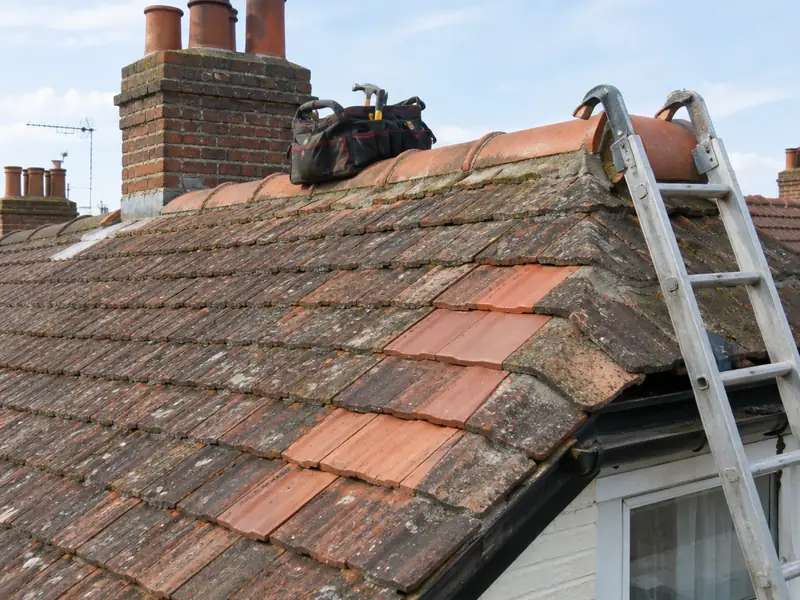
Roof repairs fix specific faults in a pitched or flat roof, such as slipped or cracked tiles, loose ridges, failed flashing, leaking valleys or chimney defects, to stop water getting in without replacing the whole roof.
For a homeowner in Blackpool, planning roof repairs tends to begin with two questions: what will it cost, and how disruptive will it be? Our guide range is £300–£1,400 including VAT, and a typical job runs to Half a day to 3 days for most repairs. Both numbers firm up once we have seen the property, measured up and agreed exactly what is included.
- Guide price
- £300–£1,400 inc VAT
- Time on site
- Half a day to 3 days for most repairs
- Postcodes
- FY1, FY2, FY3 and FY4
- Planning rules
- England
- Local area
- Lancashire
- Survey
- Free, with a written quote
How much do roof repairs cost in Blackpool?
Here is how the guide price for roof repairs breaks down in Blackpool. We start from national figures and adjust for the North West, which comes out about 5% below the national guide. The resulting range, VAT included, is £300–£1,400, and a survey, at no cost to you, firms it up.
| Type of job | What it usually involves | Guide in Blackpool |
|---|---|---|
| Minor repair | Replacing a handful of slipped or broken tiles from ladders or a roof ladder. | £200–£500 |
| Ridge, flashing or valley repair | Rebedding a ridge run, renewing flashing or relining a short valley. | £400–£1,150 |
| Larger repair with scaffolding | Several faults, chimney work or repairs on high roofs needing scaffolding. | £950–£2,800 |
Your price depends mostly on:
- Access: ladders, roof ladders, towers or full scaffolding
- Roof height and steepness
- Matching tiles, slates or lead to the existing roof
- Hidden damage to battens, felt or timbers found during repair
Scope of the work
- Inspection to trace the source of leaks or damage
- Photos of the problem areas and a clear written explanation
- Replacement of slipped, cracked or missing tiles and slates
- Ridge, hip and verge rebedding or dry-fix conversion
- Lead flashing, valley and chimney junction repairs
- Clearing debris from gutters and the work area
Homes in Lancashire
East Lancashire mill towns such as Burnley, Blackburn and Accrington have long rows of stone and brick terraces, while Preston is mostly red brick. Lancaster uses sandstone for its Georgian centre, Blackpool and the Fylde coast have guest-house terraces and many bungalows, and interwar and newer estates surround most towns.
Mill-town terraces commonly suit attic conversions, kitchen extensions and repointing. Bungalows on the coast often take loft rooms and porches, and stone properties may need lime pointing and roof repairs.
With that background in mind, here is how we typically handle roof repairs for homes in Blackpool, from the first visit to the finished result.
Planning and building rules in Blackpool
For anyone in Blackpool, the relevant framework is England's. The summary below is general, so we always contact the council about your address before putting a price in writing.
Re-roofing a house with similar materials does not usually need planning permission in England. Listed buildings and conservation areas may need consent if the covering changes.
Replacing more than a quarter of a roof’s covering counts as renovation under Building Regulations, so the work is notified and the roof insulation may need upgrading. Bats are protected across the UK; if they roost under roof tiles, soffits or fascias, work stops and a licensed ecologist advises before it restarts.
Rules change and every property is different, so we check the planning history and constraints for your address before we quote.
The four stages
A visit to your home
We arrange a free site survey on a date convenient to you. We measure up, look at the existing structure and access, and discuss your plans for roof repairs so the price reflects your home.
Written quote
We put everything into a written, fixed-price quote: the specification, what's excluded, staged payments and the expected time on site. Take whatever time you need to decide; there's no pressure to commit.
Dates and permissions
Next comes planning the work itself. We set a start date that suits you, line up the right trades, and make sure any approvals for roof repairs are in place before the first day on site.
On site to finish
The work is carried out to the agreed specification, with floors and furniture protected and the site kept tidy. At the end we clean up, walk through the finished job with you and hand over any certificates.
Working with SK Home Improvements
Common questions
What happens at the survey?
We visit your home at a time that suits you, look at the area involved, take measurements and check access, condition and any services that might be affected. We talk through what you want from roof repairs, explain the options and answer questions. There is no charge and no obligation; afterwards we send a written quote.
Is the price fixed?
Yes, for the specification we agree. Your written quote sets out exactly what is included at a fixed price. It only changes if you ask for something different, or if a problem the survey could not reasonably reveal later needs extra work. In either case we explain the change and confirm it in writing before going ahead.
Is it worth repairing an old roof?
Repairing an old roof is worthwhile when the problem is isolated and the rest of the roof is sound. If tiles are widely porous, battens are rotten or the felt has perished, repeated repairs may cost more over time than a new roof. We look at the overall condition, explain the likely lifespan and give you prices for both where it makes sense.
Why is my roof leaking?
Roof leaks usually come from slipped or cracked tiles, failed flashing around chimneys and walls, leaking valleys, blocked gutters overflowing, or perished felt beneath the tiles. Water can travel along timbers before it drips, so the stain on your ceiling may not be directly under the fault. Condensation in the loft can also look like a leak. We trace the source before recommending a repair.
What is dry-fix ridge and is it better than mortar?
Dry-fix ridge systems use screws, clips and weather seals instead of mortar to hold ridge and hip tiles in place. They avoid the cracking and loosening that mortar suffers over time, need less upkeep and are now common on new roofs. Mortar-bedded ridges suit some period or conservation-area roofs. We recommend the method that suits your roof and its location.
Also covering areas around Blackpool
Coverage for Blackpool spans FY1, FY2, FY3 and FY4. Close by, Poulton-le-Fylde, Thornton-Cleveleys and Lytham St Annes are covered too, and the rest of our UK-wide area follows the same survey-then-quote process from start to finish.