
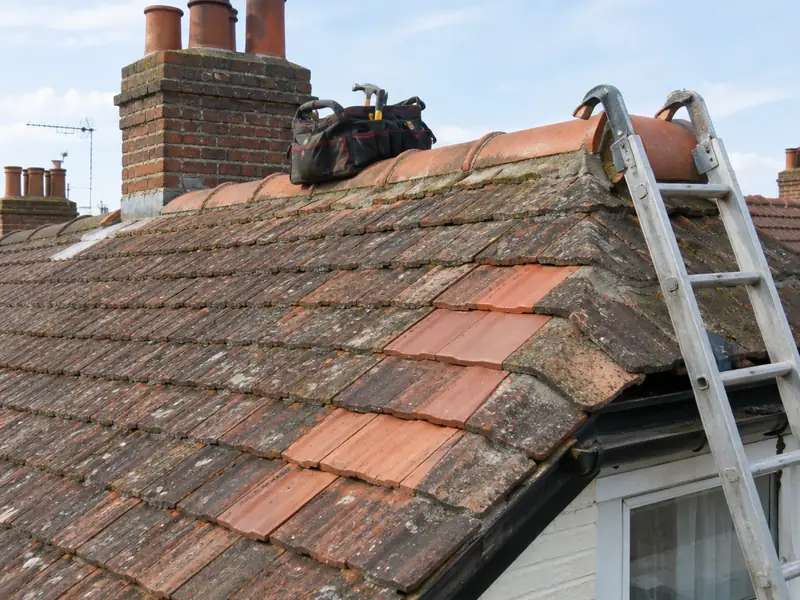
Roof repairs fix specific faults in a pitched or flat roof, such as slipped or cracked tiles, loose ridges, failed flashing, leaking valleys or chimney defects, to stop water getting in without replacing the whole roof.
Anyone planning roof repairs in Johnstone wants three things: a clear price, a realistic timetable and a tidy job. We publish a guide of £300–£1,450 including VAT for Scotland up front, explain that work normally takes Half a day to 3 days for most repairs, and confirm both in writing after a free survey of your property.
- Guide price
- £300–£1,450 inc VAT
- Time on site
- Half a day to 3 days for most repairs
- Postcodes
- PA5
- Planning rules
- Scotland
- Local area
- Renfrewshire
- Survey
- Free, with a written quote
How much do roof repairs cost in Johnstone?
Below is a breakdown of typical costs for roof repairs in Johnstone. Because rates in Scotland are about 4% below the national guide, the overall guide comes to £300–£1,450, including VAT. Size, materials and access move the figure, and a free-of-charge survey settles it.
| Type of job | What it usually involves | Guide in Johnstone |
|---|---|---|
| Minor repair | Replacing a handful of slipped or broken tiles from ladders or a roof ladder. | £200–£500 |
| Ridge, flashing or valley repair | Rebedding a ridge run, renewing flashing or relining a short valley. | £400–£1,150 |
| Larger repair with scaffolding | Several faults, chimney work or repairs on high roofs needing scaffolding. | £950–£2,900 |
Your price depends mostly on:
- Number and type of faults to repair
- Access: ladders, roof ladders, towers or full scaffolding
- Matching tiles, slates or lead to the existing roof
- Hidden damage to battens, felt or timbers found during repair
What’s included?
- Photos of the problem areas and a clear written explanation
- Safe access by ladders, towers or scaffolding as needed
- Replacement of slipped, cracked or missing tiles and slates
- Ridge, hip and verge rebedding or dry-fix conversion
- Lead flashing, valley and chimney junction repairs
- Clearing debris from gutters and the work area
Building in Johnstone
Paisley has sandstone tenements and terraces from its textile era, Greenock and Port Glasgow have tenements and housing climbing the hills above the Clyde, and Gourock and Kilmacolm have Victorian villas. Post-war estates and newer private housing surround the towns, and roughcast is a common finish.
Roughcast and tenement buildings commonly need re-rendering, window replacement and roof work. Villas suit kitchen extensions and landscaping, and semis often take loft conversions and driveways.
These patterns matter for roof repairs: older walls, roofs and floors in Johnstone can need different materials or extra preparation compared with newer homes.
Permissions for roof repairs in Johnstone
Planning law differs across the UK. For a home in Johnstone, it is the Scotland rules below that count, and we check them with the council ahead of any quote.
In Scotland, like-for-like re-roofing does not usually need planning permission, except on listed buildings or in conservation areas.
Like-for-like re-covering does not usually need a building warrant, but structural changes or new roof windows can. Bats are protected across the UK; if they roost under roof tiles, soffits or fascias, work stops and a licensed ecologist advises before it restarts.
Rules change and every property is different, so we check the planning history and constraints for your address before we quote.
How does the job run?
Survey and measure
First, someone visits your home in Johnstone to see the space, take measurements and note anything that could affect the work, such as access or the condition of what is there. There is no charge for this visit.
Written quote
We put everything into a written, fixed-price quote: the specification, what's excluded, staged payments and the expected time on site. Take whatever time you need to decide; there's no pressure to commit.
Plan and prepare
With the quote agreed, we book the work in and handle preparation: permissions where needed, building control notifications, material orders and access arrangements for your Johnstone property.
On site to finish
On site, the agreed plan is followed and any change is put in writing first. At completion we do a final clean, go through the snagging list with you and leave you with the relevant documents.
How we work
Frequently asked questions
Do I need planning permission in Johnstone?
It depends on the work, the size of the project, your property type and whether the building is listed or in a conservation area. Johnstone is in Scotland, so Scotland's rules apply. Many smaller jobs need no planning application, but some still need building control approval. We check what applies to your address before quoting.
How can I spot roof problems early?
Spotting roof problems early saves money. Look from the ground after storms for slipped or missing tiles, cracked ridge mortar or debris in gutters. In the loft, check for daylight, damp patches, stained timbers or wet insulation. Inside, watch for ceiling stains and peeling paint near outside walls. Clearing gutters each autumn prevents overflow damage.
Can you do an emergency roof repair?
After storm damage, a temporary repair such as sheeting or refixing loose tiles can stop water getting in until a permanent repair can be made. We aim to attend as quickly as possible, but availability depends on weather and demand, especially after widespread storms. In the meantime, catch drips in containers, move valuables and switch off lights near any wet ceiling.
Do you cover Paisley, Barrhead and Erskine?
Yes. As well as Johnstone, we cover Paisley, Barrhead and Erskine and the rest of Renfrewshire and Inverclyde. Our coverage is UK-wide, so the process is the same wherever you are: a free site survey, a quote in writing that fixes the price for the agreed scope, and one point of contact while the work is planned and carried out.
What is dry-fix ridge and is it better than mortar?
Dry-fix ridge systems use screws, clips and weather seals instead of mortar to hold ridge and hip tiles in place. They avoid the cracking and loosening that mortar suffers over time, need less upkeep and are now common on new roofs. Mortar-bedded ridges suit some period or conservation-area roofs. We recommend the method that suits your roof and its location.
Nearby towns
We cover every part of Johnstone, including PA5, and nearby Paisley, Barrhead and Erskine. Wherever you are within that patch, the survey is free and the quote comes to you in writing.