
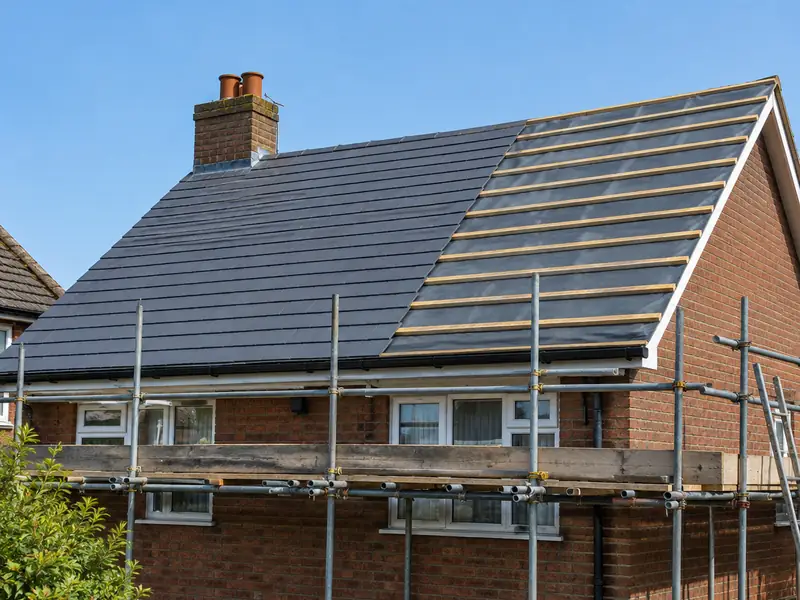
A roof replacement, or re-roof, strips the old tiles or slates, battens and felt from a pitched roof and replaces them with a new breathable membrane, battens and covering, repairing timbers and renewing ridges, valleys and flashings at the same time.
From a first conversation about a new roof to the day the site is cleared, homeowners in Forfar deal with us directly. We come out to measure up at no cost, explain the choices in plain terms and send a written quote. For context, comparable work in Scotland usually falls within £6,700–£14,500 including VAT, and it is available across DD8.
- Guide price
- £6,700–£14,500 inc VAT
- Time on site
- 1–2 weeks on site, plus scaffolding time
- Postcodes
- DD8
- Planning rules
- Scotland
- Local area
- Angus
- Survey
- Free, with a written quote
Roof replacement prices in Forfar
Prices for a new roof vary from house to house, but in Forfar most projects fall within £6,700–£14,500 including VAT. That reflects costs in Scotland, about 4% below the national guide. Treat the table as a budgeting aid; the written figure follows a survey we carry out for free.
| Type of job | What it usually involves | Guide in Forfar |
|---|---|---|
| Terraced house or bungalow | A smaller pitched roof re-covered in concrete or clay tiles, including scaffolding. | £4,800–£9,600 |
| Typical semi-detached | A 3-bed semi re-roofed in concrete or clay tiles with new membrane, battens and leadwork. | £6,700–£14,500 |
| Detached or natural slate | Larger or more complex roofs, or any roof finished in natural slate. | £11,500–£24,000 |
Expect these to shape the final quote:
- Roof area, pitch and the number of hips, valleys and dormers
- Covering material: concrete tile, clay tile or natural slate
- Condition of rafters, fascias and other timbers
- Chimneys, leadwork and roof windows to rework
What’s included?
- Survey of the covering, timbers, chimneys and loft ventilation
- Stripping old tiles or slates, battens and felt in stages
- Repairs or replacement of damaged rafters and fascia boards
- Breathable membrane and new treated battens
- New tiles or slates, or sound originals refitted where suitable
- Ridges, hips and verges dry-fixed or bedded, with new leadwork
Building in Forfar
Dundee has sandstone tenements and terraces, Victorian villas in Broughty Ferry and the West End, and extensive post-war housing. Angus towns such as Arbroath, Forfar, Montrose and Brechin use local red sandstone, and harled cottages and farmhouses are common in the countryside.
Tenement flats often need window replacement and internal refits, and houses commonly take extensions and loft conversions. Sandstone buildings need careful repointing and stone repairs, and harled cottages need breathable render.
Whatever era your Forfar home dates from, we plan a new roof around how it is actually built rather than a one-size-fits-all specification.
Permissions for a new roof in Forfar
The notes below cover Scotland, which is where Forfar sits. Rules change and every property is different, so we speak to the council before pricing your job.
In Scotland, like-for-like re-roofing does not usually need planning permission, except on listed buildings or in conservation areas.
Like-for-like re-covering does not usually need a building warrant, but structural changes or new roof windows can. Bats are protected across the UK; if they roost under roof tiles, soffits or fascias, work stops and a licensed ecologist advises before it restarts.
Rules change and every property is different, so we check the planning history and constraints for your address before we quote.
What happens after you get in touch?
We look at the job
A free survey comes first. It gives us what we need to price a new roof properly, including dimensions, existing materials and access for deliveries, and gives you the chance to ask anything you like.
Your fixed price
Next you receive a written quote with a fixed price for the agreed specification. It lists what is included, what is not, and how payments are staged, so you can compare it properly.
Dates and permissions
Before anyone starts, we confirm the programme in writing, check whether consents are required and arrange deliveries. If a skip or scaffolding on the road needs a permit, we apply for it.
The work itself
The job proceeds in the order set out in the programme, with dust and debris kept under control. Finally we tidy away, inspect the work together and pass the finished project over to you with its paperwork.
Working with SK Home Improvements
Common questions
How much does a new roof cost?
Re-roofing a typical 3-bed semi costs £6,700–£14,500, including scaffolding, new membrane and battens. As a guide, allow roughly £70–£160 per square metre of roof plus fixed costs for scaffolding and waste. Concrete tiles sit at the lower end and natural slate at the top. Hips, valleys, chimneys and timber repairs add to the price. We confirm a fixed figure after inspecting the roof and loft.
Who do I deal with during the job?
One point of contact manages your project from survey to handover. They schedule the trades working under our contract, keep you updated on progress, and are the person to call with any question. You don't need to coordinate builders, electricians or decorators separately, because that is part of what we do.
How long will a new roof take?
On a typical home, allow 1–2 weeks on site, plus scaffolding time. Larger projects, older buildings and extra work found once things are opened up can extend that, while simpler jobs may be shorter. Your quote includes an estimate of time on site, and your point of contact keeps you updated on the programme as the work progresses.
Do I need planning permission to replace my roof?
Planning permission is not usually needed to re-roof in similar materials, but it depends on the change, your home's location, whether it is listed or in a conservation area, and which UK nation you live in. Changing the roof shape, height or covering material can need permission. Listed buildings need consent for re-roofing. We check the position for your home before quoting.
How long will a new roof last?
A well-installed roof lasts for decades. Concrete tiles typically last around 50 years or more, clay tiles longer, and natural slate can last a century with proper upkeep. Lifespan depends on the quality of materials, fixings, ventilation and leadwork, and on how exposed the roof is. Keeping gutters clear and fixing slipped tiles quickly helps it reach its full life.
Also covering areas around Forfar
Whether you're in the centre of Forfar or on its outskirts, DD8 addresses are covered. We extend the same service, and the same fixed-price approach, to Carnoustie, Dundee and Arbroath.