
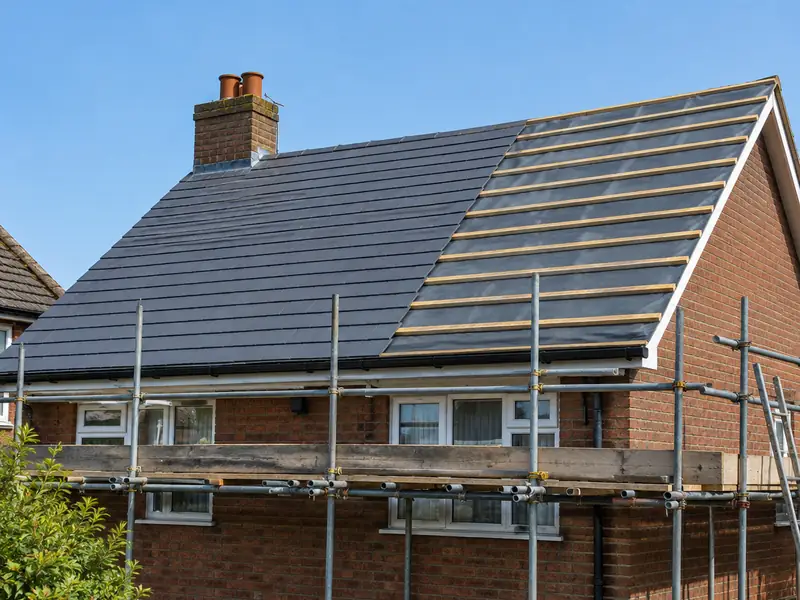
A roof replacement, or re-roof, strips the old tiles or slates, battens and felt from a pitched roof and replaces them with a new breathable membrane, battens and covering, repairing timbers and renewing ridges, valleys and flashings at the same time.
Plymstock sits within our coverage for a new roof, as do neighbouring Plymouth, Paignton and Newton Abbot. Before giving a price we want to see the property: the condition of what's there now, the access, and anything that might need extra work. The guide range for the South West is £7,100–£15,500 including VAT, and your written quote will spell out exactly what that covers.
- Guide price
- £7,100–£15,500 inc VAT
- Time on site
- 1–2 weeks on site, plus scaffolding time
- Postcodes
- PL9
- Planning rules
- England
- Local area
- Plymouth
- Survey
- Free, with a written quote
How much does a new roof cost in Plymstock?
The table below shows guide prices for a new roof in Plymstock. They are based on rates in the South West, which run about 2% above the national guide, giving an overall range of £7,100–£15,500. All figures include VAT and are firmed up after a free site survey.
| Type of job | What it usually involves | Guide in Plymstock |
|---|---|---|
| Terraced house or bungalow | A smaller pitched roof re-covered in concrete or clay tiles, including scaffolding. | £5,100–£10,000 |
| Typical semi-detached | A 3-bed semi re-roofed in concrete or clay tiles with new membrane, battens and leadwork. | £7,100–£15,500 |
| Detached or natural slate | Larger or more complex roofs, or any roof finished in natural slate. | £12,000–£25,500 |
Expect these to shape the final quote:
- Roof area, pitch and the number of hips, valleys and dormers
- Covering material: concrete tile, clay tile or natural slate
- Chimneys, leadwork and roof windows to rework
- Scaffolding, access and the height of the house
Scope of the work
- Scaffolding with edge protection, erected and removed
- Stripping old tiles or slates, battens and felt in stages
- Repairs or replacement of damaged rafters and fascia boards
- Breathable membrane and new treated battens
- New tiles or slates, or sound originals refitted where suitable
- Ridges, hips and verges dry-fixed or bedded, with new leadwork
Building in Plymstock
Devon is known for cob and thatch cottages, especially in mid and east Devon, alongside granite on Dartmoor and red sandstone around Exeter. Exeter and Plymouth have Georgian and Victorian terraces, Plymouth's centre was largely rebuilt after the war, and seaside towns such as Torquay and Exmouth have rendered villas and newer estates.
Cob and stone homes need breathable lime plaster and render rather than cement. Victorian terraces suit loft rooms and window replacement, while post-war and newer homes often take extensions, rendering and roofline renewal.
If your house in Plymstock fits one of these patterns, it helps us anticipate what a new roof will involve, though we always confirm the details on site.
Do you need permission in Plymstock?
Which rules apply depends on where you live. For Plymstock, the answer is England, and the points below reflect that; we verify them with the council before quoting.
Re-roofing a house with similar materials does not usually need planning permission in England. Listed buildings and conservation areas may need consent if the covering changes.
Replacing more than a quarter of a roof’s covering counts as renovation under Building Regulations, so the work is notified and the roof insulation may need upgrading. Bats are protected across the UK; if they roost under roof tiles, soffits or fascias, work stops and a licensed ecologist advises before it restarts.
Rules change and every property is different, so we check the planning history and constraints for your address before we quote.
How does the job run?
Survey and measure
It starts with a survey at the property, free of charge. We check condition, access and services, ask how you want the finished result to look, and answer any questions you have about a new roof.
Your fixed price
We put everything into a written, fixed-price quote: the specification, what's excluded, staged payments and the expected time on site. Take whatever time you need to decide; there's no pressure to commit.
Dates and permissions
Preparation matters as much as the build. We agree access, parking and working hours with you, order materials in good time, and confirm any permissions so the job isn't held up once it starts.
Finish and handover
Work goes ahead as scheduled and you deal with one contact throughout. When the last trade leaves, we clear and clean the site, talk you through what has been done and pass on any certificates and care instructions.
What you can expect from us
Common questions
Do I need planning permission in Plymstock?
It depends on the work, the size of the project, your property type and whether the building is listed or in a conservation area. Plymstock is in England, so England's rules apply. Many smaller jobs need no planning application, but some still need building control approval. We check what applies to your address before quoting.
Will my loft insulation and ventilation be improved?
Re-roofing is a good time to improve loft ventilation and insulation. A breathable membrane and eaves or ridge vents keep air moving and reduce condensation in the loft. Building regulations may require insulation upgrades when a large part of the roof is renewed. We check your current insulation and ventilation and include any required improvements in the quote.
Do you cover Plymouth, Paignton and Newton Abbot?
Yes. As well as Plymstock, we cover Plymouth, Paignton and Newton Abbot and the rest of Devon. Our coverage is UK-wide, so the process is the same wherever you are: a free site survey, a quote in writing that fixes the price for the agreed scope, and one point of contact while the work is planned and carried out.
How much does a new roof cost?
Re-roofing a typical 3-bed semi costs £7,100–£15,500, including scaffolding, new membrane and battens. As a guide, allow roughly £70–£160 per square metre of roof plus fixed costs for scaffolding and waste. Concrete tiles sit at the lower end and natural slate at the top. Hips, valleys, chimneys and timber repairs add to the price. We confirm a fixed figure after inspecting the roof and loft.
Do I need planning permission to replace my roof?
Planning permission is not usually needed to re-roof in similar materials, but it depends on the change, your home's location, whether it is listed or in a conservation area, and which UK nation you live in. Changing the roof shape, height or covering material can need permission. Listed buildings need consent for re-roofing. We check the position for your home before quoting.
Nearby towns
Addresses in PL9 are all covered for Plymstock, along with Plymouth, Paignton and Newton Abbot close by. Give us your postcode when you get in touch and we will confirm the details.