
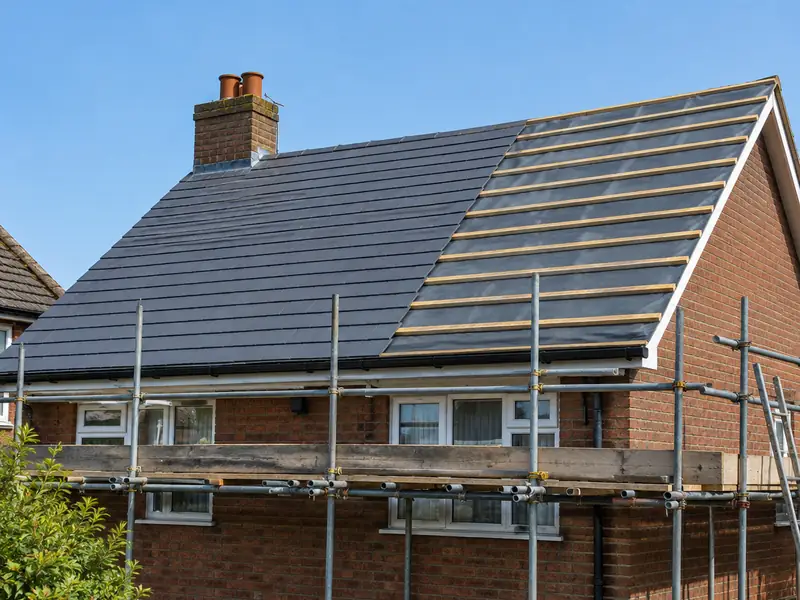
A roof replacement, or re-roof, strips the old tiles or slates, battens and felt from a pitched roof and replaces them with a new breathable membrane, battens and covering, repairing timbers and renewing ridges, valleys and flashings at the same time.
Livingston sits within our coverage for a new roof, as do neighbouring Broxburn, Bathgate and Grangemouth. Before giving a price we want to see the property: the condition of what's there now, the access, and anything that might need extra work. The guide range for Scotland is £6,700–£14,500 including VAT, and your written quote will spell out exactly what that covers.
- Guide price
- £6,700–£14,500 inc VAT
- Time on site
- 1–2 weeks on site, plus scaffolding time
- Postcodes
- EH53 and EH54
- Planning rules
- Scotland
- Local area
- West Lothian
- Survey
- Free, with a written quote
What should you budget for a new roof in Livingston?
The table below shows guide prices for a new roof in Livingston. They are based on rates in Scotland, which run about 4% below the national guide, giving an overall range of £6,700–£14,500. All figures include VAT and are firmed up after a free site survey.
| Type of job | What it usually involves | Guide in Livingston |
|---|---|---|
| Terraced house or bungalow | A smaller pitched roof re-covered in concrete or clay tiles, including scaffolding. | £4,800–£9,600 |
| Typical semi-detached | A 3-bed semi re-roofed in concrete or clay tiles with new membrane, battens and leadwork. | £6,700–£14,500 |
| Detached or natural slate | Larger or more complex roofs, or any roof finished in natural slate. | £11,500–£24,000 |
Your price depends mostly on:
- Roof area, pitch and the number of hips, valleys and dormers
- Covering material: concrete tile, clay tile or natural slate
- Condition of rafters, fascias and other timbers
- Chimneys, leadwork and roof windows to rework
What’s included?
- Survey of the covering, timbers, chimneys and loft ventilation
- Scaffolding with edge protection, erected and removed
- Repairs or replacement of damaged rafters and fascia boards
- Breathable membrane and new treated battens
- Ridges, hips and verges dry-fixed or bedded, with new leadwork
- Waste removal by skip and a clean site on completion
Building in Livingston
Edinburgh's New Town is a planned Georgian sandstone townscape within a World Heritage Site, and districts such as Marchmont and Leith have Victorian tenements. Bungalows and villas fill the suburbs, Midlothian has former mining villages, Livingston was built as a new town, and East Lothian villages often have red pantile roofs.
East-coast weather brings cold winds, haar and frost, and exposed hills around the city catch wind-driven rain.
These patterns matter for a new roof: older walls, roofs and floors in Livingston can need different materials or extra preparation compared with newer homes.
Do you need permission in Livingston?
Each UK nation sets its own consent rules, and Livingston is in Scotland. What follows is a plain summary; we check the specifics for your property with the council before pricing anything.
In Scotland, like-for-like re-roofing does not usually need planning permission, except on listed buildings or in conservation areas.
Like-for-like re-covering does not usually need a building warrant, but structural changes or new roof windows can. Bats are protected across the UK; if they roost under roof tiles, soffits or fascias, work stops and a licensed ecologist advises before it restarts.
Rules change and every property is different, so we check the planning history and constraints for your address before we quote.
From survey to handover
Free site survey
A free survey comes first. It gives us what we need to price a new roof properly, including dimensions, existing materials and access for deliveries, and gives you the chance to ask anything you like.
Your fixed price
After the survey we send a quote for a new roof that fixes the price for the scope we've agreed. If you want to change materials or scope, we revise it in writing before anything is booked.
Dates and permissions
Before anyone starts, we confirm the programme in writing, check whether consents are required and arrange deliveries. If a skip or scaffolding on the road needs a permit, we apply for it.
The work itself
The job proceeds in the order set out in the programme, with dust and debris kept under control. Finally we tidy away, inspect the work together and pass the finished project over to you with its paperwork.
Why homeowners choose us
Frequently asked questions
How do I know if I need a new roof or just repairs?
A roof needs replacing when problems are widespread, not isolated. Signs include many slipped, cracked or porous tiles, sagging between rafters, daylight or damp in the loft, perished felt that crumbles to the touch and repeated leaks in different places. A few slipped tiles or a loose ridge can usually be repaired. We inspect from outside and inside the loft and tell you honestly which is needed.
How much will a new roof cost in Livingston?
As a guide, expect to pay £6,700–£14,500 including VAT for a new roof in Livingston. That range is adjusted for Scotland, which runs about 4% below the national guide. Where your project lands depends on size, materials, access and the condition of what is already there. We confirm a fixed price in writing after a free survey of your home.
Can my old tiles or slates be reused?
Old tiles or slates can sometimes be reused if they are sound, which can help keep the look of a period house. Many older concrete tiles and some slates are porous, cracked or have failing fixing nibs, so they would not last. Reclaimed slates or tiles can make up shortfalls. We check a sample during the survey and explain the cost difference.
How long will a new roof last?
A well-installed roof lasts for decades. Concrete tiles typically last around 50 years or more, clay tiles longer, and natural slate can last a century with proper upkeep. Lifespan depends on the quality of materials, fixings, ventilation and leadwork, and on how exposed the roof is. Keeping gutters clear and fixing slipped tiles quickly helps it reach its full life.
Can I stay at home during the work?
In most cases, yes. Most people can live at home throughout, and we plan the work to keep disruption down by protecting floors, agreeing working hours and keeping access routes clear. Bigger jobs affecting kitchens, bathrooms or heating may mean a short spell with reduced facilities, and we talk this through with you at the survey.
Nearby towns
Addresses in EH53 and EH54 are all covered for Livingston, along with Broxburn, Bathgate and Grangemouth close by. Give us your postcode when you get in touch and we will confirm the details.