
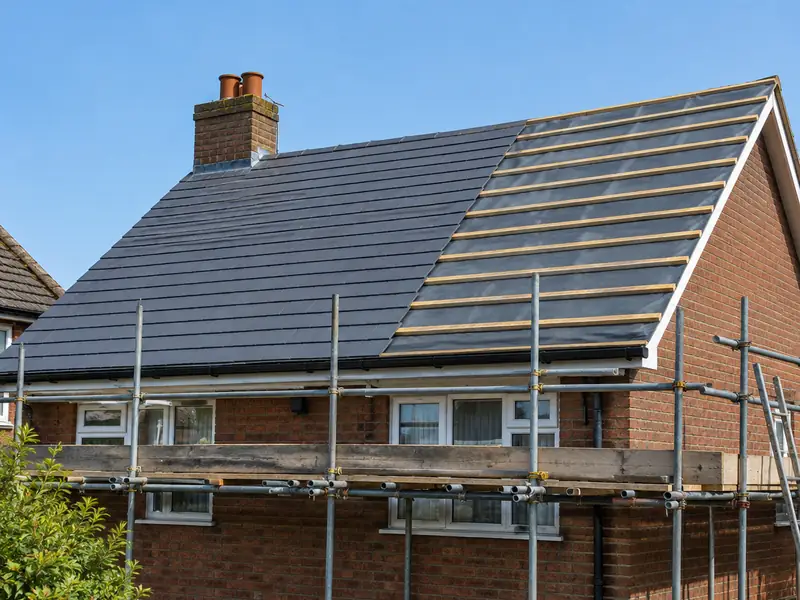
A roof replacement, or re-roof, strips the old tiles or slates, battens and felt from a pitched roof and replaces them with a new breathable membrane, battens and covering, repairing timbers and renewing ridges, valleys and flashings at the same time.
We offer a new roof throughout Glasgow, from Glasgow to the smaller places in between. Each project starts with a free survey at your home and ends with a written figure, fixed for the work you choose. Because Glasgow is in Scotland, we work to the planning system and building standards used there, and guide prices for Scotland run at £6,700–£14,500 including VAT.
- Guide price
- £6,700–£14,500 inc VAT
- Time on site
- 1–2 weeks on site, plus scaffolding time
- Planning rules
- Scotland
- Price level
- About 4% below the national guide
- Towns listed
- Whole area
- Survey
- Free, with a written quote
How much does a new roof cost in Glasgow?
The table below shows guide prices for a new roof in Glasgow. They are based on rates in Scotland, which run about 4% below the national guide, giving an overall range of £6,700–£14,500. All figures include VAT and are firmed up after a free site survey.
| Type of job | What it usually involves | Guide in Glasgow |
|---|---|---|
| Terraced house or bungalow | A smaller pitched roof re-covered in concrete or clay tiles, including scaffolding. | £4,800–£9,600 |
| Typical semi-detached | A 3-bed semi re-roofed in concrete or clay tiles with new membrane, battens and leadwork. | £6,700–£14,500 |
| Detached or natural slate | Larger or more complex roofs, or any roof finished in natural slate. | £11,500–£24,000 |
Your price depends mostly on:
- Covering material: concrete tile, clay tile or natural slate
- Condition of rafters, fascias and other timbers
- Chimneys, leadwork and roof windows to rework
- Scaffolding, access and the height of the house
What’s included?
- Scaffolding with edge protection, erected and removed
- Stripping old tiles or slates, battens and felt in stages
- Repairs or replacement of damaged rafters and fascia boards
- Breathable membrane and new treated battens
- Ridges, hips and verges dry-fixed or bedded, with new leadwork
- Waste removal by skip and a clean site on completion
Housing across Glasgow
Glasgow is known for its blond and red sandstone tenements, built in large numbers in the late Victorian and Edwardian periods, alongside terraced and villa housing in the West End and Southside. Interwar cottage flats, large post-war housing schemes, high-rise blocks and newer developments make up much of the rest of the city.
Tenement flats commonly need window replacement and internal renovation, often with neighbours' agreement for shared parts. Villas and cottage flats suit kitchen and bathroom refits, loft conversions and extensions.
High rainfall and frequent wind-driven rain mean sandstone, pointing and roofs need regular care, especially on exposed elevations.
Do you need permission in Glasgow?
Planning law differs across the UK. For a home in Glasgow, it is the Scotland rules below that count, and we check them with the council ahead of any quote.
In Scotland, like-for-like re-roofing does not usually need planning permission, except on listed buildings or in conservation areas.
Like-for-like re-covering does not usually need a building warrant, but structural changes or new roof windows can. Bats are protected across the UK; if they roost under roof tiles, soffits or fascias, work stops and a licensed ecologist advises before it restarts.
Rules change and every property is different, so we check the planning history and constraints for your address before we quote.
From survey to handover
We look at the job
It starts with a survey at the property, free of charge. We check condition, access and services, ask how you want the finished result to look, and answer any questions you have about a new roof.
Quote in writing
After the survey we send a quote for a new roof that fixes the price for the scope we've agreed. If you want to change materials or scope, we revise it in writing before anything is booked.
Getting ready
Once you accept, we agree start dates, order materials and deal with any planning, building control or neighbour notices the job needs. You'll know who is coming and when before work begins.
The work itself
The work is carried out to the agreed specification, with floors and furniture protected and the site kept tidy. At the end we clean up, walk through the finished job with you and hand over any certificates.
What you can expect from us
Questions about a new roof in Glasgow
How long will a new roof take?
On a typical home, allow 1–2 weeks on site, plus scaffolding time. Larger projects, older buildings and extra work found once things are opened up can extend that, while simpler jobs may be shorter. Your quote includes an estimate of time on site, and your point of contact keeps you updated on the programme as the work progresses.
How long will a new roof last?
A well-installed roof lasts for decades. Concrete tiles typically last around 50 years or more, clay tiles longer, and natural slate can last a century with proper upkeep. Lifespan depends on the quality of materials, fixings, ventilation and leadwork, and on how exposed the roof is. Keeping gutters clear and fixing slipped tiles quickly helps it reach its full life.
Can my old tiles or slates be reused?
Old tiles or slates can sometimes be reused if they are sound, which can help keep the look of a period house. Many older concrete tiles and some slates are porous, cracked or have failing fixing nibs, so they would not last. Reclaimed slates or tiles can make up shortfalls. We check a sample during the survey and explain the cost difference.
Is the price fixed?
Yes, for the specification we agree. Your written quote sets out exactly what is included at a fixed price. It only changes if you ask for something different, or if a problem the survey could not reasonably reveal later needs extra work. In either case we explain the change and confirm it in writing before going ahead.
How much does a new roof cost?
Re-roofing a typical 3-bed semi costs £6,700–£14,500, including scaffolding, new membrane and battens. As a guide, allow roughly £70–£160 per square metre of roof plus fixed costs for scaffolding and waste. Concrete tiles sit at the lower end and natural slate at the top. Hips, valleys, chimneys and timber repairs add to the price. We confirm a fixed figure after inspecting the roof and loft.