
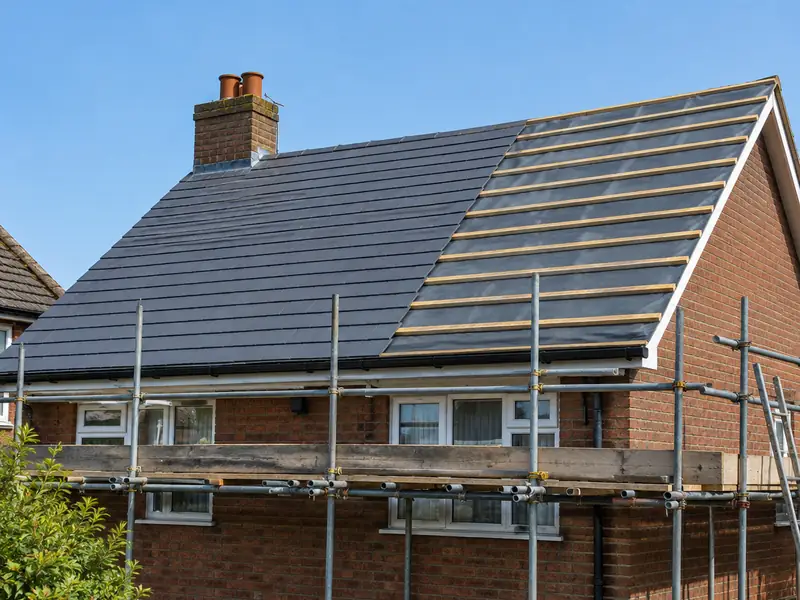
A roof replacement, or re-roof, strips the old tiles or slates, battens and felt from a pitched roof and replaces them with a new breathable membrane, battens and covering, repairing timbers and renewing ridges, valleys and flashings at the same time.
Anyone planning a new roof in Fleet wants three things: a clear price, a realistic timetable and a tidy job. We publish a guide of £7,800–£17,000 including VAT for the South East up front, explain that work normally takes 1–2 weeks on site, plus scaffolding time, and confirm both in writing after a free survey of your property.
- Guide price
- £7,800–£17,000 inc VAT
- Time on site
- 1–2 weeks on site, plus scaffolding time
- Postcodes
- GU13, GU51 and GU52
- Planning rules
- England
- Local area
- Hampshire
- Survey
- Free, with a written quote
How much does a new roof cost in Fleet?
In Fleet, guide figures for a new roof sit at £7,800–£17,000, VAT included. We set them using rates for the South East, currently about 12% above the national guide. The table shows what pushes a project towards either end of the range; your own price is set after a free survey.
| Type of job | What it usually involves | Guide in Fleet |
|---|---|---|
| Terraced house or bungalow | A smaller pitched roof re-covered in concrete or clay tiles, including scaffolding. | £5,600–£11,000 |
| Typical semi-detached | A 3-bed semi re-roofed in concrete or clay tiles with new membrane, battens and leadwork. | £7,800–£17,000 |
| Detached or natural slate | Larger or more complex roofs, or any roof finished in natural slate. | £13,500–£28,000 |
Expect these to shape the final quote:
- Roof area, pitch and the number of hips, valleys and dormers
- Condition of rafters, fascias and other timbers
- Chimneys, leadwork and roof windows to rework
- Scaffolding, access and the height of the house
What’s included?
- Survey of the covering, timbers, chimneys and loft ventilation
- Scaffolding with edge protection, erected and removed
- Stripping old tiles or slates, battens and felt in stages
- Repairs or replacement of damaged rafters and fascia boards
- New tiles or slates, or sound originals refitted where suitable
- Waste removal by skip and a clean site on completion
Homes in Hampshire
Southampton and Portsmouth have dense Victorian terraces, with plenty of post-war rebuilding after wartime bombing. Winchester keeps Georgian and medieval streets, Basingstoke expanded rapidly with 1960s and 1970s estates, and New Forest villages feature cob, thatch and brick. Brick and flint is common on the chalk downs, and new estates ring most towns.
Coastal areas along the Solent face salt and wind, while chalk downland is better drained but exposed; inland clay can move in dry summers.
In Fleet, as elsewhere in Hampshire, we take the building's age and construction into account before recommending anything, because both can change what is involved in a new roof.
Permissions for a new roof in Fleet
Planning law differs across the UK. For a home in Fleet, it is the England rules below that count, and we check them with the council ahead of any quote.
Re-roofing a house with similar materials does not usually need planning permission in England. Listed buildings and conservation areas may need consent if the covering changes.
Replacing more than a quarter of a roof’s covering counts as renovation under Building Regulations, so the work is notified and the roof insulation may need upgrading. Bats are protected across the UK; if they roost under roof tiles, soffits or fascias, work stops and a licensed ecologist advises before it restarts.
Rules change and every property is different, so we check the planning history and constraints for your address before we quote.
How does the job run?
Survey and measure
A free survey comes first. It gives us what we need to price a new roof properly, including dimensions, existing materials and access for deliveries, and gives you the chance to ask anything you like.
Price and scope agreed
You get the price in writing, itemised so you can see where the money goes. As long as the specification stays the same, that is the price you pay for a new roof.
Getting ready
Preparation matters as much as the build. We agree access, parking and working hours with you, order materials in good time, and confirm any permissions so the job isn't held up once it starts.
The work itself
Work goes ahead as scheduled and you deal with one contact throughout. When the last trade leaves, we clear and clean the site, talk you through what has been done and pass on any certificates and care instructions.
What you can expect from us
Common questions
What happens if it rains during the work?
We strip the roof in sections and only remove as much covering as we can replace or protect the same day. New breathable membrane goes on straight after stripping, which keeps most rain out, and we sheet exposed areas at the end of each day and before forecast showers. If heavy rain or high winds are forecast, we pause work. The house is never left open.
Can I stay at home during the work?
In most cases, yes. Most people can live at home throughout, and we plan the work to keep disruption down by protecting floors, agreeing working hours and keeping access routes clear. Bigger jobs affecting kitchens, bathrooms or heating may mean a short spell with reduced facilities, and we talk this through with you at the survey.
How long will a new roof last?
A well-installed roof lasts for decades. Concrete tiles typically last around 50 years or more, clay tiles longer, and natural slate can last a century with proper upkeep. Lifespan depends on the quality of materials, fixings, ventilation and leadwork, and on how exposed the roof is. Keeping gutters clear and fixing slipped tiles quickly helps it reach its full life.
Can you combine a new roof with other work?
Yes. Because we manage several trades under one contract, we can plan a new roof alongside other work on your Fleet home, such as new windows with rendering, or a kitchen refit with an extension. Combining jobs can reduce repeat set-up such as scaffolding, skips and access, and every element is listed and priced in the same written quote.
How long does a roof replacement take?
Re-roofing a typical semi-detached house takes around one to two weeks once scaffolding is up, depending on the roof's size, complexity and the weather. Smaller terraced roofs can take a few days. Scaffolding usually goes up a day or two before work starts and comes down once everything is inspected. We give you a programme and keep the roof weathertight overnight.
Near Fleet
We survey and quote throughout Fleet's GU13, GU51 and GU52 postcodes and in surrounding places such as Farnborough, Aldershot and Yateley. The process and pricing approach are identical in each of them.