
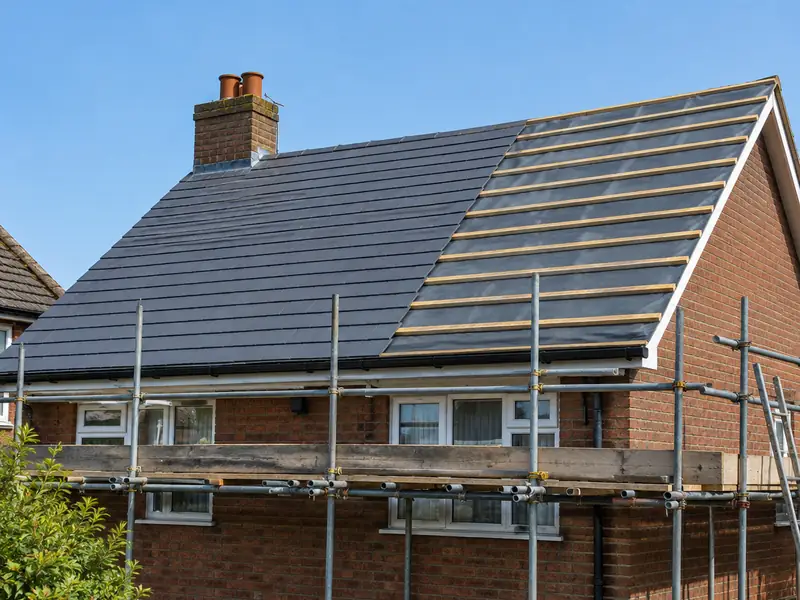
A roof replacement, or re-roof, strips the old tiles or slates, battens and felt from a pitched roof and replaces them with a new breathable membrane, battens and covering, repairing timbers and renewing ridges, valleys and flashings at the same time.
We arrange a new roof for homeowners in Tunbridge Wells and the wider Kent. The job is planned, priced and managed by us and carried out by tradespeople engaged under our contract, so there is one agreement and one contact. On a typical home the work takes 1–2 weeks on site, plus scaffolding time, and guide pricing in the South East is £7,800–£17,000, VAT included.
- Guide price
- £7,800–£17,000 inc VAT
- Time on site
- 1–2 weeks on site, plus scaffolding time
- Postcodes
- TN1, TN2, TN3 and TN4
- Planning rules
- England
- Local area
- Kent
- Survey
- Free, with a written quote
How much does a new roof cost in Tunbridge Wells?
The table below shows guide prices for a new roof in Tunbridge Wells. They are based on rates in the South East, which run about 12% above the national guide, giving an overall range of £7,800–£17,000. All figures include VAT and are firmed up after a free site survey.
| Type of job | What it usually involves | Guide in Tunbridge Wells |
|---|---|---|
| Terraced house or bungalow | A smaller pitched roof re-covered in concrete or clay tiles, including scaffolding. | £5,600–£11,000 |
| Typical semi-detached | A 3-bed semi re-roofed in concrete or clay tiles with new membrane, battens and leadwork. | £7,800–£17,000 |
| Detached or natural slate | Larger or more complex roofs, or any roof finished in natural slate. | £13,500–£28,000 |
The main things that change the figure:
- Roof area, pitch and the number of hips, valleys and dormers
- Covering material: concrete tile, clay tile or natural slate
- Condition of rafters, fascias and other timbers
- Scaffolding, access and the height of the house
Scope of the work
- Survey of the covering, timbers, chimneys and loft ventilation
- Scaffolding with edge protection, erected and removed
- Breathable membrane and new treated battens
- New tiles or slates, or sound originals refitted where suitable
- Ridges, hips and verges dry-fixed or bedded, with new leadwork
- Waste removal by skip and a clean site on completion
Homes in Kent
Kent's older buildings include oast houses, weatherboarded cottages, Wealden timber-framed houses and Kentish ragstone walls. Medway towns have long rows of Victorian terraces, Margate and Ramsgate have Regency and Victorian seafronts, and Ashford, Maidstone and Dartford have seen large new estates alongside interwar and post-war housing.
One of England's sunnier, drier counties, but Thanet and the coast are windy, and Weald and London Clay soils can shrink in summer.
In Tunbridge Wells, as elsewhere in Kent, we take the building's age and construction into account before recommending anything, because both can change what is involved in a new roof.
Planning and building rules in Tunbridge Wells
Which rules apply depends on where you live. For Tunbridge Wells, the answer is England, and the points below reflect that; we verify them with the council before quoting.
Re-roofing a house with similar materials does not usually need planning permission in England. Listed buildings and conservation areas may need consent if the covering changes.
Replacing more than a quarter of a roof’s covering counts as renovation under Building Regulations, so the work is notified and the roof insulation may need upgrading. Bats are protected across the UK; if they roost under roof tiles, soffits or fascias, work stops and a licensed ecologist advises before it restarts.
Rules change and every property is different, so we check the planning history and constraints for your address before we quote.
What happens after you get in touch?
Survey and measure
Book a visit and we'll come to you. The survey covers measurements, the state of what's there now and any obvious constraints, so the price that follows is based on your actual home, not an average.
Quote in writing
Next you receive a written quote with a fixed price for the agreed specification. It lists what is included, what is not, and how payments are staged, so you can compare it properly.
Getting ready
Next comes planning the work itself. We set a start date that suits you, line up the right trades, and make sure any approvals for a new roof are in place before the first day on site.
Finish and handover
During the work we protect the areas around it and tidy up at the end of each day. Once complete, we check the finish, remove our materials and hand over paperwork such as building control sign-off where it applies.
Why homeowners choose us
Frequently asked questions
How long will a new roof take?
On a typical home, allow 1–2 weeks on site, plus scaffolding time. Larger projects, older buildings and extra work found once things are opened up can extend that, while simpler jobs may be shorter. Your quote includes an estimate of time on site, and your point of contact keeps you updated on the programme as the work progresses.
How much does a new roof cost?
Re-roofing a typical 3-bed semi costs £7,800–£17,000, including scaffolding, new membrane and battens. As a guide, allow roughly £70–£160 per square metre of roof plus fixed costs for scaffolding and waste. Concrete tiles sit at the lower end and natural slate at the top. Hips, valleys, chimneys and timber repairs add to the price. We confirm a fixed figure after inspecting the roof and loft.
Do I need planning permission to replace my roof?
Planning permission is not usually needed to re-roof in similar materials, but it depends on the change, your home's location, whether it is listed or in a conservation area, and which UK nation you live in. Changing the roof shape, height or covering material can need permission. Listed buildings need consent for re-roofing. We check the position for your home before quoting.
What happens if it rains during the work?
We strip the roof in sections and only remove as much covering as we can replace or protect the same day. New breathable membrane goes on straight after stripping, which keeps most rain out, and we sheet exposed areas at the end of each day and before forecast showers. If heavy rain or high winds are forecast, we pause work. The house is never left open.
What happens at the survey?
We visit your home at a time that suits you, look at the area involved, take measurements and check access, condition and any services that might be affected. We talk through what you want from a new roof, explain the options and answer questions. There is no charge and no obligation; afterwards we send a written quote.
Also covering areas around Tunbridge Wells
Tunbridge Wells and its TN1, TN2, TN3 and TN4 postcodes are part of our coverage. Homeowners in Tonbridge, Crowborough and Sevenoaks can also book a free survey with us and receive a written price for their job.