
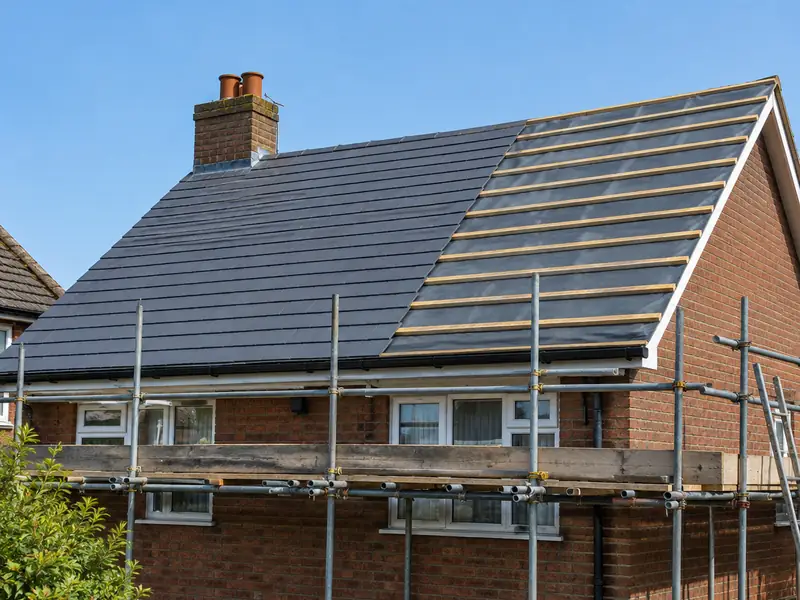
A roof replacement, or re-roof, strips the old tiles or slates, battens and felt from a pitched roof and replaces them with a new breathable membrane, battens and covering, repairing timbers and renewing ridges, valleys and flashings at the same time.
From a first conversation about a new roof to the day the site is cleared, homeowners in Fulham deal with us directly. We come out to measure up at no cost, explain the choices in plain terms and send a written quote. For context, comparable work in London usually falls within £9,100–£19,500 including VAT, and it is available across SW5, SW6, SW10 and W6.
- Guide price
- £9,100–£19,500 inc VAT
- Time on site
- 1–2 weeks on site, plus scaffolding time
- Postcodes
- SW5, SW6, SW10, W6 and W8
- Planning rules
- England
- Local area
- Greater London
- Survey
- Free, with a written quote
How much does a new roof cost in Fulham?
Budgeting for a new roof in Fulham? The numbers below include VAT and are adjusted for London, where costs are about 30% above the national guide. The headline range is £9,100–£19,500. Nothing is final until we have measured up at a free survey and agreed the specification with you.
| Type of job | What it usually involves | Guide in Fulham |
|---|---|---|
| Terraced house or bungalow | A smaller pitched roof re-covered in concrete or clay tiles, including scaffolding. | £6,500–£13,000 |
| Typical semi-detached | A 3-bed semi re-roofed in concrete or clay tiles with new membrane, battens and leadwork. | £9,100–£19,500 |
| Detached or natural slate | Larger or more complex roofs, or any roof finished in natural slate. | £15,500–£32,500 |
Your price depends mostly on:
- Roof area, pitch and the number of hips, valleys and dormers
- Covering material: concrete tile, clay tile or natural slate
- Chimneys, leadwork and roof windows to rework
- Scaffolding, access and the height of the house
Scope of the work
- Survey of the covering, timbers, chimneys and loft ventilation
- Scaffolding with edge protection, erected and removed
- Stripping old tiles or slates, battens and felt in stages
- Breathable membrane and new treated battens
- New tiles or slates, or sound originals refitted where suitable
- Waste removal by skip and a clean site on completion
Local housing and a new roof
London's housing is dominated by Victorian and Edwardian terraces, often in yellow London stock brick, with Georgian terraces in central districts and mansion blocks across many inner areas. Outer boroughs have large belts of interwar semis, and there are extensive post-war council estates. Many houses have been split into flats, and conservation areas are widespread.
Terraces suit side-return extensions and rear dormer loft conversions; interwar semis commonly take hip-to-gable lofts. Shared party walls, restricted parking and conservation rules often shape the plans and the programme.
None of this holds for every street in Fulham, which is why we look at your actual house before pricing a new roof rather than assuming from its age alone.
Do you need permission in Fulham?
The notes below cover England, which is where Fulham sits. Rules change and every property is different, so we speak to the council before pricing your job.
Re-roofing a house with similar materials does not usually need planning permission in England. Listed buildings and conservation areas may need consent if the covering changes.
Replacing more than a quarter of a roof’s covering counts as renovation under Building Regulations, so the work is notified and the roof insulation may need upgrading. Bats are protected across the UK; if they roost under roof tiles, soffits or fascias, work stops and a licensed ecologist advises before it restarts.
Rules change and every property is different, so we check the planning history and constraints for your address before we quote.
What happens after you get in touch?
Free site survey
Book a visit and we'll come to you. The survey covers measurements, the state of what's there now and any obvious constraints, so the price that follows is based on your actual home, not an average.
Written quote
You get the price in writing, itemised so you can see where the money goes. As long as the specification stays the same, that is the price you pay for a new roof.
Plan and prepare
We handle the paperwork side: checking whether planning permission or building control approval is needed, submitting applications where they are, and scheduling the trades and materials around your dates.
On site to finish
Our trades complete a new roof while your point of contact keeps you updated. When everything is finished, we clear the site, take away waste and go through the result with you before handover.
Why homeowners choose us
Frequently asked questions
Will my loft insulation and ventilation be improved?
Re-roofing is a good time to improve loft ventilation and insulation. A breathable membrane and eaves or ridge vents keep air moving and reduce condensation in the loft. Building regulations may require insulation upgrades when a large part of the roof is renewed. We check your current insulation and ventilation and include any required improvements in the quote.
Do I need planning permission to replace my roof?
Planning permission is not usually needed to re-roof in similar materials, but it depends on the change, your home's location, whether it is listed or in a conservation area, and which UK nation you live in. Changing the roof shape, height or covering material can need permission. Listed buildings need consent for re-roofing. We check the position for your home before quoting.
Is the price fixed?
Yes, for the specification we agree. Your written quote sets out exactly what is included at a fixed price. It only changes if you ask for something different, or if a problem the survey could not reasonably reveal later needs extra work. In either case we explain the change and confirm it in writing before going ahead.
How long will a new roof last?
A well-installed roof lasts for decades. Concrete tiles typically last around 50 years or more, clay tiles longer, and natural slate can last a century with proper upkeep. Lifespan depends on the quality of materials, fixings, ventilation and leadwork, and on how exposed the roof is. Keeping gutters clear and fixing slipped tiles quickly helps it reach its full life.
Can I stay at home during the work?
In most cases, yes. Most people can live at home throughout, and we plan the work to keep disruption down by protecting floors, agreeing working hours and keeping access routes clear. Bigger jobs affecting kitchens, bathrooms or heating may mean a short spell with reduced facilities, and we talk this through with you at the survey.
Also covering areas around Fulham
Homes across SW5, SW6, SW10 and W6 in Fulham are within our coverage, as are those in Chelsea, Putney and Battersea. If you are just outside these areas, ask anyway, because we work right across the UK.