
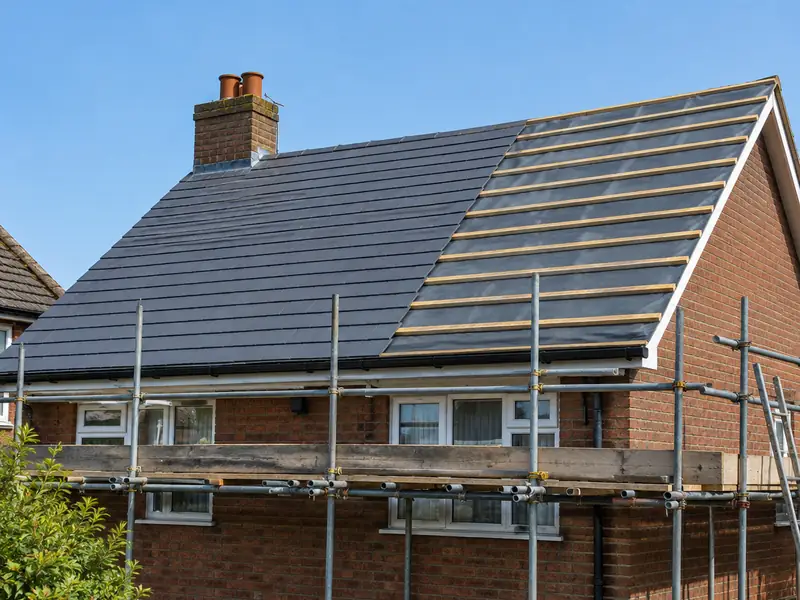
A roof replacement, or re-roof, strips the old tiles or slates, battens and felt from a pitched roof and replaces them with a new breathable membrane, battens and covering, repairing timbers and renewing ridges, valleys and flashings at the same time.
We arrange a new roof for homeowners in Merthyr Tydfil and the wider Mid Glamorgan. The job is planned, priced and managed by us and carried out by tradespeople engaged under our contract, so there is one agreement and one contact. On a typical home the work takes 1–2 weeks on site, plus scaffolding time, and guide pricing in Wales is £6,400–£14,000, VAT included.
- Guide price
- £6,400–£14,000 inc VAT
- Time on site
- 1–2 weeks on site, plus scaffolding time
- Postcodes
- CF47 and CF48
- Planning rules
- Wales
- Local area
- Mid Glamorgan
- Survey
- Free, with a written quote
Roof replacement prices in Merthyr Tydfil
In Merthyr Tydfil, guide figures for a new roof sit at £6,400–£14,000, VAT included. We set them using rates for Wales, currently about 8% below the national guide. The table shows what pushes a project towards either end of the range; your own price is set after a free survey.
| Type of job | What it usually involves | Guide in Merthyr Tydfil |
|---|---|---|
| Terraced house or bungalow | A smaller pitched roof re-covered in concrete or clay tiles, including scaffolding. | £4,600–£9,200 |
| Typical semi-detached | A 3-bed semi re-roofed in concrete or clay tiles with new membrane, battens and leadwork. | £6,400–£14,000 |
| Detached or natural slate | Larger or more complex roofs, or any roof finished in natural slate. | £11,000–£23,000 |
Your price depends mostly on:
- Roof area, pitch and the number of hips, valleys and dormers
- Covering material: concrete tile, clay tile or natural slate
- Condition of rafters, fascias and other timbers
- Scaffolding, access and the height of the house
What’s included?
- Survey of the covering, timbers, chimneys and loft ventilation
- Stripping old tiles or slates, battens and felt in stages
- Repairs or replacement of damaged rafters and fascia boards
- Breathable membrane and new treated battens
- Ridges, hips and verges dry-fixed or bedded, with new leadwork
- Waste removal by skip and a clean site on completion
Building in Merthyr Tydfil
The Rhondda, Cynon and Merthyr valleys are lined with stone terraces built for mining families, stepped along steep hillsides. Pontypridd, Caerphilly and Merthyr Tydfil have Victorian centres, and Bridgend has grown with large modern estates alongside interwar and post-war housing.
The valleys get heavy rainfall and steep, sloping sites are common, so drainage, retaining walls and render specification matter.
Knowing the typical building types in Mid Glamorgan helps, but a survey of your own home in Merthyr Tydfil is what decides the right approach to a new roof.
Permissions for a new roof in Merthyr Tydfil
England, Wales, Scotland and Northern Ireland each handle planning a little differently. Merthyr Tydfil comes under Wales, covered below, and we raise any questions with the council before your quote is finalised.
Re-roofing with similar materials does not usually need planning permission in Wales, except on listed buildings or where a conservation area restricts materials.
Building Regulations in Wales apply to major re-roofing, including insulation upgrades. Bats are protected across the UK; if they roost under roof tiles, soffits or fascias, work stops and a licensed ecologist advises before it restarts.
Rules change and every property is different, so we check the planning history and constraints for your address before we quote.
From survey to handover
We look at the job
We arrange a free site survey on a date convenient to you. We measure up, look at the existing structure and access, and discuss your plans for a new roof so the price reflects your home.
Written quote
We turn the survey notes into a written quote. The price is fixed for the specification we agree, and the document sets out materials, scope and payment stages in plain language.
Getting ready
We handle the paperwork side: checking whether planning permission or building control approval is needed, submitting applications where they are, and scheduling the trades and materials around your dates.
Finish and handover
On site, the agreed plan is followed and any change is put in writing first. At completion we do a final clean, go through the snagging list with you and leave you with the relevant documents.
Working with SK Home Improvements
Common questions
Do I need planning permission to replace my roof?
Planning permission is not usually needed to re-roof in similar materials, but it depends on the change, your home's location, whether it is listed or in a conservation area, and which UK nation you live in. Changing the roof shape, height or covering material can need permission. Listed buildings need consent for re-roofing. We check the position for your home before quoting.
How long will a new roof last?
A well-installed roof lasts for decades. Concrete tiles typically last around 50 years or more, clay tiles longer, and natural slate can last a century with proper upkeep. Lifespan depends on the quality of materials, fixings, ventilation and leadwork, and on how exposed the roof is. Keeping gutters clear and fixing slipped tiles quickly helps it reach its full life.
Is the price fixed?
Yes, for the specification we agree. Your written quote sets out exactly what is included at a fixed price. It only changes if you ask for something different, or if a problem the survey could not reasonably reveal later needs extra work. In either case we explain the change and confirm it in writing before going ahead.
What happens at the survey?
We visit your home at a time that suits you, look at the area involved, take measurements and check access, condition and any services that might be affected. We talk through what you want from a new roof, explain the options and answer questions. There is no charge and no obligation; afterwards we send a written quote.
Can my old tiles or slates be reused?
Old tiles or slates can sometimes be reused if they are sound, which can help keep the look of a period house. Many older concrete tiles and some slates are porous, cracked or have failing fixing nibs, so they would not last. Reclaimed slates or tiles can make up shortfalls. We check a sample during the survey and explain the cost difference.
Nearby towns
Homes across CF47 and CF48 in Merthyr Tydfil are within our coverage, as are those in Aberdare, Rhondda and Ebbw Vale. If you are just outside these areas, ask anyway, because we work right across the UK.