
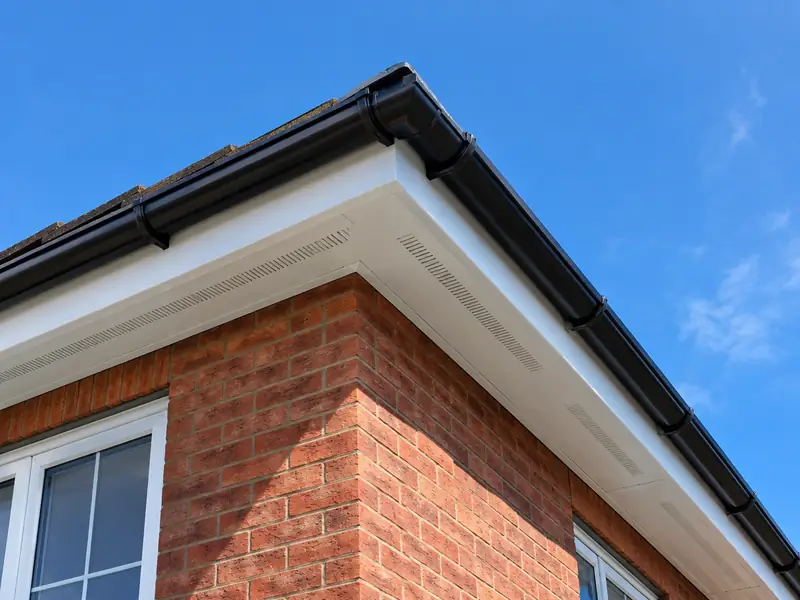
Roofline replacement renews the fascia boards that carry your gutters, the soffits beneath the eaves, bargeboards on gable ends and the gutters and downpipes, usually in low-maintenance uPVC, to protect rafter ends and carry rainwater safely away.
Thinking about new fascias, soffits and guttering in Cookstown? We take charge of the whole project, co-ordinating every trade involved, and one person keeps you updated. Guide prices for Northern Ireland sit at £1,700–£3,900 including VAT, and a typical job takes 1–3 days for a typical house. Your own figure depends on what the survey finds and the specification you settle on.
- Guide price
- £1,700–£3,900 inc VAT
- Time on site
- 1–3 days for a typical house
- Postcodes
- BT80
- Planning rules
- Northern Ireland
- Local area
- County Tyrone
- Survey
- Free, with a written quote
Fascias, soffits and guttering prices in Cookstown
To help you plan, we show what new fascias, soffits and guttering typically costs in Cookstown instead of holding figures back for a sales call. The range is £1,700–£3,900 with VAT, using rates in Northern Ireland that are about 14% below the national guide. A free survey then fixes your actual price.
| Type of job | What it usually involves | Guide in Cookstown |
|---|---|---|
| Guttering and downpipes only | New gutters and downpipes on a typical house, where fascias are sound. | £350–£1,300 |
| Full roofline on a semi | Fascias, soffits, gutters and downpipes on the front and rear of a 3-bed semi. | £1,700–£3,900 |
| Detached or with bargeboards | Larger houses, gable bargeboards, dormers or extensive rafter repairs. | £3,400–£6,900 |
What moves the price up or down:
- Length of eaves and number of gable ends
- Colour and finish of the uPVC or metal chosen
- Scaffolding and access, including over conservatories
- Number of downpipes and drain connections
What’s included?
- Survey of boards, rafter ends, gutters and eaves ventilation
- Scaffolding or access towers as needed
- Removal and disposal of old fascias, soffits and gutters
- Repairs to rotten rafter ends and sprockets
- New uPVC fascias, soffits and bargeboards in your chosen colour
- Eaves ventilation and tile support trays fitted
What are homes like around Cookstown?
Tyrone is largely rural, with detached houses and bungalows on individual plots across the countryside, many finished in render or roughcast. Omagh, Dungannon, Cookstown and Strabane have Victorian terraced streets, post-war estates and newer developments, and stone farmhouses survive in older rural areas.
Wet and fairly cool, with upland exposure in the Sperrins and frost common through the winter months.
None of this holds for every street in Cookstown, which is why we look at your actual house before pricing new fascias, soffits and guttering rather than assuming from its age alone.
Permissions for new fascias, soffits and guttering in Cookstown
Which rules apply depends on where you live. For Cookstown, the answer is Northern Ireland, and the points below reflect that; we verify them with the council before quoting.
Replacing fascias, soffits and guttering does not normally need planning permission in Northern Ireland.
Like-for-like roofline work is not normally covered by building control. Bats are protected across the UK; if they roost under roof tiles, soffits or fascias, work stops and a licensed ecologist advises before it restarts.
Rules change and every property is different, so we check the planning history and constraints for your address before we quote.
From survey to handover
A visit to your home
A free survey comes first. It gives us what we need to price new fascias, soffits and guttering properly, including dimensions, existing materials and access for deliveries, and gives you the chance to ask anything you like.
Your fixed price
We turn the survey notes into a written quote. The price is fixed for the specification we agree, and the document sets out materials, scope and payment stages in plain language.
Dates and permissions
Next comes planning the work itself. We set a start date that suits you, line up the right trades, and make sure any approvals for new fascias, soffits and guttering are in place before the first day on site.
Finish and handover
Work goes ahead as scheduled and you deal with one contact throughout. When the last trade leaves, we clear and clean the site, talk you through what has been done and pass on any certificates and care instructions.
Working with SK Home Improvements
Fascias, soffits and guttering in Cookstown: questions
How long does roofline replacement take?
Replacing fascias, soffits and guttering on a typical semi-detached house usually takes one to three days, once scaffolding is in place. Larger houses, dormers and gable bargeboards take longer, as do rafter repairs found when the old boards come off. We work one elevation at a time and connect the new guttering as we go, so rainwater is always carried away.
What happens at the survey?
We visit your home at a time that suits you, look at the area involved, take measurements and check access, condition and any services that might be affected. We talk through what you want from new fascias, soffits and guttering, explain the options and answer questions. There is no charge and no obligation; afterwards we send a written quote.
Can I stay at home during the work?
In most cases, yes. Most people can live at home throughout, and we plan the work to keep disruption down by protecting floors, agreeing working hours and keeping access routes clear. Bigger jobs affecting kitchens, bathrooms or heating may mean a short spell with reduced facilities, and we talk this through with you at the survey.
Do you need to access the roof tiles?
Replacing fascias usually means lifting or supporting the bottom row of roof tiles, because the felt or membrane must run over the new fascia into the gutter. Eaves protection trays are fitted to replace perished felt at the edge and stop rain getting behind the gutter. The tiles are then refixed. We include this detail in every full roofline replacement.
How do I look after uPVC roofline?
uPVC fascias and soffits need little upkeep: wash them once or twice a year with warm soapy water and a soft brush, avoiding solvents and abrasive cleaners. Gutters need clearing at least once a year, usually in late autumn, and more often near trees. Check downpipes are running clear after heavy rain. Gutter guards can reduce how often clearing is needed.
Nearby towns
We survey and quote throughout Cookstown's BT80 postcodes and in surrounding places such as Magherafelt, Dungannon and Portadown. The process and pricing approach are identical in each of them.