
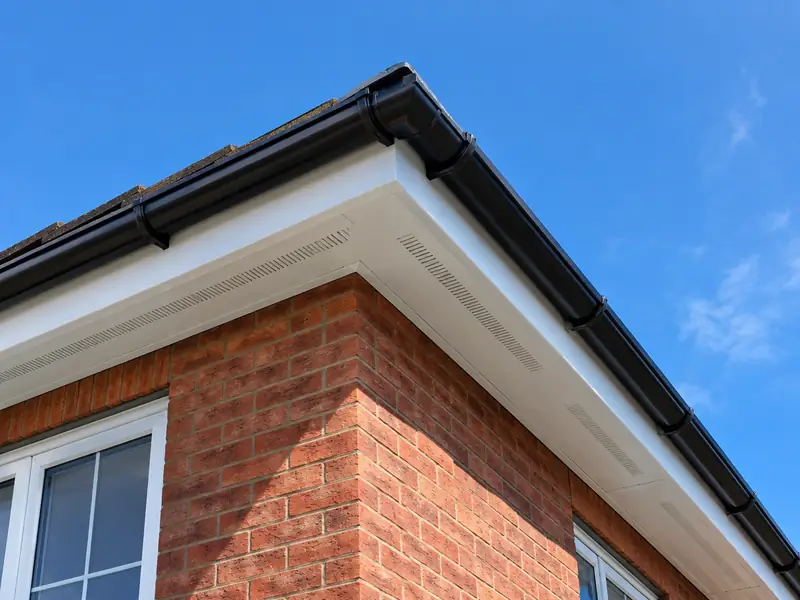
Roofline replacement renews the fascia boards that carry your gutters, the soffits beneath the eaves, bargeboards on gable ends and the gutters and downpipes, usually in low-maintenance uPVC, to protect rafter ends and carry rainwater safely away.
If you live in Chelsea and are weighing up new fascias, soffits and guttering, the starting point is a visit to measure up and talk through what you want, which costs nothing. We cover homes across SW3, SW5, SW7 and SW10, and a typical project of this kind in London lands somewhere in the £2,600–£5,800 bracket, including VAT. The exact figure depends on size, access and the finish you choose.
- Guide price
- £2,600–£5,800 inc VAT
- Time on site
- 1–3 days for a typical house
- Postcodes
- SW3, SW5, SW7, SW10 and SW1W
- Planning rules
- England
- Local area
- Greater London
- Survey
- Free, with a written quote
How much do new fascias, soffits and guttering cost in Chelsea?
The table below shows guide prices for new fascias, soffits and guttering in Chelsea. They are based on rates in London, which run about 30% above the national guide, giving an overall range of £2,600–£5,800. All figures include VAT and are firmed up after a free site survey.
| Type of job | What it usually involves | Guide in Chelsea |
|---|---|---|
| Guttering and downpipes only | New gutters and downpipes on a typical house, where fascias are sound. | £500–£1,950 |
| Full roofline on a semi | Fascias, soffits, gutters and downpipes on the front and rear of a 3-bed semi. | £2,600–£5,800 |
| Detached or with bargeboards | Larger houses, gable bargeboards, dormers or extensive rafter repairs. | £5,200–£10,500 |
The main things that change the figure:
- Colour and finish of the uPVC or metal chosen
- Rafter end repairs found when old boards come off
- Scaffolding and access, including over conservatories
- Number of downpipes and drain connections
What do you get?
- Survey of boards, rafter ends, gutters and eaves ventilation
- Removal and disposal of old fascias, soffits and gutters
- New uPVC fascias, soffits and bargeboards in your chosen colour
- Eaves ventilation and tile support trays fitted
- New gutters and downpipes set to correct falls
- Downpipes connected to existing drains and the site cleaned
What are homes like around Chelsea?
London's housing is dominated by Victorian and Edwardian terraces, often in yellow London stock brick, with Georgian terraces in central districts and mansion blocks across many inner areas. Outer boroughs have large belts of interwar semis, and there are extensive post-war council estates. Many houses have been split into flats, and conservation areas are widespread.
Terraces suit side-return extensions and rear dormer loft conversions; interwar semis commonly take hip-to-gable lofts. Shared party walls, restricted parking and conservation rules often shape the plans and the programme.
Knowing the typical building types in London helps, but a survey of your own home in Chelsea is what decides the right approach to new fascias, soffits and guttering.
Permissions for new fascias, soffits and guttering in Chelsea
Each UK nation sets its own consent rules, and Chelsea is in England. What follows is a plain summary; we check the specifics for your property with the council before pricing anything.
Replacing fascias, soffits and guttering does not need planning permission in England unless the house is listed or a conservation area restricts materials.
Building Regulations do not normally apply to like-for-like roofline replacement. Bats are protected across the UK; if they roost under roof tiles, soffits or fascias, work stops and a licensed ecologist advises before it restarts.
Rules change and every property is different, so we check the planning history and constraints for your address before we quote.
The four stages
Free site survey
We begin by looking at the job in person. During the free survey we discuss options, materials and budget for new fascias, soffits and guttering, and photograph or measure anything the quote needs to reflect.
Quote in writing
You get the price in writing, itemised so you can see where the money goes. As long as the specification stays the same, that is the price you pay for new fascias, soffits and guttering.
Booking the work
Preparation matters as much as the build. We agree access, parking and working hours with you, order materials in good time, and confirm any permissions so the job isn't held up once it starts.
On site to finish
The work is carried out to the agreed specification, with floors and furniture protected and the site kept tidy. At the end we clean up, walk through the finished job with you and hand over any certificates.
What you can expect from us
Common questions
Who do I deal with during the job?
One point of contact manages your project from survey to handover. They schedule the trades working under our contract, keep you updated on progress, and are the person to call with any question. You don't need to coordinate builders, electricians or decorators separately, because that is part of what we do.
Is the price fixed?
Yes, for the specification we agree. Your written quote sets out exactly what is included at a fixed price. It only changes if you ask for something different, or if a problem the survey could not reasonably reveal later needs extra work. In either case we explain the change and confirm it in writing before going ahead.
Should I replace my fascias or just cap them?
Capping, or cladding over old timber fascias with thin uPVC, costs less but traps any rot underneath and hides the condition of the rafter ends. Full replacement removes the old boards so rafter ends can be checked and repaired, and gives a stronger fixing for gutters. We usually recommend full replacement unless the existing timber is genuinely sound.
Why is roof ventilation important at the eaves?
Ventilation at the eaves lets air flow into the roof space and out at the ridge, carrying away moisture that would otherwise condense on cold timbers. Poor ventilation can lead to damp, mould and rot in the loft. Many older soffits have no vents, and loft insulation can block airflow. New soffits and eaves trays are fitted to keep a clear air path.
What if birds or bats are nesting in my roofline?
Nesting birds and roosting bats are protected by law across the UK, so work that would disturb an active nest or roost must wait or be planned with advice. Birds commonly nest under the eaves in spring and summer. If we find signs during the survey, we explain the options and timing. New soffits can include gaps or boxes for wildlife if you want them.
Also covering areas around Chelsea
Coverage for Chelsea spans SW3, SW5, SW7 and SW10. Close by, Battersea, Fulham and Pimlico are covered too, and the rest of our UK-wide area follows the same survey-then-quote process from start to finish.