
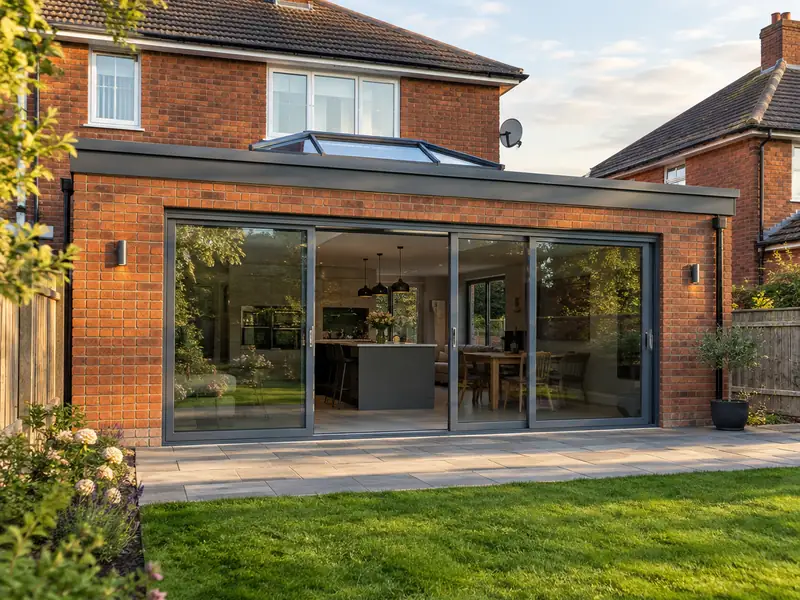
A single-storey extension is a new ground-floor room built onto your house, usually at the rear or side, with its own foundations, walls and roof, creating a bigger kitchen, living space or bedroom without moving home.
If you live in Crieff and are weighing up a single-storey extension, the starting point is a visit to measure up and talk through what you want, which costs nothing. We cover homes across PH7, and a typical project of this kind in Scotland lands somewhere in the £33,500–£72,000 bracket, including VAT. The exact figure depends on size, access and the finish you choose.
- Guide price
- £33,500–£72,000 inc VAT
- Time on site
- 10–16 weeks on site
- Postcodes
- PH7
- Planning rules
- Scotland
- Local area
- Perth and Kinross
- Survey
- Free, with a written quote
How much does a single-storey extension cost in Crieff?
The costs listed here are typical for a single-storey extension around Crieff and include VAT. They reflect labour and material costs in Scotland, about 4% below the national guide, giving a range of £33,500–£72,000. Exact pricing depends on your home, so we only fix it once a free site survey is done.
| Type of job | What it usually involves | Guide in Crieff |
|---|---|---|
| Small extension (8–12m²) | A modest rear or side extension, such as a utility room or a slightly larger kitchen. | £21,000–£38,500 |
| Typical rear extension (15–25m²) | A kitchen-diner or family room with bifold doors and a rooflight or lantern. | £33,500–£72,000 |
| Large or wrap-around (30m² plus) | A wrap-around or wide rear extension, often with structural steelwork into the house. | £67,000–£125,000 |
What moves the price up or down:
- Roof type, rooflights, lanterns and the amount of glazing
- Ground conditions, foundation depth and drains to divert
- Steelwork needed to open into the existing house
- Finishes, kitchen, flooring and heating specification
What’s included?
- Cavity walls built and insulated to building regulations
- Flat or pitched roof, with rooflights or a lantern if specified
- Steel beams to open into the existing house
- Windows and external doors, including bifolds if chosen
- Plastering, screed floor and internal doors
- Building control inspections and completion certificate
Building in Crieff
Perth has Georgian terraces and Victorian sandstone villas, Highland Perthshire towns such as Pitlochry and Aberfeldy have stone villas and cottages, and Kinross and Crieff mix older stone housing with post-war and modern estates. Slate roofs and harled finishes are common in rural areas.
Sandstone villas in Perth and Highland Perthshire often need repointing and slate roof repairs, and many sit in conservation areas. Semis and newer homes commonly take extensions, garage conversions and garden landscaping.
That mix of housing shapes how we approach a single-storey extension in Crieff: the age and construction of your home affect the materials, the method and, in the end, the price.
Permissions for a single-storey extension in Crieff
Which rules apply depends on where you live. For Crieff, the answer is Scotland, and the points below reflect that; we verify them with the council before quoting.
In Scotland, Class 1A permitted development covers some single-storey extensions, within limits on depth, height and distance from boundaries, and not in conservation areas or on flats. Anything outside those limits needs planning permission from the council.
A building warrant from the council’s building standards service is usually needed before work starts, and a completion certificate is accepted at the end. There is no Party Wall Act in Scotland; work near a boundary is agreed with neighbours under general law.
Rules change and every property is different, so we check the planning history and constraints for your address before we quote.
From survey to handover
Free site survey
A free survey comes first. It gives us what we need to price a single-storey extension properly, including dimensions, existing materials and access for deliveries, and gives you the chance to ask anything you like.
Quote in writing
You get the price in writing, itemised so you can see where the money goes. As long as the specification stays the same, that is the price you pay for a single-storey extension.
Dates and permissions
Before anyone starts, we confirm the programme in writing, check whether consents are required and arrange deliveries. If a skip or scaffolding on the road needs a permit, we apply for it.
On site to finish
On site, the agreed plan is followed and any change is put in writing first. At completion we do a final clean, go through the snagging list with you and leave you with the relevant documents.
Why homeowners choose us
Questions about a single-storey extension in Crieff
What does a typical extension build look like week by week?
A typical single-storey extension follows the same order: clearing the site and digging foundations, building walls up to roof level, then fitting the roof and windows to make it weathertight. Electrics, plumbing, insulation and plastering follow. The last stage is opening into the house, laying the screed and fitting doors and finishes. Building control inspects at key stages, and we book those visits for you.
How long will a single-storey extension take?
On a typical home, allow 10–16 weeks on site. Larger projects, older buildings and extra work found once things are opened up can extend that, while simpler jobs may be shorter. Your quote includes an estimate of time on site, and your point of contact keeps you updated on the programme as the work progresses.
How much will a single-storey extension cost in Crieff?
As a guide, expect to pay £33,500–£72,000 including VAT for a single-storey extension in Crieff. That range is adjusted for Scotland, which runs about 4% below the national guide. Where your project lands depends on size, materials, access and the condition of what is already there. We confirm a fixed price in writing after a free survey of your home.
What is the Party Wall Act and does it apply to me?
The Party Wall etc. Act 1996 applies in England and Wales only. In England and Wales, it requires you to give notice to neighbours before certain work on or near a shared wall, such as digging foundations within 3m of their building and deeper than its footings. Neighbours can agree or appoint a surveyor. Scotland and Northern Ireland have no equivalent Act, though general rights still apply. We identify whether notices are needed during the survey.
Can we stay at home during the build?
Most people stay at home while we build a single-storey extension, because the new structure goes up outside before we break through. The disruptive part is usually the last few weeks, when we open into the house and fit the kitchen. We put up dust screens, keep a safe route through the house and agree a temporary kitchen setup if needed. Water and power are only off for short, planned periods.
Near Crieff
From PH7 to the edges of Crieff and on into Auchterarder, Perth and Alloa, we can arrange a site visit and a written quote for your project, planned around dates that work for you.