
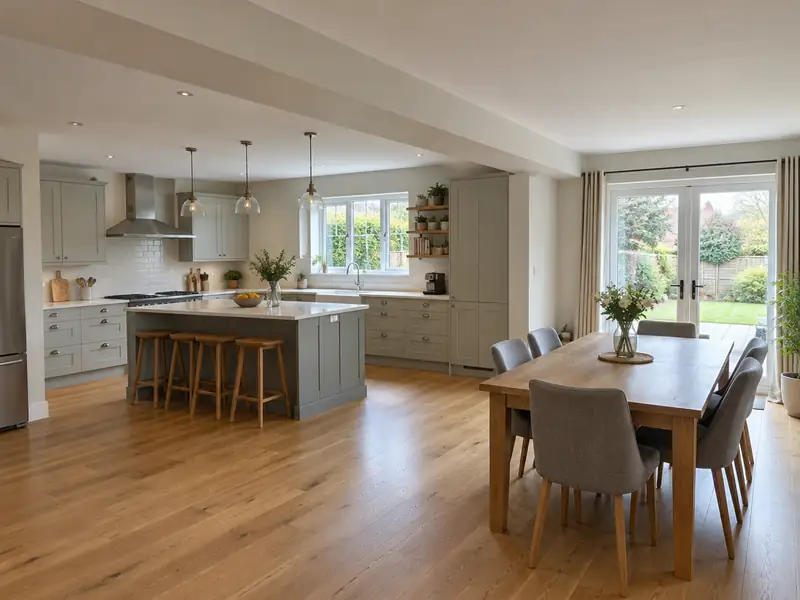
Wall removal is taking out an internal wall to open up rooms; where the wall is load-bearing, a steel beam sized by a structural engineer is installed on padstones to carry the weight above, with the work approved by building control.
If you have removing a wall on your list for a property in Leighton Buzzard, we can help from the first measurements to the final clean-up. For a typical home, plan for 1–3 weeks including making good, though larger or more complex jobs take longer. We cover postcodes LU7 and nearby Dunstable, Bletchley and Milton Keynes, and every quote we send is fixed for the scope described in it.
- Guide price
- £3,200–£8,400 inc VAT
- Time on site
- 1–3 weeks including making good
- Postcodes
- LU7
- Planning rules
- England
- Local area
- Central Bedfordshire
- Survey
- Free, with a written quote
Wall removal and steel beams prices in Leighton Buzzard
In Leighton Buzzard, guide figures for removing a wall sit at £3,200–£8,400, VAT included. We set them using rates for the East of England, currently about 5% above the national guide. The table shows what pushes a project towards either end of the range; your own price is set after a free survey.
| Type of job | What it usually involves | Guide in Leighton Buzzard |
|---|---|---|
| Non-load-bearing wall | Removing a stud or block partition and making good walls, ceiling and floor. | £850–£2,100 |
| Load-bearing wall up to 4m | A typical kitchen-diner knock-through with one steel beam, calculations and building control. | £3,200–£8,400 |
| Wide or complex opening | Openings over 4m, posts, flush beams or chimney breast removal. | £8,400–£17,000 |
Expect these to shape the final quote:
- Beam size, posts, flush fixing and padstone details
- Services in the wall that need rerouting
- Floor and ceiling repairs where the wall stood
- Engineer, building control and any party wall costs
What do you get?
- Survey to establish what the wall supports and where loads go
- Structural engineer's calculations and beam specification
- Wall taken down and waste removed from site
- Steel beam installed on padstones and packed tight
- Beam boarded or treated for fire protection
- Plastering, flooring repairs and making good ready for decorating
Building in Leighton Buzzard
Bedfordshire has a long brick-making history, and brick dominates: Victorian terraces in Bedford and Luton, interwar semis, large post-war estates around Luton and Dunstable, and newer developments near Bedford and Biggleswade. Villages in the north of the county keep limestone cottages, with timber framing and thatch scattered across older settlements.
Terraced houses here often benefit from rear extensions, loft rooms and repointing. Interwar and post-war semis commonly suit kitchen extensions, porches and garage conversions, while older village properties may call for lime plastering and sympathetic window replacements.
None of this holds for every street in Leighton Buzzard, which is why we look at your actual house before pricing removing a wall rather than assuming from its age alone.
Do you need permission in Leighton Buzzard?
England, Wales, Scotland and Northern Ireland each handle planning a little differently. Leighton Buzzard comes under England, covered below, and we raise any questions with the council before your quote is finalised.
Removing an internal wall does not need planning permission in England unless the house is listed.
If the wall is load-bearing, Building Regulations approval is needed, with a structural engineer’s calculations for the steel beam and padstones. Where the beam bears on a shared wall, the Party Wall etc. Act 1996 applies.
Rules change and every property is different, so we check the planning history and constraints for your address before we quote.
How does the job run?
Free site survey
It starts with a survey at the property, free of charge. We check condition, access and services, ask how you want the finished result to look, and answer any questions you have about removing a wall.
Price and scope agreed
Next you receive a written quote with a fixed price for the agreed specification. It lists what is included, what is not, and how payments are staged, so you can compare it properly.
Booking the work
Preparation matters as much as the build. We agree access, parking and working hours with you, order materials in good time, and confirm any permissions so the job isn't held up once it starts.
On site to finish
The job proceeds in the order set out in the programme, with dust and debris kept under control. Finally we tidy away, inspect the work together and pass the finished project over to you with its paperwork.
Why homeowners choose us
Common questions
What happens at the survey?
We visit your home at a time that suits you, look at the area involved, take measurements and check access, condition and any services that might be affected. We talk through what you want from removing a wall, explain the options and answer questions. There is no charge and no obligation; afterwards we send a written quote.
How disruptive is removing a wall?
Removing a wall is dusty and noisy, but the most disruptive part is short, usually one to three days for propping, demolition and installing the steel. We seal doorways with dust screens, protect floors and keep a safe route through the house. Making good, plastering and floor repairs follow over the next week or two. Most people stay at home throughout.
Can I stay at home during the work?
In most cases, yes. Most people can live at home throughout, and we plan the work to keep disruption down by protecting floors, agreeing working hours and keeping access routes clear. Bigger jobs affecting kitchens, bathrooms or heating may mean a short spell with reduced facilities, and we talk this through with you at the survey.
Does the Party Wall Act apply to wall removal?
The Party Wall etc. Act 1996 applies in England and Wales only. Removing an internal wall usually does not involve it, but if the beam bears into a wall shared with a neighbour, as is common in terraced and semi-detached houses, you must serve notice first. Scotland and Northern Ireland have no equivalent Act. We tell you during the survey whether notices are needed.
How do I know if a wall is load-bearing?
A wall is load-bearing if it carries weight from above, such as floor joists, another wall, the roof or a chimney. Clues include joists running across the wall rather than alongside it, and walls lined up with walls on the floor above. Brick or block walls are often structural but not always. We check from above and below during the survey, and an engineer confirms the design.
Also covering areas around Leighton Buzzard
Coverage for Leighton Buzzard spans LU7. Close by, Dunstable, Bletchley and Milton Keynes are covered too, and the rest of our UK-wide area follows the same survey-then-quote process from start to finish.