
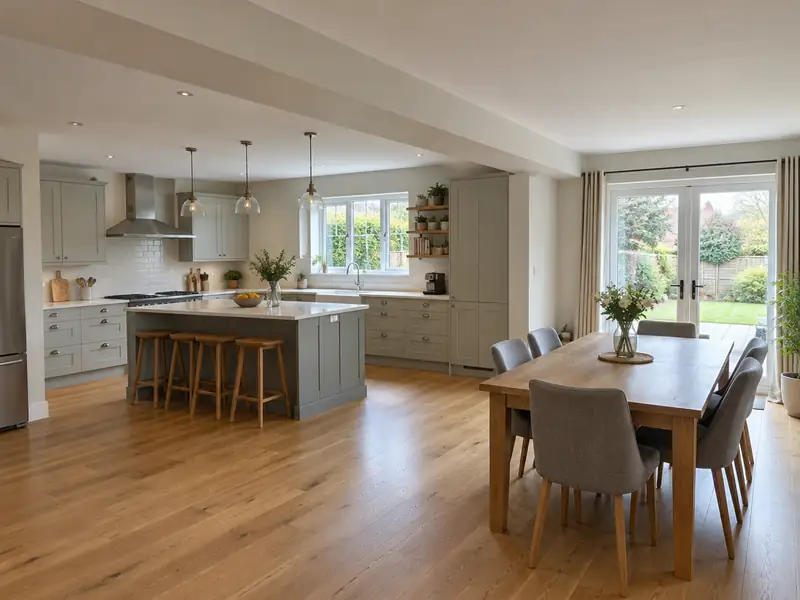
Wall removal is taking out an internal wall to open up rooms; where the wall is load-bearing, a steel beam sized by a structural engineer is installed on padstones to carry the weight above, with the work approved by building control.
Anyone planning removing a wall in Clacton-on-Sea wants three things: a clear price, a realistic timetable and a tidy job. We publish a guide of £3,200–£8,400 including VAT for the East of England up front, explain that work normally takes 1–3 weeks including making good, and confirm both in writing after a free survey of your property.
- Guide price
- £3,200–£8,400 inc VAT
- Time on site
- 1–3 weeks including making good
- Postcodes
- CO15
- Planning rules
- England
- Local area
- Essex
- Survey
- Free, with a written quote
What should you budget for removing a wall in Clacton-on-Sea?
Below is a breakdown of typical costs for removing a wall in Clacton-on-Sea. Because rates in the East of England are about 5% above the national guide, the overall guide comes to £3,200–£8,400, including VAT. Size, materials and access move the figure, and a free-of-charge survey settles it.
| Type of job | What it usually involves | Guide in Clacton-on-Sea |
|---|---|---|
| Non-load-bearing wall | Removing a stud or block partition and making good walls, ceiling and floor. | £850–£2,100 |
| Load-bearing wall up to 4m | A typical kitchen-diner knock-through with one steel beam, calculations and building control. | £3,200–£8,400 |
| Wide or complex opening | Openings over 4m, posts, flush beams or chimney breast removal. | £8,400–£17,000 |
What moves the price up or down:
- Beam size, posts, flush fixing and padstone details
- Services in the wall that need rerouting
- Floor and ceiling repairs where the wall stood
- Engineer, building control and any party wall costs
Scope of the work
- Survey to establish what the wall supports and where loads go
- Structural engineer's calculations and beam specification
- Building control application and inspections
- Steel beam installed on padstones and packed tight
- Beam boarded or treated for fire protection
- Plastering, flooring repairs and making good ready for decorating
Local housing and removing a wall
Essex ranges from timber-framed and weatherboarded cottages in the north, some with decorative pargeting, to Victorian terraces in Colchester, Chelmsford and Southend. Basildon and Harlow were built as post-war new towns, much of the south-east has interwar suburbs and bungalows, and large new estates continue to appear around Chelmsford and Braintree.
Terraces and semis commonly suit loft conversions and rear extensions, and many bungalows can take a loft room. New-town homes often need cladding, window and roofline renewal, while timber-framed cottages call for lime plaster and repairs that respect the original frame.
With that background in mind, here is how we typically handle removing a wall for homes in Clacton-on-Sea, from the first visit to the finished result.
Do you need permission in Clacton-on-Sea?
For anyone in Clacton-on-Sea, the relevant framework is England's. The summary below is general, so we always contact the council about your address before putting a price in writing.
Removing an internal wall does not need planning permission in England unless the house is listed.
If the wall is load-bearing, Building Regulations approval is needed, with a structural engineer’s calculations for the steel beam and padstones. Where the beam bears on a shared wall, the Party Wall etc. Act 1996 applies.
Rules change and every property is different, so we check the planning history and constraints for your address before we quote.
From survey to handover
We look at the job
A free survey comes first. It gives us what we need to price removing a wall properly, including dimensions, existing materials and access for deliveries, and gives you the chance to ask anything you like.
Price and scope agreed
We put everything into a written, fixed-price quote: the specification, what's excluded, staged payments and the expected time on site. Take whatever time you need to decide; there's no pressure to commit.
Dates and permissions
Before anyone starts, we confirm the programme in writing, check whether consents are required and arrange deliveries. If a skip or scaffolding on the road needs a permit, we apply for it.
Finish and handover
Our trades complete removing a wall while your point of contact keeps you updated. When everything is finished, we clear the site, take away waste and go through the result with you before handover.
What you can expect from us
Common questions
How do I know if a wall is load-bearing?
A wall is load-bearing if it carries weight from above, such as floor joists, another wall, the roof or a chimney. Clues include joists running across the wall rather than alongside it, and walls lined up with walls on the floor above. Brick or block walls are often structural but not always. We check from above and below during the survey, and an engineer confirms the design.
What happens to pipes and cables in the wall?
Pipes, cables and radiators in a wall being removed must be rerouted before demolition. Electrical work is done and certified by a qualified electrician, and pipework is diverted by a plumber, usually through the ceiling void or floor. We identify services during the survey and include rerouting in the quote, so there are no surprises once work starts.
Do you cover Harwich, Colchester and Felixstowe?
Yes. As well as Clacton-on-Sea, we cover Harwich, Colchester and Felixstowe and the rest of Essex. Our coverage is UK-wide, so the process is the same wherever you are: a free site survey, a quote in writing that fixes the price for the agreed scope, and one point of contact while the work is planned and carried out.
What is a steel beam and why is it needed?
A steel beam, often called an RSJ, is a strong steel section installed where a load-bearing wall used to be, so the weight above is carried across the opening to the walls at each end. It sits on padstones that spread the load. The size depends on the span and the load, which a structural engineer calculates. The beam is then boxed in or plastered.
What happens at the survey?
We visit your home at a time that suits you, look at the area involved, take measurements and check access, condition and any services that might be affected. We talk through what you want from removing a wall, explain the options and answer questions. There is no charge and no obligation; afterwards we send a written quote.
Near Clacton-on-Sea
Our coverage in Clacton-on-Sea includes CO15. We also travel to Harwich, Colchester and Felixstowe, so neighbouring addresses are looked after on exactly the same terms as those in town.