
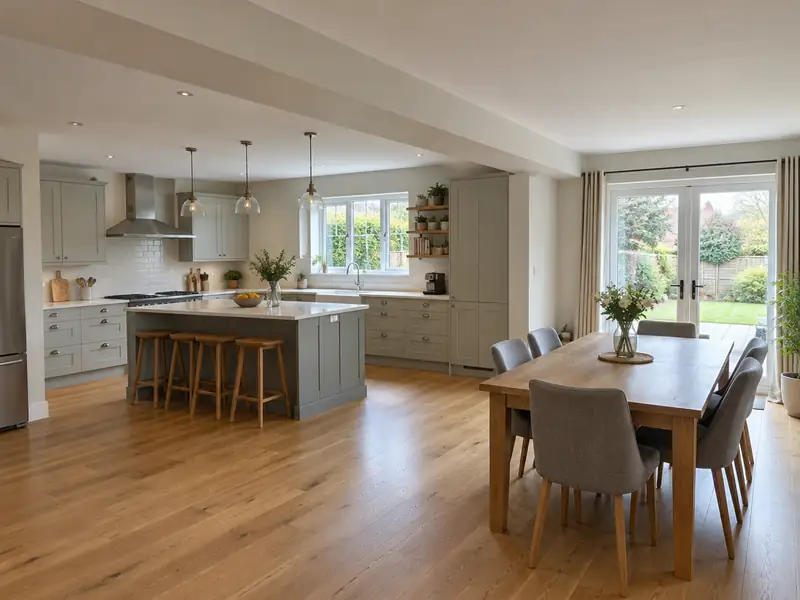
Wall removal is taking out an internal wall to open up rooms; where the wall is load-bearing, a steel beam sized by a structural engineer is installed on padstones to carry the weight above, with the work approved by building control.
Anyone planning removing a wall in Porthcawl wants three things: a clear price, a realistic timetable and a tidy job. We publish a guide of £2,800–£7,400 including VAT for Wales up front, explain that work normally takes 1–3 weeks including making good, and confirm both in writing after a free survey of your property.
- Guide price
- £2,800–£7,400 inc VAT
- Time on site
- 1–3 weeks including making good
- Postcodes
- CF36
- Planning rules
- Wales
- Local area
- Bridgend
- Survey
- Free, with a written quote
How much does removing a wall cost in Porthcawl?
What will removing a wall cost in Porthcawl? Our guide range is £2,800–£7,400 including VAT. That figure is adjusted for Wales, about 8% below the national guide, and is intended for planning a budget. A firm written price for your chosen specification follows a free survey at your home.
| Type of job | What it usually involves | Guide in Porthcawl |
|---|---|---|
| Non-load-bearing wall | Removing a stud or block partition and making good walls, ceiling and floor. | £750–£1,850 |
| Load-bearing wall up to 4m | A typical kitchen-diner knock-through with one steel beam, calculations and building control. | £2,800–£7,400 |
| Wide or complex opening | Openings over 4m, posts, flush beams or chimney breast removal. | £7,400–£14,500 |
Expect these to shape the final quote:
- Beam size, posts, flush fixing and padstone details
- Services in the wall that need rerouting
- Floor and ceiling repairs where the wall stood
- Engineer, building control and any party wall costs
What’s included?
- Survey to establish what the wall supports and where loads go
- Structural engineer's calculations and beam specification
- Temporary propping and dust protection during the work
- Wall taken down and waste removed from site
- Beam boarded or treated for fire protection
- Plastering, flooring repairs and making good ready for decorating
What are homes like around Porthcawl?
The Rhondda, Cynon and Merthyr valleys are lined with stone terraces built for mining families, stepped along steep hillsides. Pontypridd, Caerphilly and Merthyr Tydfil have Victorian centres, and Bridgend has grown with large modern estates alongside interwar and post-war housing.
Valley terraces commonly need repointing, roof repairs, rendering and window replacement, and loft conversions can add useful space. Newer estate homes often take garage conversions, porches and landscaping.
In Porthcawl, as elsewhere in Mid Glamorgan, we take the building's age and construction into account before recommending anything, because both can change what is involved in removing a wall.
Planning and building rules in Porthcawl
The notes below cover Wales, which is where Porthcawl sits. Rules change and every property is different, so we speak to the council before pricing your job.
Removing an internal wall does not need planning permission in Wales unless the building is listed.
Load-bearing walls need Building Regulations approval and structural calculations; the Party Wall etc. Act 1996 applies to shared walls.
Rules change and every property is different, so we check the planning history and constraints for your address before we quote.
What happens after you get in touch?
A visit to your home
It starts with a survey at the property, free of charge. We check condition, access and services, ask how you want the finished result to look, and answer any questions you have about removing a wall.
Quote in writing
The quote arrives in writing, not over the phone. It covers the full scope, the finishes you've chosen, any exclusions and the payment schedule, with a fixed price tied to that specification.
Getting ready
We handle the paperwork side: checking whether planning permission or building control approval is needed, submitting applications where they are, and scheduling the trades and materials around your dates.
Finish and handover
Work goes ahead as scheduled and you deal with one contact throughout. When the last trade leaves, we clear and clean the site, talk you through what has been done and pass on any certificates and care instructions.
How we work
Common questions
Can I stay at home during the work?
In most cases, yes. Most people can live at home throughout, and we plan the work to keep disruption down by protecting floors, agreeing working hours and keeping access routes clear. Bigger jobs affecting kitchens, bathrooms or heating may mean a short spell with reduced facilities, and we talk this through with you at the survey.
Can you combine removing a wall with other work?
Yes. Because we manage several trades under one contract, we can plan removing a wall alongside other work on your Porthcawl home, such as new windows with rendering, or a kitchen refit with an extension. Combining jobs can reduce repeat set-up such as scaffolding, skips and access, and every element is listed and priced in the same written quote.
How do I know if a wall is load-bearing?
A wall is load-bearing if it carries weight from above, such as floor joists, another wall, the roof or a chimney. Clues include joists running across the wall rather than alongside it, and walls lined up with walls on the floor above. Brick or block walls are often structural but not always. We check from above and below during the survey, and an engineer confirms the design.
Does the Party Wall Act apply to wall removal?
The Party Wall etc. Act 1996 applies in England and Wales only. Removing an internal wall usually does not involve it, but if the beam bears into a wall shared with a neighbour, as is common in terraced and semi-detached houses, you must serve notice first. Scotland and Northern Ireland have no equivalent Act. We tell you during the survey whether notices are needed.
How disruptive is removing a wall?
Removing a wall is dusty and noisy, but the most disruptive part is short, usually one to three days for propping, demolition and installing the steel. We seal doorways with dust screens, protect floors and keep a safe route through the house. Making good, plastering and floor repairs follow over the next week or two. Most people stay at home throughout.
Nearby towns
Whether you're in the centre of Porthcawl or on its outskirts, CF36 addresses are covered. We extend the same service, and the same fixed-price approach, to Bridgend, Maesteg and Llantwit Major.