
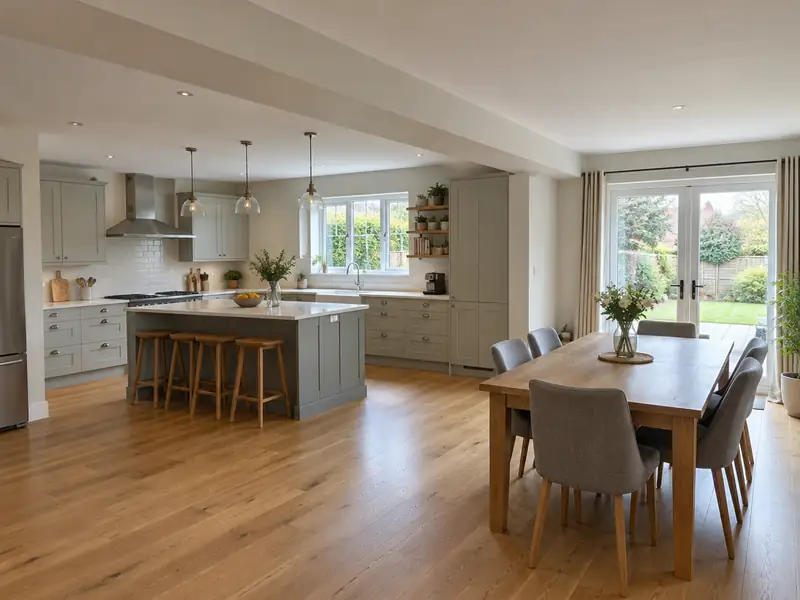
Wall removal is taking out an internal wall to open up rooms; where the wall is load-bearing, a steel beam sized by a structural engineer is installed on padstones to carry the weight above, with the work approved by building control.
We arrange removing a wall for homeowners in Didcot and the wider Oxfordshire. The job is planned, priced and managed by us and carried out by tradespeople engaged under our contract, so there is one agreement and one contact. On a typical home the work takes 1–3 weeks including making good, and guide pricing in the South East is £3,400–£9,000, VAT included.
- Guide price
- £3,400–£9,000 inc VAT
- Time on site
- 1–3 weeks including making good
- Postcodes
- OX11
- Planning rules
- England
- Local area
- Oxfordshire
- Survey
- Free, with a written quote
Wall removal and steel beams prices in Didcot
Here is how the guide price for removing a wall breaks down in Didcot. We start from national figures and adjust for the South East, which comes out about 12% above the national guide. The resulting range, VAT included, is £3,400–£9,000, and a survey, at no cost to you, firms it up.
| Type of job | What it usually involves | Guide in Didcot |
|---|---|---|
| Non-load-bearing wall | Removing a stud or block partition and making good walls, ceiling and floor. | £900–£2,200 |
| Load-bearing wall up to 4m | A typical kitchen-diner knock-through with one steel beam, calculations and building control. | £3,400–£9,000 |
| Wide or complex opening | Openings over 4m, posts, flush beams or chimney breast removal. | £9,000–£18,000 |
The main things that change the figure:
- Opening width and the load the wall carries
- Beam size, posts, flush fixing and padstone details
- Services in the wall that need rerouting
- Engineer, building control and any party wall costs
What’s included?
- Survey to establish what the wall supports and where loads go
- Building control application and inspections
- Wall taken down and waste removed from site
- Steel beam installed on padstones and packed tight
- Beam boarded or treated for fire protection
- Plastering, flooring repairs and making good ready for decorating
What are homes like around Didcot?
West Oxfordshire's Cotswold villages are built of honey-coloured limestone, while Banbury and the north use orange ironstone. Oxford has Victorian terraces in Jericho and East Oxford and Gothic brick villas in North Oxford. Didcot, Bicester and Witney have grown with large new estates around older market-town centres.
Stone cottages often need lime pointing and conservation-sensitive windows. Victorian terraces suit loft conversions and side-return extensions, and newer estate homes commonly take garage conversions and garden landscaping.
None of this holds for every street in Didcot, which is why we look at your actual house before pricing removing a wall rather than assuming from its age alone.
Permissions for removing a wall in Didcot
England, Wales, Scotland and Northern Ireland each handle planning a little differently. Didcot comes under England, covered below, and we raise any questions with the council before your quote is finalised.
Removing an internal wall does not need planning permission in England unless the house is listed.
If the wall is load-bearing, Building Regulations approval is needed, with a structural engineer’s calculations for the steel beam and padstones. Where the beam bears on a shared wall, the Party Wall etc. Act 1996 applies.
Rules change and every property is different, so we check the planning history and constraints for your address before we quote.
From survey to handover
Free site survey
It starts with a survey at the property, free of charge. We check condition, access and services, ask how you want the finished result to look, and answer any questions you have about removing a wall.
Your fixed price
After the survey we send a quote for removing a wall that fixes the price for the scope we've agreed. If you want to change materials or scope, we revise it in writing before anything is booked.
Dates and permissions
Once you accept, we agree start dates, order materials and deal with any planning, building control or neighbour notices the job needs. You'll know who is coming and when before work begins.
Finish and handover
Work goes ahead as scheduled and you deal with one contact throughout. When the last trade leaves, we clear and clean the site, talk you through what has been done and pass on any certificates and care instructions.
How we work
Wall removal and steel beams in Didcot: questions
Do I need planning permission in Didcot?
It depends on the work, the size of the project, your property type and whether the building is listed or in a conservation area. Didcot is in England, so England's rules apply. Many smaller jobs need no planning application, but some still need building control approval. We check what applies to your address before quoting.
Which postcodes in Didcot do you cover?
We cover OX11, along with the rest of Oxfordshire. If your postcode is not listed, get in touch anyway: our coverage is UK-wide, and we can usually arrange a survey wherever you live. Enter your postcode in the guide-price tool or contact form and we will confirm.
How disruptive is removing a wall?
Removing a wall is dusty and noisy, but the most disruptive part is short, usually one to three days for propping, demolition and installing the steel. We seal doorways with dust screens, protect floors and keep a safe route through the house. Making good, plastering and floor repairs follow over the next week or two. Most people stay at home throughout.
How much does it cost to remove a load-bearing wall?
Removing a load-bearing wall of about 3–4m with a steel beam typically costs £3,400–£9,000, including structural calculations, building control and making good. A non-load-bearing partition costs much less. As a rough guide, allow around £600–£1,600 per metre of opening plus fixed costs for the engineer, approvals and propping. Wider openings, posts and flush beams cost more. We confirm a fixed price after the survey.
What is a steel beam and why is it needed?
A steel beam, often called an RSJ, is a strong steel section installed where a load-bearing wall used to be, so the weight above is carried across the opening to the walls at each end. It sits on padstones that spread the load. The size depends on the span and the load, which a structural engineer calculates. The beam is then boxed in or plastered.
Also covering areas around Didcot
Our coverage in Didcot includes OX11. We also travel to Abingdon, Oxford and Thatcham, so neighbouring addresses are looked after on exactly the same terms as those in town.