
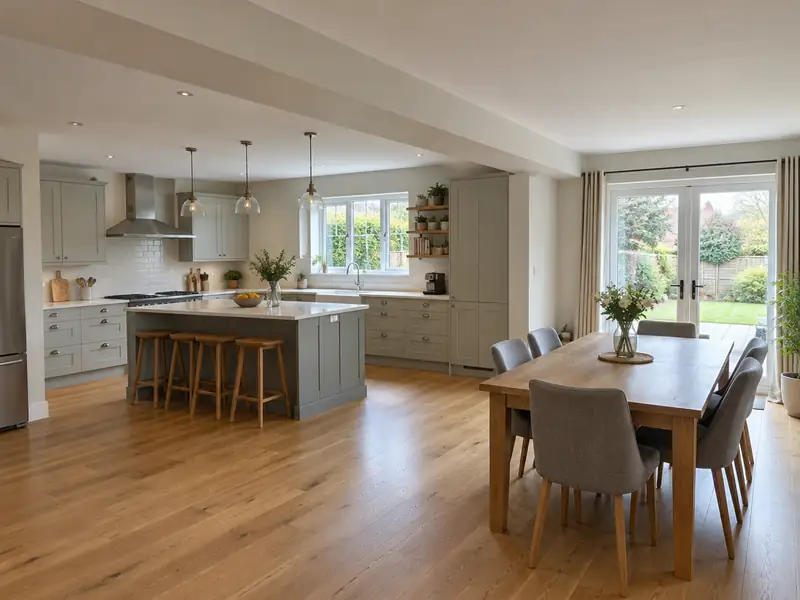
Wall removal is taking out an internal wall to open up rooms; where the wall is load-bearing, a steel beam sized by a structural engineer is installed on padstones to carry the weight above, with the work approved by building control.
We take on removing a wall throughout Clevedon and the surrounding BS21 postcodes, as well as in Nailsea, Portishead and Weston-super-Mare. The guide range for this work in the South West is £3,100–£8,200 including VAT; where your project falls depends on its size, the materials you pick and how easy the site is to reach. A free survey turns that range into a fixed figure.
- Guide price
- £3,100–£8,200 inc VAT
- Time on site
- 1–3 weeks including making good
- Postcodes
- BS21
- Planning rules
- England
- Local area
- North Somerset
- Survey
- Free, with a written quote
Wall removal and steel beams prices in Clevedon
Use the table to gauge the cost of removing a wall in Clevedon before we visit. Figures include VAT and are scaled for the South West, coming out about 2% above the national guide, which gives £3,100–£8,200 overall. After a free survey, you receive a fixed written price.
| Type of job | What it usually involves | Guide in Clevedon |
|---|---|---|
| Non-load-bearing wall | Removing a stud or block partition and making good walls, ceiling and floor. | £800–£2,000 |
| Load-bearing wall up to 4m | A typical kitchen-diner knock-through with one steel beam, calculations and building control. | £3,100–£8,200 |
| Wide or complex opening | Openings over 4m, posts, flush beams or chimney breast removal. | £8,200–£16,500 |
Expect these to shape the final quote:
- Beam size, posts, flush fixing and padstone details
- Services in the wall that need rerouting
- Floor and ceiling repairs where the wall stood
- Engineer, building control and any party wall costs
Scope of the work
- Survey to establish what the wall supports and where loads go
- Building control application and inspections
- Temporary propping and dust protection during the work
- Wall taken down and waste removed from site
- Beam boarded or treated for fire protection
- Plastering, flooring repairs and making good ready for decorating
Local housing and removing a wall
Somerset's building stone varies widely: Bath stone in Bath, golden Ham stone around Yeovil, blue lias in villages on the Levels and Mendip stone in the north. Weston-super-Mare has Victorian villas and terraces, Taunton and Bridgwater have brick terraces and post-war estates, and new housing continues to spread around the larger towns.
Stone properties often need lime pointing, stone repairs and windows that respect conservation areas, especially in Bath. Brick terraces suit loft rooms and extensions, and estate homes commonly take garage conversions.
Whatever era your Clevedon home dates from, we plan removing a wall around how it is actually built rather than a one-size-fits-all specification.
Planning and building rules in Clevedon
Each UK nation sets its own consent rules, and Clevedon is in England. What follows is a plain summary; we check the specifics for your property with the council before pricing anything.
Removing an internal wall does not need planning permission in England unless the house is listed.
If the wall is load-bearing, Building Regulations approval is needed, with a structural engineer’s calculations for the steel beam and padstones. Where the beam bears on a shared wall, the Party Wall etc. Act 1996 applies.
Rules change and every property is different, so we check the planning history and constraints for your address before we quote.
The four stages
A visit to your home
It starts with a survey at the property, free of charge. We check condition, access and services, ask how you want the finished result to look, and answer any questions you have about removing a wall.
Your fixed price
The quote arrives in writing, not over the phone. It covers the full scope, the finishes you've chosen, any exclusions and the payment schedule, with a fixed price tied to that specification.
Booking the work
Preparation matters as much as the build. We agree access, parking and working hours with you, order materials in good time, and confirm any permissions so the job isn't held up once it starts.
On site to finish
The work is carried out to the agreed specification, with floors and furniture protected and the site kept tidy. At the end we clean up, walk through the finished job with you and hand over any certificates.
Working with SK Home Improvements
Common questions
Can you combine removing a wall with other work?
Yes. Because we manage several trades under one contract, we can plan removing a wall alongside other work on your Clevedon home, such as new windows with rendering, or a kitchen refit with an extension. Combining jobs can reduce repeat set-up such as scaffolding, skips and access, and every element is listed and priced in the same written quote.
How long will removing a wall take?
On a typical home, allow 1–3 weeks including making good. Larger projects, older buildings and extra work found once things are opened up can extend that, while simpler jobs may be shorter. Your quote includes an estimate of time on site, and your point of contact keeps you updated on the programme as the work progresses.
How much does it cost to remove a load-bearing wall?
Removing a load-bearing wall of about 3–4m with a steel beam typically costs £3,100–£8,200, including structural calculations, building control and making good. A non-load-bearing partition costs much less. As a rough guide, allow around £600–£1,600 per metre of opening plus fixed costs for the engineer, approvals and propping. Wider openings, posts and flush beams cost more. We confirm a fixed price after the survey.
How do I know if a wall is load-bearing?
A wall is load-bearing if it carries weight from above, such as floor joists, another wall, the roof or a chimney. Clues include joists running across the wall rather than alongside it, and walls lined up with walls on the floor above. Brick or block walls are often structural but not always. We check from above and below during the survey, and an engineer confirms the design.
What happens to pipes and cables in the wall?
Pipes, cables and radiators in a wall being removed must be rerouted before demolition. Electrical work is done and certified by a qualified electrician, and pipework is diverted by a plumber, usually through the ceiling void or floor. We identify services during the survey and include rerouting in the quote, so there are no surprises once work starts.
Near Clevedon
From BS21 to the edges of Clevedon and on into Nailsea, Portishead and Weston-super-Mare, we can arrange a site visit and a written quote for your project, planned around dates that work for you.