
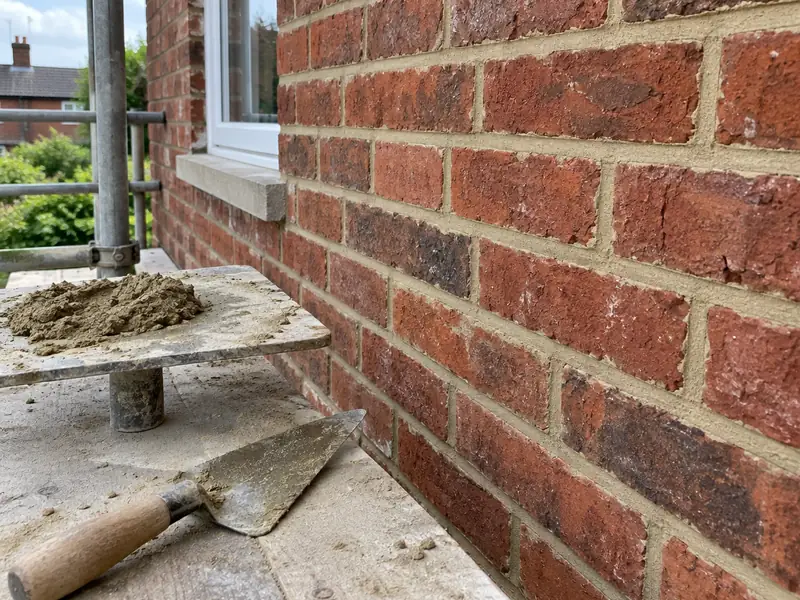
Repointing is raking out old, crumbling mortar from between bricks and replacing it with fresh mortar, sealing the joints against rain and protecting the wall; brickwork repairs replace spalled or cracked bricks and rebuild damaged sections.
Every house in Skegness is a little different, so we never price brickwork and repointing from a brochure. We look at the structure, access and existing finishes first, then put in writing a fixed figure for the scope we settle on. As a rough steer, homeowners in the East Midlands should budget £2,400–£5,800 including VAT, with work typically taking 3–10 days for a typical house.
- Guide price
- £2,400–£5,800 inc VAT
- Time on site
- 3–10 days for a typical house
- Postcodes
- PE25
- Planning rules
- England
- Local area
- Lincolnshire
- Survey
- Free, with a written quote
Brickwork and repointing prices in Skegness
Here is how the guide price for brickwork and repointing breaks down in Skegness. We start from national figures and adjust for the East Midlands, which comes out about 4% below the national guide. The resulting range, VAT included, is £2,400–£5,800, and a survey, at no cost to you, firms it up.
| Type of job | What it usually involves | Guide in Skegness |
|---|---|---|
| Chimney or small area | Repointing a chimney stack, gable or single wall, including access. | £600–£1,750 |
| Typical semi-detached | Repointing the main elevations of a 3-bed semi, including scaffolding. | £2,400–£5,800 |
| Detached or lime work | Larger houses, or period homes repointed in lime with brick repairs. | £4,800–£9,600 |
Your price depends mostly on:
- Mortar type: cement or lime, and joint style
- Number of bricks to replace and how well they match
- Scaffolding and access, including chimneys
- Condition of the existing mortar and how hard it is to remove
What does the job include in Skegness?
- Survey of mortar, bricks, cracks and the cause of any damp
- Scaffolding or access towers where needed
- Raking out old mortar to the correct depth
- Mortar mixed to suit the wall, in lime or cement
- Colour and joint style matched as closely as possible
- Replacement of spalled or cracked bricks
Homes in Lincolnshire
Lincoln has limestone buildings on the hill and Victorian brick terraces below, and Stamford is known for its Georgian limestone streets. Red brick and clay pantiles are common across villages, Grimsby and Cleethorpes have Victorian terraces, and the coast from Skegness to Mablethorpe has many bungalows and holiday-era homes.
Bungalows often suit loft conversions and extensions; terraces take rear extensions and window replacement. Pantile roofs may need careful re-roofing, and stone properties call for lime pointing and suitable repairs.
For brickwork and repointing in Skegness, this means checking things like wall construction, roof structure and existing services before we put a figure on paper.
Permissions for brickwork and repointing in Skegness
England, Wales, Scotland and Northern Ireland each handle planning a little differently. Skegness comes under England, covered below, and we raise any questions with the council before your quote is finalised.
Repointing and repairing brickwork with matching materials is maintenance, so it does not need planning permission in England. On a listed building, work that affects its character, including a change of mortar or brick, may need listed building consent.
Building Regulations do not normally apply to repointing or brick repairs, but rebuilding a wall, chimney or structural section can need building control involvement.
Rules change and every property is different, so we check the planning history and constraints for your address before we quote.
How does the job run?
Survey and measure
We begin by looking at the job in person. During the free survey we discuss options, materials and budget for brickwork and repointing, and photograph or measure anything the quote needs to reflect.
Price and scope agreed
We put everything into a written, fixed-price quote: the specification, what's excluded, staged payments and the expected time on site. Take whatever time you need to decide; there's no pressure to commit.
Plan and prepare
Next comes planning the work itself. We set a start date that suits you, line up the right trades, and make sure any approvals for brickwork and repointing are in place before the first day on site.
The work itself
During the work we protect the areas around it and tidy up at the end of each day. Once complete, we check the finish, remove our materials and hand over paperwork such as building control sign-off where it applies.
Working with SK Home Improvements
Common questions
What causes bricks to crumble?
Bricks usually crumble, or spall, when water gets into them and turns to ice, pushing the face off. This is often caused by hard cement mortar or impermeable paint trapping moisture in soft bricks, or by leaking gutters soaking the wall. Damaged bricks can be cut out and replaced with matching ones, or turned round if the back face is sound. We fix the cause at the same time.
What happens at the survey?
We visit your home at a time that suits you, look at the area involved, take measurements and check access, condition and any services that might be affected. We talk through what you want from brickwork and repointing, explain the options and answer questions. There is no charge and no obligation; afterwards we send a written quote.
How do I know if my house needs repointing?
A house needs repointing when the mortar between bricks is crumbling, recessed well behind the brick face, cracked or missing. You may be able to scrape it out with a key. Damp patches inside, especially on exposed walls, and plants growing in joints are other signs. Patches of failed mortar can be repointed on their own, but widespread decay usually means a full elevation.
Which postcodes in Skegness do you cover?
We cover PE25, along with the rest of Lincolnshire. If your postcode is not listed, get in touch anyway: our coverage is UK-wide, and we can usually arrange a survey wherever you live. Enter your postcode in the guide-price tool or contact form and we will confirm.
Should my house be repointed with lime or cement?
Houses built before about the 1920s were usually built with soft bricks and lime mortar, and should normally be repointed in lime. Hard cement mortar in these walls traps moisture and can cause the brick faces to crumble. Newer homes built with cement mortar are usually repointed in a similar mix. We check your wall construction before recommending a mortar.
Also covering areas around Skegness
Addresses in PE25 are all covered for Skegness, along with Boston, King's Lynn and Spalding close by. Give us your postcode when you get in touch and we will confirm the details.