
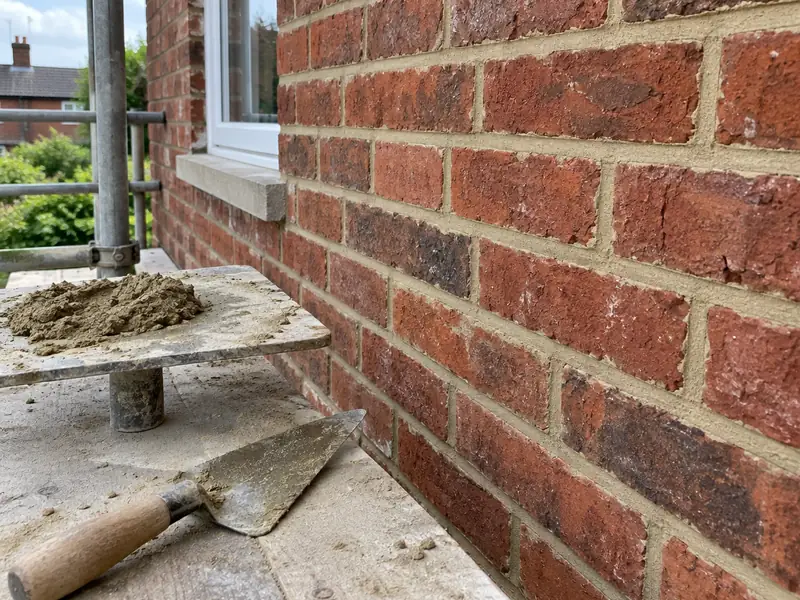
Repointing is raking out old, crumbling mortar from between bricks and replacing it with fresh mortar, sealing the joints against rain and protecting the wall; brickwork repairs replace spalled or cracked bricks and rebuild damaged sections.
Anyone planning brickwork and repointing in Boston wants three things: a clear price, a realistic timetable and a tidy job. We publish a guide of £2,400–£5,800 including VAT for the East Midlands up front, explain that work normally takes 3–10 days for a typical house, and confirm both in writing after a free survey of your property.
- Guide price
- £2,400–£5,800 inc VAT
- Time on site
- 3–10 days for a typical house
- Postcodes
- PE21
- Planning rules
- England
- Local area
- Lincolnshire
- Survey
- Free, with a written quote
Brickwork and repointing prices in Boston
To help you plan, we show what brickwork and repointing typically costs in Boston instead of holding figures back for a sales call. The range is £2,400–£5,800 with VAT, using rates in the East Midlands that are about 4% below the national guide. A free survey then fixes your actual price.
| Type of job | What it usually involves | Guide in Boston |
|---|---|---|
| Chimney or small area | Repointing a chimney stack, gable or single wall, including access. | £600–£1,750 |
| Typical semi-detached | Repointing the main elevations of a 3-bed semi, including scaffolding. | £2,400–£5,800 |
| Detached or lime work | Larger houses, or period homes repointed in lime with brick repairs. | £4,800–£9,600 |
The main things that change the figure:
- Wall area to repoint and the height of the house
- Mortar type: cement or lime, and joint style
- Scaffolding and access, including chimneys
- Condition of the existing mortar and how hard it is to remove
Scope of the work
- Survey of mortar, bricks, cracks and the cause of any damp
- Raking out old mortar to the correct depth
- Mortar mixed to suit the wall, in lime or cement
- Colour and joint style matched as closely as possible
- Clean-down of brick faces after pointing
- Waste removal and a tidy site
Local housing and brickwork and repointing
Lincoln has limestone buildings on the hill and Victorian brick terraces below, and Stamford is known for its Georgian limestone streets. Red brick and clay pantiles are common across villages, Grimsby and Cleethorpes have Victorian terraces, and the coast from Skegness to Mablethorpe has many bungalows and holiday-era homes.
Bungalows often suit loft conversions and extensions; terraces take rear extensions and window replacement. Pantile roofs may need careful re-roofing, and stone properties call for lime pointing and suitable repairs.
These patterns matter for brickwork and repointing: older walls, roofs and floors in Boston can need different materials or extra preparation compared with newer homes.
Do you need permission in Boston?
For anyone in Boston, the relevant framework is England's. The summary below is general, so we always contact the council about your address before putting a price in writing.
Repointing and repairing brickwork with matching materials is maintenance, so it does not need planning permission in England. On a listed building, work that affects its character, including a change of mortar or brick, may need listed building consent.
Building Regulations do not normally apply to repointing or brick repairs, but rebuilding a wall, chimney or structural section can need building control involvement.
Rules change and every property is different, so we check the planning history and constraints for your address before we quote.
The four stages
Survey and measure
We arrange a free site survey on a date convenient to you. We measure up, look at the existing structure and access, and discuss your plans for brickwork and repointing so the price reflects your home.
Price and scope agreed
We turn the survey notes into a written quote. The price is fixed for the specification we agree, and the document sets out materials, scope and payment stages in plain language.
Plan and prepare
Next comes planning the work itself. We set a start date that suits you, line up the right trades, and make sure any approvals for brickwork and repointing are in place before the first day on site.
The work itself
On site, the agreed plan is followed and any change is put in writing first. At completion we do a final clean, go through the snagging list with you and leave you with the relevant documents.
Why homeowners choose us
Common questions
Can you combine brickwork and repointing with other work?
Yes. Because we manage several trades under one contract, we can plan brickwork and repointing alongside other work on your Boston home, such as new windows with rendering, or a kitchen refit with an extension. Combining jobs can reduce repeat set-up such as scaffolding, skips and access, and every element is listed and priced in the same written quote.
Do I need planning permission in Boston?
It depends on the work, the size of the project, your property type and whether the building is listed or in a conservation area. Boston is in England, so England's rules apply. Many smaller jobs need no planning application, but some still need building control approval. We check what applies to your address before quoting.
How do I know if my house needs repointing?
A house needs repointing when the mortar between bricks is crumbling, recessed well behind the brick face, cracked or missing. You may be able to scrape it out with a key. Damp patches inside, especially on exposed walls, and plants growing in joints are other signs. Patches of failed mortar can be repointed on their own, but widespread decay usually means a full elevation.
Is repointing messy or noisy?
Raking out old mortar is noisy and dusty, especially when power tools are used on hard mortar. We sheet scaffolding to contain dust, keep windows closed nearby and clear up at the end of each day. The noisy phase moves around the house elevation by elevation. Inside, you may notice some dust on windowsills, so it helps to keep windows shut.
Should my house be repointed with lime or cement?
Houses built before about the 1920s were usually built with soft bricks and lime mortar, and should normally be repointed in lime. Hard cement mortar in these walls traps moisture and can cause the brick faces to crumble. Newer homes built with cement mortar are usually repointed in a similar mix. We check your wall construction before recommending a mortar.
Nearby towns
We welcome enquiries from all PE21 postcodes in Boston, plus Spalding, Skegness and Wisbech. Each one gets the same survey at no charge and a written price fixed for the work described.