
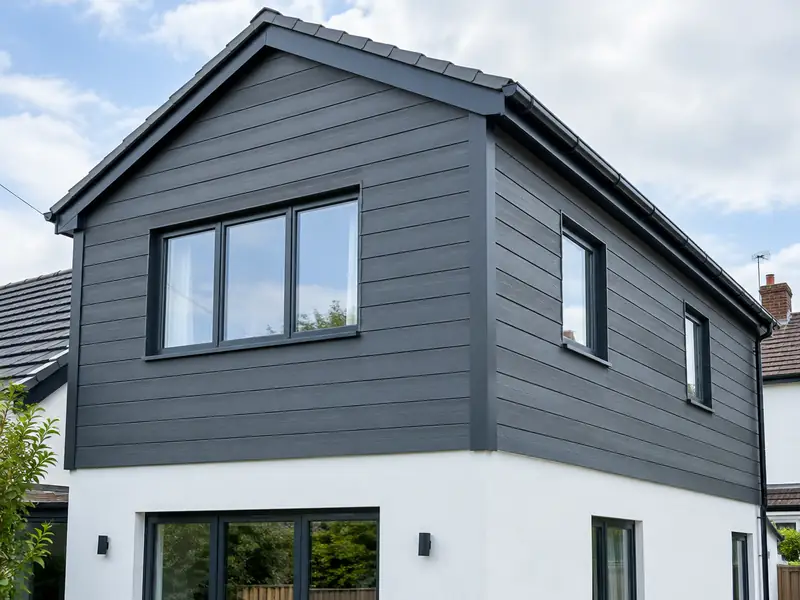
Cladding is a protective outer layer of boards or panels, such as timber, composite, fibre cement or uPVC, fixed to battens on the outside of a wall to change its appearance, shed rain and, where insulation is added, reduce heat loss.
We take on cladding throughout Dundee and the surrounding DD1, DD2, DD3 and DD4 postcodes, as well as in Carnoustie, St Andrews and Forfar. The guide range for this work in Scotland is £4,800–£11,500 including VAT; where your project falls depends on its size, the materials you pick and how easy the site is to reach. A free survey turns that range into a fixed figure.
- Guide price
- £4,800–£11,500 inc VAT
- Time on site
- 3 days to 3 weeks depending on area
- Postcodes
- DD1, DD2, DD3, DD4 and DD5
- Planning rules
- Scotland
- Local area
- Dundee City
- Survey
- Free, with a written quote
How much does cladding cost in Dundee?
To help you plan, we show what cladding typically costs in Dundee instead of holding figures back for a sales call. The range is £4,800–£11,500 with VAT, using rates in Scotland that are about 4% below the national guide. A free survey then fixes your actual price.
| Type of job | What it usually involves | Guide in Dundee |
|---|---|---|
| Feature area or dormer | A gable, dormer, bay or small feature wall in uPVC, timber or composite. | £1,450–£4,800 |
| Extension or upper storey | About 40–60m² of timber, composite or fibre cement with membrane and battens. | £4,800–£11,500 |
| Whole house | Cladding most elevations of a house, often with added insulation. | £11,500–£29,000 |
The main things that change the figure:
- Wall area to be clad and the height of the building
- Insulation behind the cladding
- Window reveals, corners and roof junctions to detail
- Scaffolding, access and distance from boundaries
What’s included?
- Survey of the wall, boundaries, damp and window details
- Breather membrane and treated battens fixed to the wall
- Cavity barriers and fire-stopping where regulations require
- Cladding boards fixed with suitable stainless or coated fixings
- Corner trims, window reveals and ventilated top and bottom edges
- Waste removal and a clean site on completion
Building in Dundee
Dundee has sandstone tenements and terraces, Victorian villas in Broughty Ferry and the West End, and extensive post-war housing. Angus towns such as Arbroath, Forfar, Montrose and Brechin use local red sandstone, and harled cottages and farmhouses are common in the countryside.
Relatively dry for Scotland, but cold easterly winds and frosts are common, and coastal towns face salt and haar.
Whatever era your Dundee home dates from, we plan cladding around how it is actually built rather than a one-size-fits-all specification.
Planning and building rules in Dundee
Each UK nation sets its own consent rules, and Dundee is in Scotland. What follows is a plain summary; we check the specifics for your property with the council before pricing anything.
In Scotland, changing the external finish of a house in a conservation area or on a listed building needs consent; elsewhere, like-for-like re-rendering is usually treated as repair.
Large-scale re-cladding or external insulation can need a building warrant; like-for-like render repairs normally do not.
Rules change and every property is different, so we check the planning history and constraints for your address before we quote.
The four stages
Free site survey
A free survey comes first. It gives us what we need to price cladding properly, including dimensions, existing materials and access for deliveries, and gives you the chance to ask anything you like.
Written quote
The quote arrives in writing, not over the phone. It covers the full scope, the finishes you've chosen, any exclusions and the payment schedule, with a fixed price tied to that specification.
Plan and prepare
Preparation matters as much as the build. We agree access, parking and working hours with you, order materials in good time, and confirm any permissions so the job isn't held up once it starts.
Build and hand over
Work goes ahead as scheduled and you deal with one contact throughout. When the last trade leaves, we clear and clean the site, talk you through what has been done and pass on any certificates and care instructions.
What you can expect from us
Frequently asked questions
Will timber cladding change colour?
Untreated timber cladding naturally weathers to a silver-grey over a year or two as sunlight breaks down the surface. The change can be uneven at first, especially under eaves where rain does not reach. If you want to keep the original colour, a UV-protective stain or oil is needed and must be renewed every few years. Pre-weathered and coated boards are also available.
How much will cladding cost in Dundee?
As a guide, expect to pay £4,800–£11,500 including VAT for cladding in Dundee. That range is adjusted for Scotland, which runs about 4% below the national guide. Where your project lands depends on size, materials, access and the condition of what is already there. We confirm a fixed price in writing after a free survey of your home.
How long does cladding take to install?
Cladding a small dormer or gable usually takes a few days, an extension or upper storey around one to two weeks, and a whole house two to three weeks or more. Scaffolding, insulation and detailing around many windows add time. Timber boards may need to acclimatise on site first. We give you a programme with the written quote.
Do I need planning permission to clad my house?
Whether cladding needs planning permission depends on the material and how it changes the look of the house, your home's location, whether it is listed or in a conservation area, and which UK nation you live in. In England, cladding is generally permitted development only if the materials look similar to the existing house, and it is not permitted development in conservation areas. We check before quoting.
How long will cladding take?
On a typical home, allow 3 days to 3 weeks depending on area. Larger projects, older buildings and extra work found once things are opened up can extend that, while simpler jobs may be shorter. Your quote includes an estimate of time on site, and your point of contact keeps you updated on the programme as the work progresses.
Near Dundee
We cover every part of Dundee, including DD1, DD2, DD3 and DD4, and nearby Carnoustie, St Andrews and Forfar. Wherever you are within that patch, the survey is free and the quote comes to you in writing.