
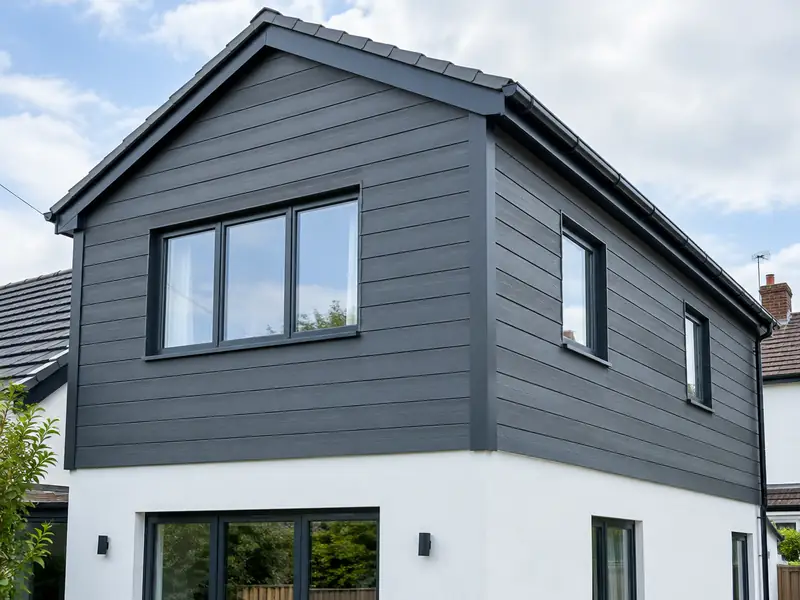
Cladding is a protective outer layer of boards or panels, such as timber, composite, fibre cement or uPVC, fixed to battens on the outside of a wall to change its appearance, shed rain and, where insulation is added, reduce heat loss.
From Wrexham, Buckley, Deeside and Colwyn Bay to the quieter corners of Clwyd, homeowners can book a free survey for cladding. We look at the building, agree the scope, then send a quote in writing that fixes the cost of that scope. Work follows the rules for Wales, and our published range for Wales, £4,600–£11,000 with VAT, gives you a sense of budget before we visit.
- Guide price
- £4,600–£11,000 inc VAT
- Time on site
- 3 days to 3 weeks depending on area
- Planning rules
- Wales
- Price level
- About 8% below the national guide
- Towns listed
- 10
- Survey
- Free, with a written quote
How much does cladding cost in Clwyd?
In Clwyd, guide figures for cladding sit at £4,600–£11,000, VAT included. We set them using rates for Wales, currently about 8% below the national guide. The table shows what pushes a project towards either end of the range; your own price is set after a free survey.
| Type of job | What it usually involves | Guide in Clwyd |
|---|---|---|
| Feature area or dormer | A gable, dormer, bay or small feature wall in uPVC, timber or composite. | £1,400–£4,600 |
| Extension or upper storey | About 40–60m² of timber, composite or fibre cement with membrane and battens. | £4,600–£11,000 |
| Whole house | Cladding most elevations of a house, often with added insulation. | £11,000–£27,500 |
Your price depends mostly on:
- Wall area to be clad and the height of the building
- Cladding material and board profile
- Window reveals, corners and roof junctions to detail
- Scaffolding, access and distance from boundaries
What do you get?
- Scaffolding or access towers as needed
- Breather membrane and treated battens fixed to the wall
- Insulation behind the cladding where agreed
- Cavity barriers and fire-stopping where regulations require
- Cladding boards fixed with suitable stainless or coated fixings
- Corner trims, window reveals and ventilated top and bottom edges
Homes in Clwyd
Wrexham has Victorian terraces in red Ruabon brick, alongside interwar and post-war estates. The north coast resorts of Rhyl, Prestatyn and Colwyn Bay have Victorian villas, guest-house terraces and bungalows, while Denbighshire and Flintshire villages use local stone under Welsh slate roofs.
Terraces suit loft conversions and rear extensions, and many need repointing and roof work. Coastal bungalows commonly take loft rooms and window renewal, and stone cottages need lime-based repairs.
The north Wales coast is exposed to wind and salt from the Irish Sea, and the Clwydian hills inland are wetter and colder.
Planning and building rules in Clwyd
Homes in Clwyd come under the regulations for Wales, summarised below. We don't rely on general rules alone: we confirm the position for your address with the council before a quote goes out.
In Wales, rendering or cladding may need planning permission in conservation areas, and listed buildings need consent.
Building Regulations in Wales can require insulation upgrades when a large part of an external wall is renovated.
Rules change and every property is different, so we check the planning history and constraints for your address before we quote.
How does the job run?
Free site survey
Book a visit and we'll come to you. The survey covers measurements, the state of what's there now and any obvious constraints, so the price that follows is based on your actual home, not an average.
Written quote
You get the price in writing, itemised so you can see where the money goes. As long as the specification stays the same, that is the price you pay for cladding.
Plan and prepare
Preparation matters as much as the build. We agree access, parking and working hours with you, order materials in good time, and confirm any permissions so the job isn't held up once it starts.
The work itself
The work is carried out to the agreed specification, with floors and furniture protected and the site kept tidy. At the end we clean up, walk through the finished job with you and hand over any certificates.
How we work
Questions about cladding in Clwyd
Do I need planning permission to clad my house?
Whether cladding needs planning permission depends on the material and how it changes the look of the house, your home's location, whether it is listed or in a conservation area, and which UK nation you live in. In England, cladding is generally permitted development only if the materials look similar to the existing house, and it is not permitted development in conservation areas. We check before quoting.
What happens at the survey?
We visit your home at a time that suits you, look at the area involved, take measurements and check access, condition and any services that might be affected. We talk through what you want from cladding, explain the options and answer questions. There is no charge and no obligation; afterwards we send a written quote.
How long does cladding take to install?
Cladding a small dormer or gable usually takes a few days, an extension or upper storey around one to two weeks, and a whole house two to three weeks or more. Scaffolding, insulation and detailing around many windows add time. Timber boards may need to acclimatise on site first. We give you a programme with the written quote.
Who do I deal with during the job?
One point of contact manages your project from survey to handover. They schedule the trades working under our contract, keep you updated on progress, and are the person to call with any question. You don't need to coordinate builders, electricians or decorators separately, because that is part of what we do.
Can you clad over existing render or brick?
Cladding is usually fixed over existing render or brick using battens, as long as the wall is sound and dry. Loose render may need removing first so the fixings hold. The battens create a ventilated gap so any moisture can drain and dry. We check the wall during the survey and explain any preparation needed before cladding.
Towns in Clwyd
Below is our list of Clwyd towns for cladding. If yours isn't shown, we may still cover it, so it is worth asking us directly.