
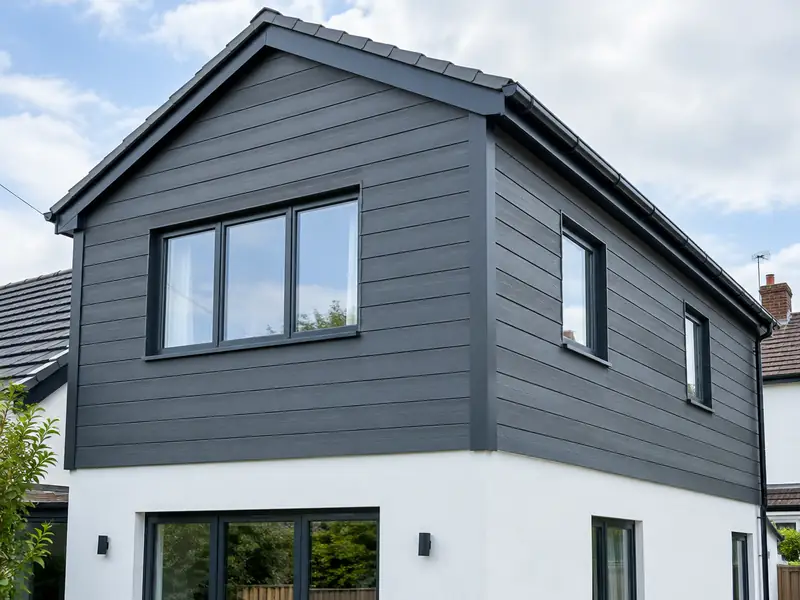
Cladding is a protective outer layer of boards or panels, such as timber, composite, fibre cement or uPVC, fixed to battens on the outside of a wall to change its appearance, shed rain and, where insulation is added, reduce heat loss.
For a homeowner in Deeside, planning cladding tends to begin with two questions: what will it cost, and how disruptive will it be? Our guide range is £4,600–£11,000 including VAT, and a typical job runs to 3 days to 3 weeks depending on area. Both numbers firm up once we have seen the property, measured up and agreed exactly what is included.
- Guide price
- £4,600–£11,000 inc VAT
- Time on site
- 3 days to 3 weeks depending on area
- Postcodes
- CH5
- Planning rules
- Wales
- Local area
- Flintshire
- Survey
- Free, with a written quote
Cladding prices in Deeside
What will cladding cost in Deeside? Our guide range is £4,600–£11,000 including VAT. That figure is adjusted for Wales, about 8% below the national guide, and is intended for planning a budget. A firm written price for your chosen specification follows a free survey at your home.
| Type of job | What it usually involves | Guide in Deeside |
|---|---|---|
| Feature area or dormer | A gable, dormer, bay or small feature wall in uPVC, timber or composite. | £1,400–£4,600 |
| Extension or upper storey | About 40–60m² of timber, composite or fibre cement with membrane and battens. | £4,600–£11,000 |
| Whole house | Cladding most elevations of a house, often with added insulation. | £11,000–£27,500 |
Expect these to shape the final quote:
- Wall area to be clad and the height of the building
- Insulation behind the cladding
- Window reveals, corners and roof junctions to detail
- Scaffolding, access and distance from boundaries
Scope of the work
- Survey of the wall, boundaries, damp and window details
- Breather membrane and treated battens fixed to the wall
- Insulation behind the cladding where agreed
- Cladding boards fixed with suitable stainless or coated fixings
- Corner trims, window reveals and ventilated top and bottom edges
- Waste removal and a clean site on completion
Building in Deeside
Wrexham has Victorian terraces in red Ruabon brick, alongside interwar and post-war estates. The north coast resorts of Rhyl, Prestatyn and Colwyn Bay have Victorian villas, guest-house terraces and bungalows, while Denbighshire and Flintshire villages use local stone under Welsh slate roofs.
Terraces suit loft conversions and rear extensions, and many need repointing and roof work. Coastal bungalows commonly take loft rooms and window renewal, and stone cottages need lime-based repairs.
Whatever era your Deeside home dates from, we plan cladding around how it is actually built rather than a one-size-fits-all specification.
Permissions for cladding in Deeside
Which rules apply depends on where you live. For Deeside, the answer is Wales, and the points below reflect that; we verify them with the council before quoting.
In Wales, rendering or cladding may need planning permission in conservation areas, and listed buildings need consent.
Building Regulations in Wales can require insulation upgrades when a large part of an external wall is renovated.
Rules change and every property is different, so we check the planning history and constraints for your address before we quote.
What happens after you get in touch?
A visit to your home
Book a visit and we'll come to you. The survey covers measurements, the state of what's there now and any obvious constraints, so the price that follows is based on your actual home, not an average.
Quote in writing
Next you receive a written quote with a fixed price for the agreed specification. It lists what is included, what is not, and how payments are staged, so you can compare it properly.
Booking the work
Next comes planning the work itself. We set a start date that suits you, line up the right trades, and make sure any approvals for cladding are in place before the first day on site.
On site to finish
The work is carried out to the agreed specification, with floors and furniture protected and the site kept tidy. At the end we clean up, walk through the finished job with you and hand over any certificates.
How we work
Common questions
Can you clad over existing render or brick?
Cladding is usually fixed over existing render or brick using battens, as long as the wall is sound and dry. Loose render may need removing first so the fixings hold. The battens create a ventilated gap so any moisture can drain and dry. We check the wall during the survey and explain any preparation needed before cladding.
Do I need planning permission to clad my house?
Whether cladding needs planning permission depends on the material and how it changes the look of the house, your home's location, whether it is listed or in a conservation area, and which UK nation you live in. In England, cladding is generally permitted development only if the materials look similar to the existing house, and it is not permitted development in conservation areas. We check before quoting.
Which postcodes in Deeside do you cover?
We cover CH5, along with the rest of Clwyd. If your postcode is not listed, get in touch anyway: our coverage is UK-wide, and we can usually arrange a survey wherever you live. Enter your postcode in the guide-price tool or contact form and we will confirm.
Which cladding material needs the least maintenance?
Fibre cement, composite and uPVC cladding need the least upkeep, usually just an occasional wash. Thermally modified and hardwood timber can be left to weather naturally to a silver-grey, which needs no treatment, but keeping the original colour means re-staining every few years. Painted timber needs repainting regularly. We explain the long-term care of each option.
Do you cover Hawarden, Buckley and Flint?
Yes. As well as Deeside, we cover Hawarden, Buckley and Flint and the rest of Clwyd. Our coverage is UK-wide, so the process is the same wherever you are: a free site survey, a quote in writing that fixes the price for the agreed scope, and one point of contact while the work is planned and carried out.
Nearby towns
Addresses in CH5 are all covered for Deeside, along with Hawarden, Buckley and Flint close by. Give us your postcode when you get in touch and we will confirm the details.