
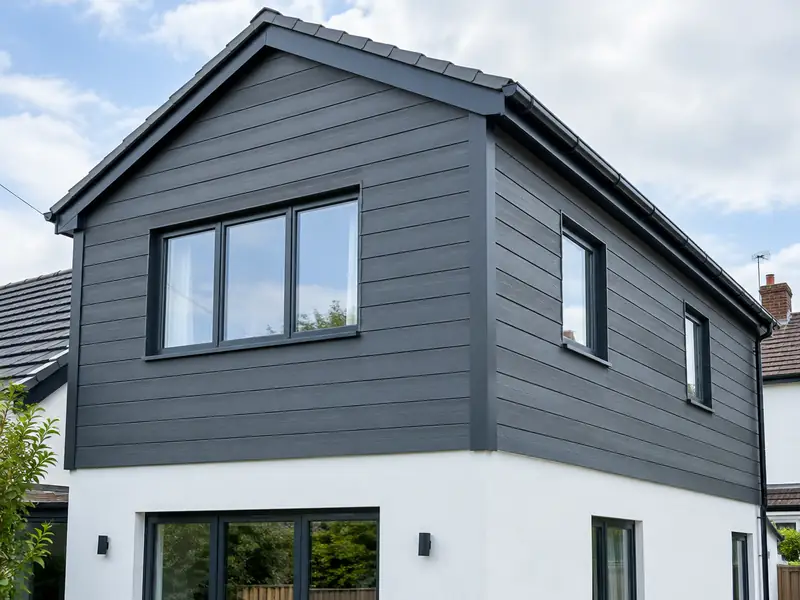
Cladding is a protective outer layer of boards or panels, such as timber, composite, fibre cement or uPVC, fixed to battens on the outside of a wall to change its appearance, shed rain and, where insulation is added, reduce heat loss.
Every house in Workington is a little different, so we never price cladding from a brochure. We look at the structure, access and existing finishes first, then put in writing a fixed figure for the scope we settle on. As a rough steer, homeowners in the North West should budget £4,800–£11,500 including VAT, with work typically taking 3 days to 3 weeks depending on area.
- Guide price
- £4,800–£11,500 inc VAT
- Time on site
- 3 days to 3 weeks depending on area
- Postcodes
- CA14
- Planning rules
- England
- Local area
- Cumbria
- Survey
- Free, with a written quote
What should you budget for cladding in Workington?
The table below shows guide prices for cladding in Workington. They are based on rates in the North West, which run about 5% below the national guide, giving an overall range of £4,800–£11,500. All figures include VAT and are firmed up after a free site survey.
| Type of job | What it usually involves | Guide in Workington |
|---|---|---|
| Feature area or dormer | A gable, dormer, bay or small feature wall in uPVC, timber or composite. | £1,400–£4,800 |
| Extension or upper storey | About 40–60m² of timber, composite or fibre cement with membrane and battens. | £4,800–£11,500 |
| Whole house | Cladding most elevations of a house, often with added insulation. | £11,500–£28,500 |
The main things that change the figure:
- Cladding material and board profile
- Insulation behind the cladding
- Window reveals, corners and roof junctions to detail
- Scaffolding, access and distance from boundaries
What’s included?
- Survey of the wall, boundaries, damp and window details
- Breather membrane and treated battens fixed to the wall
- Cavity barriers and fire-stopping where regulations require
- Cladding boards fixed with suitable stainless or coated fixings
- Corner trims, window reveals and ventilated top and bottom edges
- Waste removal and a clean site on completion
What are homes like around Workington?
Lake District villages are built largely of slate and rubble stone, often finished in roughcast or limewash, under slate roofs. Kendal is known for grey limestone and Penrith for red sandstone, Carlisle has sandstone and brick terraces, and west coast towns such as Barrow, Workington and Whitehaven have Victorian industrial terraces and post-war estates.
Cumbria is among the wettest parts of England, and high ground and west-facing coasts see severe wind-driven rain, so exposure ratings matter for render and pointing.
None of this holds for every street in Workington, which is why we look at your actual house before pricing cladding rather than assuming from its age alone.
Permissions for cladding in Workington
Which rules apply depends on where you live. For Workington, the answer is England, and the points below reflect that; we verify them with the council before quoting.
In England, re-rendering or cladding a house is often allowed without planning permission, but stone, render, timber, plastic or tile cladding is not permitted development in conservation areas, and listed buildings need consent.
If you render or re-clad more than 25% of an external wall, Building Regulations usually require the wall’s insulation to be improved where that is practical, and building control should be notified.
Rules change and every property is different, so we check the planning history and constraints for your address before we quote.
From survey to handover
We look at the job
It starts with a survey at the property, free of charge. We check condition, access and services, ask how you want the finished result to look, and answer any questions you have about cladding.
Quote in writing
The quote arrives in writing, not over the phone. It covers the full scope, the finishes you've chosen, any exclusions and the payment schedule, with a fixed price tied to that specification.
Dates and permissions
We handle the paperwork side: checking whether planning permission or building control approval is needed, submitting applications where they are, and scheduling the trades and materials around your dates.
On site to finish
The job proceeds in the order set out in the programme, with dust and debris kept under control. Finally we tidy away, inspect the work together and pass the finished project over to you with its paperwork.
Why homeowners choose us
Questions about cladding in Workington
How long does cladding take to install?
Cladding a small dormer or gable usually takes a few days, an extension or upper storey around one to two weeks, and a whole house two to three weeks or more. Scaffolding, insulation and detailing around many windows add time. Timber boards may need to acclimatise on site first. We give you a programme with the written quote.
How much does house cladding cost?
Cladding around 40–60m² of wall, such as an extension or upper storey, costs £4,800–£11,500, including membrane, battens and trims. As a guide, allow roughly £80–£180 per square metre plus fixed costs for scaffolding and set-up. uPVC and softwood sit at the lower end, while hardwood, composite and fibre cement cost more. Adding insulation increases the price. We confirm a fixed figure after the survey.
How long will cladding take?
On a typical home, allow 3 days to 3 weeks depending on area. Larger projects, older buildings and extra work found once things are opened up can extend that, while simpler jobs may be shorter. Your quote includes an estimate of time on site, and your point of contact keeps you updated on the programme as the work progresses.
Do you cover Whitehaven, Annan and Dumfries?
Yes. As well as Workington, we cover Whitehaven, Annan and Dumfries and the rest of Cumbria. Our coverage is UK-wide, so the process is the same wherever you are: a free site survey, a quote in writing that fixes the price for the agreed scope, and one point of contact while the work is planned and carried out.
Can you clad over existing render or brick?
Cladding is usually fixed over existing render or brick using battens, as long as the wall is sound and dry. Loose render may need removing first so the fixings hold. The battens create a ventilated gap so any moisture can drain and dry. We check the wall during the survey and explain any preparation needed before cladding.
Also covering areas around Workington
Workington and its CA14 postcodes are part of our coverage. Homeowners in Whitehaven, Annan and Dumfries can also book a free survey with us and receive a written price for their job.