
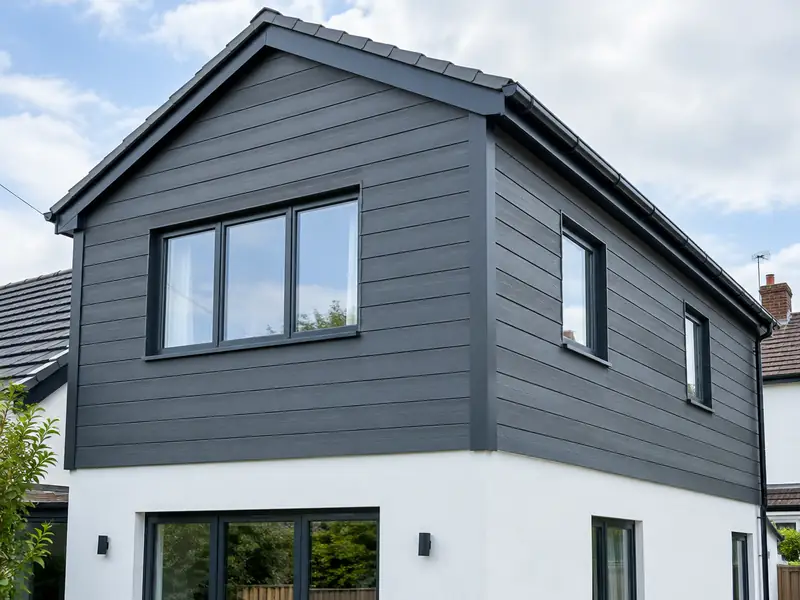
Cladding is a protective outer layer of boards or panels, such as timber, composite, fibre cement or uPVC, fixed to battens on the outside of a wall to change its appearance, shed rain and, where insulation is added, reduce heat loss.
Whether you live in one of the larger towns, such as Carlisle, Barrow-in-Furness, Kendal and Whitehaven, or somewhere quieter in Cumbria, the way we handle cladding is identical. We survey, agree the specification with you, and confirm a fixed price on paper. Everything is planned under the regulations in force in England, and guide costs in the North West sit at £4,800–£11,500 with VAT.
- Guide price
- £4,800–£11,500 inc VAT
- Time on site
- 3 days to 3 weeks depending on area
- Planning rules
- England
- Price level
- About 5% below the national guide
- Towns listed
- 5
- Survey
- Free, with a written quote
Cladding prices in Cumbria
What should you budget for cladding in Cumbria? Use the figures below as a starting point. Prices in the North West sit about 5% below the national guide, so the range here is £4,800–£11,500 including VAT. Your fixed price comes in writing once we've surveyed the property, at no charge.
| Type of job | What it usually involves | Guide in Cumbria |
|---|---|---|
| Feature area or dormer | A gable, dormer, bay or small feature wall in uPVC, timber or composite. | £1,400–£4,800 |
| Extension or upper storey | About 40–60m² of timber, composite or fibre cement with membrane and battens. | £4,800–£11,500 |
| Whole house | Cladding most elevations of a house, often with added insulation. | £11,500–£28,500 |
Your price depends mostly on:
- Wall area to be clad and the height of the building
- Insulation behind the cladding
- Window reveals, corners and roof junctions to detail
- Scaffolding, access and distance from boundaries
What’s included?
- Survey of the wall, boundaries, damp and window details
- Scaffolding or access towers as needed
- Insulation behind the cladding where agreed
- Cladding boards fixed with suitable stainless or coated fixings
- Corner trims, window reveals and ventilated top and bottom edges
- Waste removal and a clean site on completion
Housing across Cumbria
Lake District villages are built largely of slate and rubble stone, often finished in roughcast or limewash, under slate roofs. Kendal is known for grey limestone and Penrith for red sandstone, Carlisle has sandstone and brick terraces, and west coast towns such as Barrow, Workington and Whitehaven have Victorian industrial terraces and post-war estates.
Stone cottages often need lime pointing, roof slating and breathable render. Industrial terraces can gain space through attic conversions and rear extensions, while rural homes commonly add porches, driveways and window upgrades.
Cumbria is among the wettest parts of England, and high ground and west-facing coasts see severe wind-driven rain, so exposure ratings matter for render and pointing.
Do you need permission in Cumbria?
As Cumbria is in England, read the following with that system of planning and building control in mind. We check what applies to your house with the council before you receive a quote.
In England, re-rendering or cladding a house is often allowed without planning permission, but stone, render, timber, plastic or tile cladding is not permitted development in conservation areas, and listed buildings need consent.
If you render or re-clad more than 25% of an external wall, Building Regulations usually require the wall’s insulation to be improved where that is practical, and building control should be notified.
Rules change and every property is different, so we check the planning history and constraints for your address before we quote.
How does the job run?
We look at the job
It starts with a survey at the property, free of charge. We check condition, access and services, ask how you want the finished result to look, and answer any questions you have about cladding.
Price and scope agreed
Next you receive a written quote with a fixed price for the agreed specification. It lists what is included, what is not, and how payments are staged, so you can compare it properly.
Booking the work
With the quote agreed, we book the work in and handle preparation: permissions where needed, building control notifications, material orders and access arrangements for your Cumbria property.
Finish and handover
On site, the agreed plan is followed and any change is put in writing first. At completion we do a final clean, go through the snagging list with you and leave you with the relevant documents.
How we work
Questions about cladding in Cumbria
Is the price fixed?
Yes, for the specification we agree. Your written quote sets out exactly what is included at a fixed price. It only changes if you ask for something different, or if a problem the survey could not reasonably reveal later needs extra work. In either case we explain the change and confirm it in writing before going ahead.
How much does house cladding cost?
Cladding around 40–60m² of wall, such as an extension or upper storey, costs £4,800–£11,500, including membrane, battens and trims. As a guide, allow roughly £80–£180 per square metre plus fixed costs for scaffolding and set-up. uPVC and softwood sit at the lower end, while hardwood, composite and fibre cement cost more. Adding insulation increases the price. We confirm a fixed figure after the survey.
Can you clad over existing render or brick?
Cladding is usually fixed over existing render or brick using battens, as long as the wall is sound and dry. Loose render may need removing first so the fixings hold. The battens create a ventilated gap so any moisture can drain and dry. We check the wall during the survey and explain any preparation needed before cladding.
Can I stay at home during the work?
In most cases, yes. Most people can live at home throughout, and we plan the work to keep disruption down by protecting floors, agreeing working hours and keeping access routes clear. Bigger jobs affecting kitchens, bathrooms or heating may mean a short spell with reduced facilities, and we talk this through with you at the survey.
Can cladding improve insulation?
Cladding can improve insulation if insulation boards are fixed to the wall behind the battens, which reduces heat loss and can help with cold or damp internal walls. This adds thickness, so window reveals, sills and roof edges need careful detailing. Cladding alone, without insulation, adds very little warmth. We can price both options so you can compare.
Towns in Cumbria
Find your town below. Every place listed in Cumbria is covered for cladding, with the same survey, written quote and fixed-price process.