
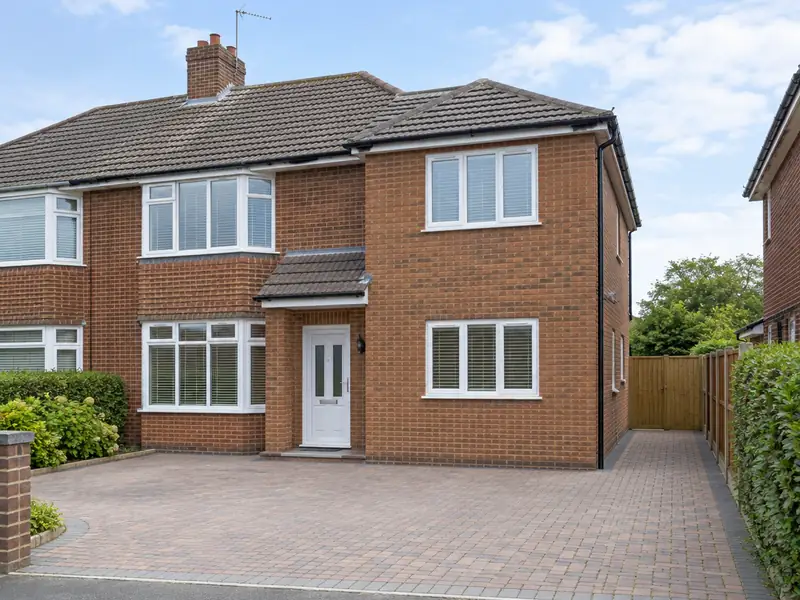
A double-storey extension adds two floors of new space to your house in one build, typically a larger kitchen or living room downstairs with an extra bedroom, bathroom or en-suite above, sharing one set of foundations and one roof.
Planning a double-storey extension for a home in Exeter means making a handful of decisions about materials, layout, finish and timing. We help you work through them at a free survey, then confirm in writing what it will cost for the options you pick. Most projects of this type need 14–22 weeks on site, and we cover every EX1, EX2, EX3 and EX4 address as well as the rest of Devon.
- Guide price
- £61,000–£122,000 inc VAT
- Time on site
- 14–22 weeks on site
- Postcodes
- EX1, EX2, EX3 and EX4
- Planning rules
- England
- Local area
- Devon
- Survey
- Free, with a written quote
Double-storey extensions prices in Exeter
To help you plan, we show what a double-storey extension typically costs in Exeter instead of holding figures back for a sales call. The range is £61,000–£122,000 with VAT, using rates in the South West that are about 2% above the national guide. A free survey then fixes your actual price.
| Type of job | What it usually involves | Guide in Exeter |
|---|---|---|
| Small (15–20m² total) | A compact rear or side extension adding a small room on each floor. | £41,000–£66,000 |
| Typical (30–40m² total) | A larger kitchen or living room below with a double bedroom or en-suite above. | £61,000–£122,000 |
| Large (50m² plus total) | Wide or deep extensions, often with a new bathroom, steelwork and high-spec glazing. | £102,000–£184,000 |
Expect these to shape the final quote:
- Combined floor area across both storeys
- How the new roof joins the existing roof
- Bathrooms, en-suites and plumbing on the upper floor
- Foundation depth, ground conditions and drains to divert
What do you get?
- Insulated cavity walls with brick or render to match the house
- First-floor joists, stud walls and new openings upstairs
- Roof structure tied into the existing roof, tiled to match
- Scaffolding for the full build, erected and inspected
- Windows, external doors, plastering and internal doors
- Building control inspections and completion certificate
Building in Exeter
Devon is known for cob and thatch cottages, especially in mid and east Devon, alongside granite on Dartmoor and red sandstone around Exeter. Exeter and Plymouth have Georgian and Victorian terraces, Plymouth's centre was largely rebuilt after the war, and seaside towns such as Torquay and Exmouth have rendered villas and newer estates.
Mild but wet, with strong coastal winds; exposed elevations need render and pointing specified for driving rain, and cob walls must be kept dry at the base.
These patterns matter for a double-storey extension: older walls, roofs and floors in Exeter can need different materials or extra preparation compared with newer homes.
Do you need permission in Exeter?
Exeter is in England, so the planning and building rules set out below are the ones that apply. We confirm the details with the council before we quote.
In England, a two-storey rear extension can only be permitted development if it is no more than 3 m deep, at least 7 m from the rear boundary and finished to match the house. Most double-storey and all two-storey side extensions need full planning permission.
Building Regulations approval is needed, with structural calculations for beams, foundations and the roof. The Party Wall etc. Act 1996 often applies on semi-detached and terraced houses.
Rules change and every property is different, so we check the planning history and constraints for your address before we quote.
From survey to handover
Survey and measure
Book a visit and we'll come to you. The survey covers measurements, the state of what's there now and any obvious constraints, so the price that follows is based on your actual home, not an average.
Quote in writing
The quote arrives in writing, not over the phone. It covers the full scope, the finishes you've chosen, any exclusions and the payment schedule, with a fixed price tied to that specification.
Plan and prepare
Preparation matters as much as the build. We agree access, parking and working hours with you, order materials in good time, and confirm any permissions so the job isn't held up once it starts.
Finish and handover
Our trades complete a double-storey extension while your point of contact keeps you updated. When everything is finished, we clear the site, take away waste and go through the result with you before handover.
Why homeowners choose us
Questions about a double-storey extension in Exeter
Do you cover Heavitree, Exmouth and Tiverton?
Yes. As well as Exeter, we cover Heavitree, Exmouth and Tiverton and the rest of Devon. Our coverage is UK-wide, so the process is the same wherever you are: a free site survey, a quote in writing that fixes the price for the agreed scope, and one point of contact while the work is planned and carried out.
Can the new upstairs room have its own bathroom?
A new upstairs room can usually have an en-suite, provided waste pipes can reach the soil stack or a new one can be installed. Running the waste pipe to the right falls is the main design question, and a pumped system is an option where gravity will not work. We plan bathroom positions at the design stage so pipes, ventilation and insulation are built in rather than added later.
Will the extension affect my neighbours?
A double-storey extension can affect neighbours' light, outlook and privacy, which is why planning departments look closely at height, depth and window positions. Side windows facing neighbours often need obscure glass. Work near a shared wall may also need party wall notices; the Party Wall etc. Act 1996 applies in England and Wales only. We talk through these points early so the design is realistic.
How much will a double-storey extension cost in Exeter?
As a guide, expect to pay £61,000–£122,000 including VAT for a double-storey extension in Exeter. That range is adjusted for the South West, which runs about 2% above the national guide. Where your project lands depends on size, materials, access and the condition of what is already there. We confirm a fixed price in writing after a free survey of your home.
Is a double-storey extension better value than single-storey?
A double-storey extension usually gives better value per square metre than a single-storey one, because the same foundations and roof serve twice the floor area. The overall cost is higher, and planning can be harder because of the effect on neighbours. If you might want an extra bedroom later, building both floors now avoids a second round of disruption and scaffolding.
Nearby towns
Coverage for Exeter spans EX1, EX2, EX3 and EX4. Close by, Heavitree, Exmouth and Tiverton are covered too, and the rest of our UK-wide area follows the same survey-then-quote process from start to finish.