
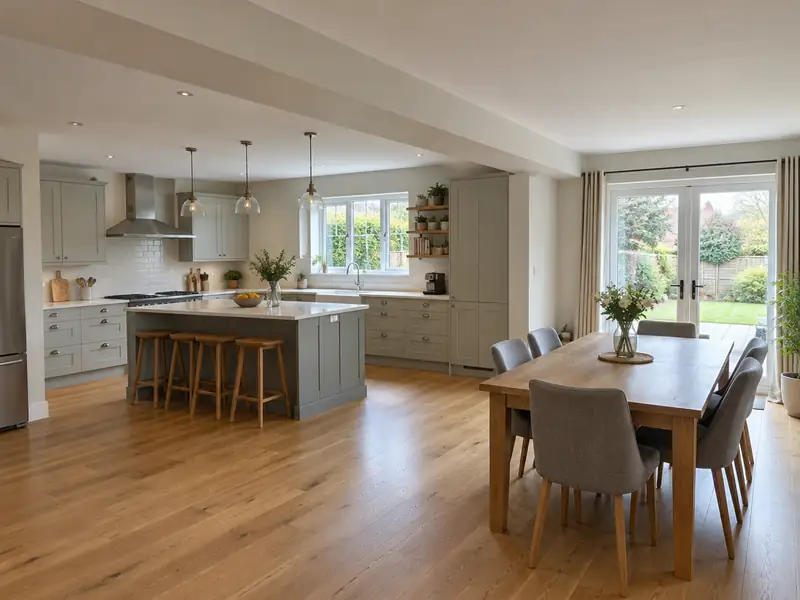
Wall removal is taking out an internal wall to open up rooms; where the wall is load-bearing, a steel beam sized by a structural engineer is installed on padstones to carry the weight above, with the work approved by building control.
We arrange removing a wall for homeowners in Exeter and the wider Devon. The job is planned, priced and managed by us and carried out by tradespeople engaged under our contract, so there is one agreement and one contact. On a typical home the work takes 1–3 weeks including making good, and guide pricing in the South West is £3,100–£8,200, VAT included.
- Guide price
- £3,100–£8,200 inc VAT
- Time on site
- 1–3 weeks including making good
- Postcodes
- EX1, EX2, EX3 and EX4
- Planning rules
- England
- Local area
- Devon
- Survey
- Free, with a written quote
Wall removal and steel beams prices in Exeter
To help you plan, we show what removing a wall typically costs in Exeter instead of holding figures back for a sales call. The range is £3,100–£8,200 with VAT, using rates in the South West that are about 2% above the national guide. A free survey then fixes your actual price.
| Type of job | What it usually involves | Guide in Exeter |
|---|---|---|
| Non-load-bearing wall | Removing a stud or block partition and making good walls, ceiling and floor. | £800–£2,000 |
| Load-bearing wall up to 4m | A typical kitchen-diner knock-through with one steel beam, calculations and building control. | £3,100–£8,200 |
| Wide or complex opening | Openings over 4m, posts, flush beams or chimney breast removal. | £8,200–£16,500 |
The main things that change the figure:
- Beam size, posts, flush fixing and padstone details
- Services in the wall that need rerouting
- Floor and ceiling repairs where the wall stood
- Engineer, building control and any party wall costs
What does the job include in Exeter?
- Survey to establish what the wall supports and where loads go
- Structural engineer's calculations and beam specification
- Building control application and inspections
- Temporary propping and dust protection during the work
- Steel beam installed on padstones and packed tight
- Plastering, flooring repairs and making good ready for decorating
Building in Exeter
Devon is known for cob and thatch cottages, especially in mid and east Devon, alongside granite on Dartmoor and red sandstone around Exeter. Exeter and Plymouth have Georgian and Victorian terraces, Plymouth's centre was largely rebuilt after the war, and seaside towns such as Torquay and Exmouth have rendered villas and newer estates.
Mild but wet, with strong coastal winds; exposed elevations need render and pointing specified for driving rain, and cob walls must be kept dry at the base.
For removing a wall in Exeter, this means checking things like wall construction, roof structure and existing services before we put a figure on paper.
Do you need permission in Exeter?
Because Exeter falls under England's rules, the guidance below is the version relevant to you. Before sending a price, we check your property's position with the council.
Removing an internal wall does not need planning permission in England unless the house is listed.
If the wall is load-bearing, Building Regulations approval is needed, with a structural engineer’s calculations for the steel beam and padstones. Where the beam bears on a shared wall, the Party Wall etc. Act 1996 applies.
Rules change and every property is different, so we check the planning history and constraints for your address before we quote.
How does the job run?
Free site survey
First, someone visits your home in Exeter to see the space, take measurements and note anything that could affect the work, such as access or the condition of what is there. There is no charge for this visit.
Your fixed price
We turn the survey notes into a written quote. The price is fixed for the specification we agree, and the document sets out materials, scope and payment stages in plain language.
Booking the work
Next comes planning the work itself. We set a start date that suits you, line up the right trades, and make sure any approvals for removing a wall are in place before the first day on site.
Build and hand over
During the work we protect the areas around it and tidy up at the end of each day. Once complete, we check the finish, remove our materials and hand over paperwork such as building control sign-off where it applies.
Why homeowners choose us
Questions about removing a wall in Exeter
How long will removing a wall take?
On a typical home, allow 1–3 weeks including making good. Larger projects, older buildings and extra work found once things are opened up can extend that, while simpler jobs may be shorter. Your quote includes an estimate of time on site, and your point of contact keeps you updated on the programme as the work progresses.
Does the Party Wall Act apply to wall removal?
The Party Wall etc. Act 1996 applies in England and Wales only. Removing an internal wall usually does not involve it, but if the beam bears into a wall shared with a neighbour, as is common in terraced and semi-detached houses, you must serve notice first. Scotland and Northern Ireland have no equivalent Act. We tell you during the survey whether notices are needed.
How much will removing a wall cost in Exeter?
As a guide, expect to pay £3,100–£8,200 including VAT for removing a wall in Exeter. That range is adjusted for the South West, which runs about 2% above the national guide. Where your project lands depends on size, materials, access and the condition of what is already there. We confirm a fixed price in writing after a free survey of your home.
How much does it cost to remove a load-bearing wall?
Removing a load-bearing wall of about 3–4m with a steel beam typically costs £3,100–£8,200, including structural calculations, building control and making good. A non-load-bearing partition costs much less. As a rough guide, allow around £600–£1,600 per metre of opening plus fixed costs for the engineer, approvals and propping. Wider openings, posts and flush beams cost more. We confirm a fixed price after the survey.
How do I know if a wall is load-bearing?
A wall is load-bearing if it carries weight from above, such as floor joists, another wall, the roof or a chimney. Clues include joists running across the wall rather than alongside it, and walls lined up with walls on the floor above. Brick or block walls are often structural but not always. We check from above and below during the survey, and an engineer confirms the design.
Nearby towns
Exeter and its EX1, EX2, EX3 and EX4 postcodes are part of our coverage. Homeowners in Heavitree, Exmouth and Tiverton can also book a free survey with us and receive a written price for their job.