
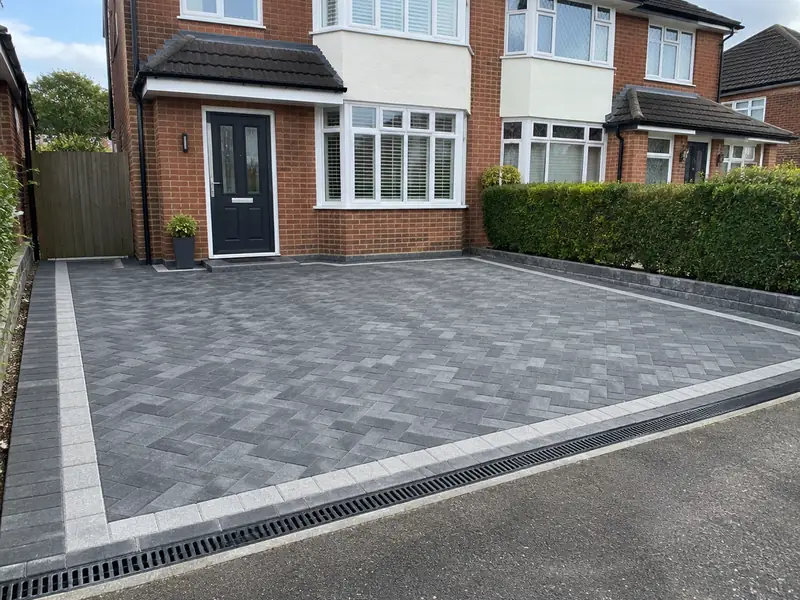
A new driveway is a hard-wearing surface for parking, such as block paving, resin bound gravel, tarmac or gravel, laid on an excavated and compacted sub-base with edging and drainage designed to carry vehicle loads and handle rainwater.
Thinking about a new driveway in Bridgend? We take charge of the whole project, co-ordinating every trade involved, and one person keeps you updated. Guide prices for Wales sit at £3,700–£8,300 including VAT, and a typical job takes 3–7 days on site. Your own figure depends on what the survey finds and the specification you settle on.
- Guide price
- £3,700–£8,300 inc VAT
- Time on site
- 3–7 days on site
- Postcodes
- CF31
- Planning rules
- Wales
- Local area
- Mid Glamorgan
- Survey
- Free, with a written quote
Driveways prices in Bridgend
What should you budget for a new driveway in Bridgend? Use the figures below as a starting point. Prices in Wales sit about 8% below the national guide, so the range here is £3,700–£8,300 including VAT. Your fixed price comes in writing once we've surveyed the property, at no charge.
| Type of job | What it usually involves | Guide in Bridgend |
|---|---|---|
| Gravel or tarmac | A typical 40–50m² drive in gravel on a grid, or tarmac with block edging. | £1,850–£4,600 |
| Block paving or resin bound | A typical 40–50m² drive with sub-base, edging and drainage. | £3,700–£8,300 |
| Large or premium driveway | Larger drives, natural stone, walls, steps or a new dropped kerb. | £7,400–£14,500 |
What moves the price up or down:
- Surface: gravel, tarmac, block paving, resin or stone
- Drainage, soakaways and changes in level
- Edging, steps, walls and manhole adjustments
- Access for machinery and removal of spoil
Scope of the work
- Survey of levels, drainage, manholes and access
- Weed membrane and compacted MOT Type 1 sub-base
- Edging kerbs or restraints to hold the surface in place
- Drainage channels or soakaway where needed
- New surface laid, compacted and finished
- Site cleared and waste removed
Local housing and a new driveway
The Rhondda, Cynon and Merthyr valleys are lined with stone terraces built for mining families, stepped along steep hillsides. Pontypridd, Caerphilly and Merthyr Tydfil have Victorian centres, and Bridgend has grown with large modern estates alongside interwar and post-war housing.
Valley terraces commonly need repointing, roof repairs, rendering and window replacement, and loft conversions can add useful space. Newer estate homes often take garage conversions, porches and landscaping.
With that background in mind, here is how we typically handle a new driveway for homes in Bridgend, from the first visit to the finished result.
Permissions for a new driveway in Bridgend
Homes in Bridgend come under the regulations for Wales, summarised below. We don't rely on general rules alone: we confirm the position for your address with the council before a quote goes out.
In Wales, hard surfaces in front gardens need to be permeable or drain within the property to avoid planning permission. Larger schemes can also need approval from the council’s SuDS Approving Body (SAB), and a dropped kerb needs highways consent.
Building Regulations do not usually apply, but drainage design matters.
Rules change and every property is different, so we check the planning history and constraints for your address before we quote.
From survey to handover
We look at the job
It starts with a survey at the property, free of charge. We check condition, access and services, ask how you want the finished result to look, and answer any questions you have about a new driveway.
Quote in writing
We turn the survey notes into a written quote. The price is fixed for the specification we agree, and the document sets out materials, scope and payment stages in plain language.
Booking the work
Next comes planning the work itself. We set a start date that suits you, line up the right trades, and make sure any approvals for a new driveway are in place before the first day on site.
The work itself
Work goes ahead as scheduled and you deal with one contact throughout. When the last trade leaves, we clear and clean the site, talk you through what has been done and pass on any certificates and care instructions.
How we work
Driveways in Bridgend: questions
What is a sub-base and why does it matter?
The sub-base is the layer of crushed, compacted stone beneath the driveway surface that spreads the weight of vehicles into the ground. Most driveway failures, such as sinking, rutting and loose blocks, come from a sub-base that is too thin or poorly compacted. We excavate to the right depth for your soil and compact the sub-base in layers before laying the surface.
How long will a new driveway take?
On a typical home, allow 3–7 days on site. Larger projects, older buildings and extra work found once things are opened up can extend that, while simpler jobs may be shorter. Your quote includes an estimate of time on site, and your point of contact keeps you updated on the programme as the work progresses.
Which driveway surface is easiest to maintain?
Resin bound gravel is one of the easiest surfaces to maintain, because it is smooth, porous and resists weeds, needing only an occasional sweep and wash. Block paving needs re-sanding joints and occasional weed control. Tarmac needs little upkeep but can soften in heat. Gravel needs raking and topping up. We explain the upkeep of each surface before you choose.
Do I need planning permission for a driveway?
Whether a driveway needs planning permission depends on its size, surface and drainage, your home's location, whether it is listed or in a conservation area, and which UK nation you are in. In England, a new or replacement front driveway over 5m² needs permission unless it uses a permeable surface or drains to a lawn or border. We check the rules and design to suit.
Do you cover Porthcawl, Llantwit Major and Maesteg?
Yes. As well as Bridgend, we cover Porthcawl, Llantwit Major and Maesteg and the rest of Mid Glamorgan. Our coverage is UK-wide, so the process is the same wherever you are: a free site survey, a quote in writing that fixes the price for the agreed scope, and one point of contact while the work is planned and carried out.
Near Bridgend
Whether you're in the centre of Bridgend or on its outskirts, CF31 addresses are covered. We extend the same service, and the same fixed-price approach, to Porthcawl, Llantwit Major and Maesteg.