
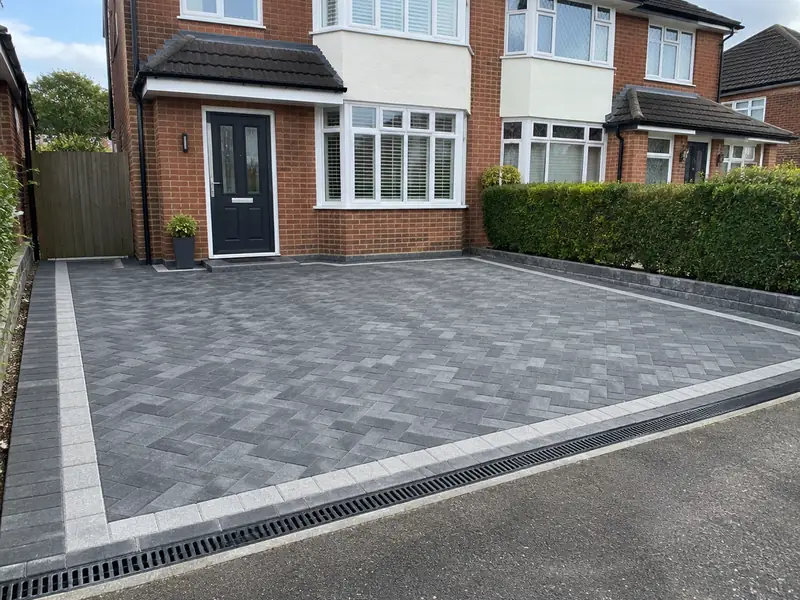
A new driveway is a hard-wearing surface for parking, such as block paving, resin bound gravel, tarmac or gravel, laid on an excavated and compacted sub-base with edging and drainage designed to carry vehicle loads and handle rainwater.
We arrange a new driveway for homeowners in Great Yarmouth and the wider Norfolk. The job is planned, priced and managed by us and carried out by tradespeople engaged under our contract, so there is one agreement and one contact. On a typical home the work takes 3–7 days on site, and guide pricing in the East of England is £4,200–£9,400, VAT included.
- Guide price
- £4,200–£9,400 inc VAT
- Time on site
- 3–7 days on site
- Postcodes
- NR29, NR30 and NR31
- Planning rules
- England
- Local area
- Norfolk
- Survey
- Free, with a written quote
How much does a new driveway cost in Great Yarmouth?
Every figure below is a guide for a new driveway in Great Yarmouth, inclusive of VAT. Regional pricing for the East of England works out about 5% above the national guide, and the overall span is £4,200–£9,400. The survey costs you nothing, and after it we commit to a firm price for your specification in writing.
| Type of job | What it usually involves | Guide in Great Yarmouth |
|---|---|---|
| Gravel or tarmac | A typical 40–50m² drive in gravel on a grid, or tarmac with block edging. | £2,100–£5,200 |
| Block paving or resin bound | A typical 40–50m² drive with sub-base, edging and drainage. | £4,200–£9,400 |
| Large or premium driveway | Larger drives, natural stone, walls, steps or a new dropped kerb. | £8,400–£17,000 |
The main things that change the figure:
- Driveway area and the depth of excavation needed
- Surface: gravel, tarmac, block paving, resin or stone
- Drainage, soakaways and changes in level
- Access for machinery and removal of spoil
What do you get?
- Survey of levels, drainage, manholes and access
- Excavation and removal of the old surface and soil
- Weed membrane and compacted MOT Type 1 sub-base
- Edging kerbs or restraints to hold the surface in place
- Manhole covers raised or replaced to new levels
- New surface laid, compacted and finished
What are homes like around Great Yarmouth?
Flint is everywhere in Norfolk, often combined with brick quoins and red or black-glazed pantile roofs. Norwich has Victorian terraces and interwar suburbs around its medieval centre, Norfolk reed thatch survives across the county, carrstone is used in the west, and coastal towns such as Great Yarmouth and Cromer have Victorian terraces and newer bungalows.
Flint walls often need lime repointing and careful repairs, and pantile roofs need matching tiles. Norwich terraces suit loft conversions and rear extensions, while coastal bungalows commonly take loft rooms, porches and new windows.
None of this holds for every street in Great Yarmouth, which is why we look at your actual house before pricing a new driveway rather than assuming from its age alone.
Do you need permission in Great Yarmouth?
Homes in Great Yarmouth come under the regulations for England, summarised below. We don't rely on general rules alone: we confirm the position for your address with the council before a quote goes out.
In England, a new or replacement front-garden surface over 5 m² needs planning permission unless it is permeable or drains to a lawn or border within your property. A new dropped kerb needs consent from the council’s highways team, and access onto a classified road may need planning permission.
Building Regulations do not usually apply to driveways, but drainage must not discharge onto the road or a neighbour’s land.
Rules change and every property is different, so we check the planning history and constraints for your address before we quote.
How does the job run?
Survey and measure
First, someone visits your home in Great Yarmouth to see the space, take measurements and note anything that could affect the work, such as access or the condition of what is there. There is no charge for this visit.
Price and scope agreed
Next you receive a written quote with a fixed price for the agreed specification. It lists what is included, what is not, and how payments are staged, so you can compare it properly.
Booking the work
We handle the paperwork side: checking whether planning permission or building control approval is needed, submitting applications where they are, and scheduling the trades and materials around your dates.
Finish and handover
The job proceeds in the order set out in the programme, with dust and debris kept under control. Finally we tidy away, inspect the work together and pass the finished project over to you with its paperwork.
Why homeowners choose us
Questions about a new driveway in Great Yarmouth
How long does it take to lay a driveway?
Laying a typical driveway takes around three to seven days, depending on size, surface and ground conditions. Excavation and sub-base usually take the first few days, then edging, drainage and the surface. Resin needs dry weather and time to cure, and you will usually need to keep cars off for a short period afterwards. We confirm timings and access arrangements with your quote.
Can you combine a new driveway with other work?
Yes. Because we manage several trades under one contract, we can plan a new driveway alongside other work on your Great Yarmouth home, such as new windows with rendering, or a kitchen refit with an extension. Combining jobs can reduce repeat set-up such as scaffolding, skips and access, and every element is listed and priced in the same written quote.
Which driveway surface is easiest to maintain?
Resin bound gravel is one of the easiest surfaces to maintain, because it is smooth, porous and resists weeds, needing only an occasional sweep and wash. Block paving needs re-sanding joints and occasional weed control. Tarmac needs little upkeep but can soften in heat. Gravel needs raking and topping up. We explain the upkeep of each surface before you choose.
How much will a new driveway cost in Great Yarmouth?
As a guide, expect to pay £4,200–£9,400 including VAT for a new driveway in Great Yarmouth. That range is adjusted for the East of England, which runs about 5% above the national guide. Where your project lands depends on size, materials, access and the condition of what is already there. We confirm a fixed price in writing after a free survey of your home.
How do you stop a driveway flooding?
A driveway stays dry when rainwater can drain away rather than pooling or running towards the house. Permeable surfaces such as resin bound gravel or permeable block paving let water soak through to the ground. Non-permeable surfaces need falls directing water to a channel drain, soakaway or garden border. We check levels and drainage during the survey and design the falls accordingly.
Near Great Yarmouth
If your address falls within NR29, NR30 and NR31, we cover it. The same goes for neighbouring Lowestoft, Norwich and Bowthorpe, which we include alongside Great Yarmouth when arranging surveys and quotes.