
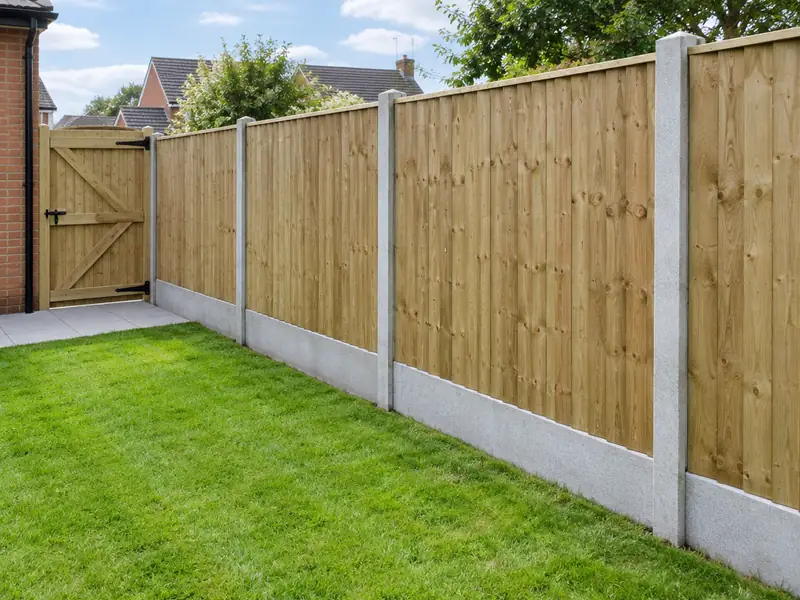
Fencing installation is setting fence posts into the ground, usually in concrete, and fixing panels or boards between them to mark a boundary, add privacy or keep children and pets in, with gates fitted where access is needed.
Every house in Carnoustie is a little different, so we never price new fencing and gates from a brochure. We look at the structure, access and existing finishes first, then put in writing a fixed figure for the scope we settle on. As a rough steer, homeowners in Scotland should budget £1,150–£2,900 including VAT, with work typically taking 1–3 days for a typical garden.
- Guide price
- £1,150–£2,900 inc VAT
- Time on site
- 1–3 days for a typical garden
- Postcodes
- DD7
- Planning rules
- Scotland
- Local area
- Angus
- Survey
- Free, with a written quote
Fencing and gates prices in Carnoustie
The costs listed here are typical for new fencing and gates around Carnoustie and include VAT. They reflect labour and material costs in Scotland, about 4% below the national guide, giving a range of £1,150–£2,900. Exact pricing depends on your home, so we only fix it once a free site survey is done.
| Type of job | What it usually involves | Guide in Carnoustie |
|---|---|---|
| Repairs or a short run | Replacing a few panels and posts, or a short run of up to about 6m. | £300–£850 |
| Typical garden boundary | About 20m of panel or closeboard fencing with concrete posts and gravel boards. | £1,150–£2,900 |
| Composite or long runs with gates | Composite or premium fencing, longer runs, or a driveway gate. | £2,900–£6,700 |
Expect these to shape the final quote:
- Total length and height of fencing
- Fence style and material: panels, closeboard or composite
- Ground conditions, slopes and removal of the old fence
- Number, size and type of gates
Scope of the work
- Measured survey of each fence run, levels and slopes
- Concrete or timber gravel boards to keep panels off the soil
- Panels or boards fixed level or stepped to follow the ground
- Post caps and capping rails where specified
- Gates hung with hinges, latches and locks
- Site cleared and waste removed
Local housing and new fencing and gates
Dundee has sandstone tenements and terraces, Victorian villas in Broughty Ferry and the West End, and extensive post-war housing. Angus towns such as Arbroath, Forfar, Montrose and Brechin use local red sandstone, and harled cottages and farmhouses are common in the countryside.
Tenement flats often need window replacement and internal refits, and houses commonly take extensions and loft conversions. Sandstone buildings need careful repointing and stone repairs, and harled cottages need breathable render.
For new fencing and gates in Carnoustie, this means checking things like wall construction, roof structure and existing services before we put a figure on paper.
Permissions for new fencing and gates in Carnoustie
England, Wales, Scotland and Northern Ireland each handle planning a little differently. Carnoustie comes under Scotland, covered below, and we raise any questions with the council before your quote is finalised.
In Scotland, gates, fences and walls up to 2 m high are usually permitted development, with a 1 m limit in front of the house or next to a road.
A building warrant is not needed for ordinary garden fences.
Rules change and every property is different, so we check the planning history and constraints for your address before we quote.
How does the job run?
Free site survey
It starts with a survey at the property, free of charge. We check condition, access and services, ask how you want the finished result to look, and answer any questions you have about new fencing and gates.
Your fixed price
We turn the survey notes into a written quote. The price is fixed for the specification we agree, and the document sets out materials, scope and payment stages in plain language.
Plan and prepare
Before anyone starts, we confirm the programme in writing, check whether consents are required and arrange deliveries. If a skip or scaffolding on the road needs a permit, we apply for it.
The work itself
The job proceeds in the order set out in the programme, with dust and debris kept under control. Finally we tidy away, inspect the work together and pass the finished project over to you with its paperwork.
What you can expect from us
Fencing and gates in Carnoustie: questions
How do you fence a sloping garden?
On a sloping garden, fence panels are usually stepped, so each panel is level and set slightly higher or lower than the one before, with the gap below filled by a gravel board. Closeboard fences can instead follow the slope, giving a smooth top line. The choice depends on how steep the slope is and the look you want. We discuss both at the survey.
Do I need planning permission in Carnoustie?
It depends on the work, the size of the project, your property type and whether the building is listed or in a conservation area. Carnoustie is in Scotland, so Scotland's rules apply. Many smaller jobs need no planning application, but some still need building control approval. We check what applies to your address before quoting.
Who owns the fence between me and my neighbour?
Fence ownership is usually shown on the title plan or deeds, sometimes with a T mark on the side of the owner. If it is unclear, it may be shared. Even on your own boundary, it is sensible to talk to neighbours before replacing a fence, agree access and confirm the line. We fit the fence on the line you confirm and can face the good side outwards if you wish.
How long does it take to replace a fence?
Replacing a typical 20m garden fence usually takes one to two days, including taking down the old fence, setting posts in concrete and fitting panels or boards. Longer runs, slopes, hard ground and gates take longer. Post concrete needs time to set before panels are fully loaded. We give you an expected timeline with your quote.
Can you combine new fencing and gates with other work?
Yes. Because we manage several trades under one contract, we can plan new fencing and gates alongside other work on your Carnoustie home, such as new windows with rendering, or a kitchen refit with an extension. Combining jobs can reduce repeat set-up such as scaffolding, skips and access, and every element is listed and priced in the same written quote.
Near Carnoustie
We survey and quote throughout Carnoustie's DD7 postcodes and in surrounding places such as Arbroath, Dundee and St Andrews. The process and pricing approach are identical in each of them.