
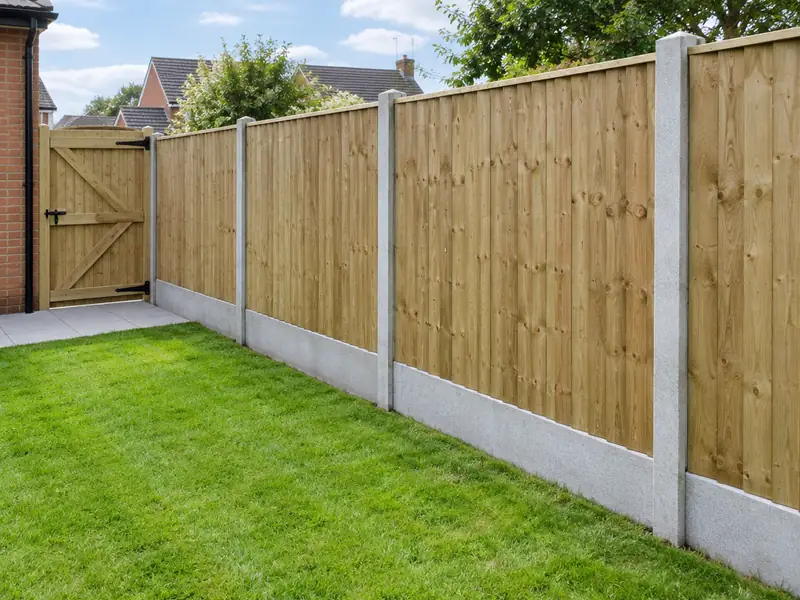
Fencing installation is setting fence posts into the ground, usually in concrete, and fixing panels or boards between them to mark a boundary, add privacy or keep children and pets in, with gates fitted where access is needed.
Every house in March is a little different, so we never price new fencing and gates from a brochure. We look at the structure, access and existing finishes first, then put in writing a fixed figure for the scope we settle on. As a rough steer, homeowners in the East of England should budget £1,250–£3,200 including VAT, with work typically taking 1–3 days for a typical garden.
- Guide price
- £1,250–£3,200 inc VAT
- Time on site
- 1–3 days for a typical garden
- Postcodes
- PE15
- Planning rules
- England
- Local area
- Cambridgeshire
- Survey
- Free, with a written quote
How much do new fencing and gates cost in March?
Use the table to gauge the cost of new fencing and gates in March before we visit. Figures include VAT and are scaled for the East of England, coming out about 5% above the national guide, which gives £1,250–£3,200 overall. After a free survey, you receive a fixed written price.
| Type of job | What it usually involves | Guide in March |
|---|---|---|
| Repairs or a short run | Replacing a few panels and posts, or a short run of up to about 6m. | £300–£950 |
| Typical garden boundary | About 20m of panel or closeboard fencing with concrete posts and gravel boards. | £1,250–£3,200 |
| Composite or long runs with gates | Composite or premium fencing, longer runs, or a driveway gate. | £3,200–£7,400 |
Your price depends mostly on:
- Fence style and material: panels, closeboard or composite
- Post type: concrete, timber or aluminium
- Ground conditions, slopes and removal of the old fence
- Number, size and type of gates
Scope of the work
- Measured survey of each fence run, levels and slopes
- Removal and disposal of the old fence and posts
- Concrete or timber posts set in concrete
- Panels or boards fixed level or stepped to follow the ground
- Gates hung with hinges, latches and locks
- Site cleared and waste removed
What are homes like around March?
Cambridge has many Victorian terraces in pale gault brick, with Edwardian villas and modern estates around the city. Peterborough expanded as a new town from the 1970s, adding large planned estates, while Ely, Huntingdon, St Neots and the Fenland market towns keep Georgian and Victorian centres. Limestone appears in villages near the Northamptonshire border.
This is one of the driest parts of the UK, but open fenland is windy and peat or clay ground can shrink, affecting foundations.
With that background in mind, here is how we typically handle new fencing and gates for homes in March, from the first visit to the finished result.
Planning and building rules in March
Each UK nation sets its own consent rules, and March is in England. What follows is a plain summary; we check the specifics for your property with the council before pricing anything.
In England, fences, walls and gates up to 2 m high are usually permitted development, or up to 1 m where they are next to a road used by vehicles or its footpath. Listed buildings, conservation areas and estates with planning conditions can be stricter.
Building Regulations do not apply to ordinary garden fences, but boundary lines should be agreed with your neighbour first.
Rules change and every property is different, so we check the planning history and constraints for your address before we quote.
How does the job run?
Free site survey
A free survey comes first. It gives us what we need to price new fencing and gates properly, including dimensions, existing materials and access for deliveries, and gives you the chance to ask anything you like.
Quote in writing
We put everything into a written, fixed-price quote: the specification, what's excluded, staged payments and the expected time on site. Take whatever time you need to decide; there's no pressure to commit.
Getting ready
We handle the paperwork side: checking whether planning permission or building control approval is needed, submitting applications where they are, and scheduling the trades and materials around your dates.
Build and hand over
On site, the agreed plan is followed and any change is put in writing first. At completion we do a final clean, go through the snagging list with you and leave you with the relevant documents.
Why homeowners choose us
Questions about new fencing and gates in March
Which postcodes in March do you cover?
We cover PE15, along with the rest of Cambridgeshire. If your postcode is not listed, get in touch anyway: our coverage is UK-wide, and we can usually arrange a survey wherever you live. Enter your postcode in the guide-price tool or contact form and we will confirm.
Do you cover Wisbech, Ely and Peterborough?
Yes. As well as March, we cover Wisbech, Ely and Peterborough and the rest of Cambridgeshire. Our coverage is UK-wide, so the process is the same wherever you are: a free site survey, a quote in writing that fixes the price for the agreed scope, and one point of contact while the work is planned and carried out.
How much does a new fence cost?
About 20m of new panel or closeboard fencing with concrete posts costs £1,250–£3,200, including removal of the old fence. As a guide, allow roughly £55–£130 per metre plus a small fixed cost for removal and waste. Lap panels sit at the lower end, while closeboard, slatted and composite fencing cost more. Gates, slopes and hard ground add to the price. We confirm a fixed price after measuring.
Are concrete posts better than timber?
Concrete posts do not rot and are the most durable choice for panel fences, especially on exposed sites. They are heavier and more utilitarian in appearance. Timber posts look more natural and suit closeboard and featheredge fences, but they eventually rot at ground level, even when treated. Aluminium posts suit composite systems. We recommend posts based on your fence style and exposure.
How high can my fence be?
Fence height limits depend on planning rules, your home's location, whether it is listed or in a conservation area, and which UK nation you live in. In England, fences up to 2m high are usually permitted development, reduced to 1m next to a road used by vehicles. Higher fences need planning permission. We check the rules for your boundary before quoting.
Near March
March and its PE15 postcodes are part of our coverage. Homeowners in Wisbech, Ely and Peterborough can also book a free survey with us and receive a written price for their job.