
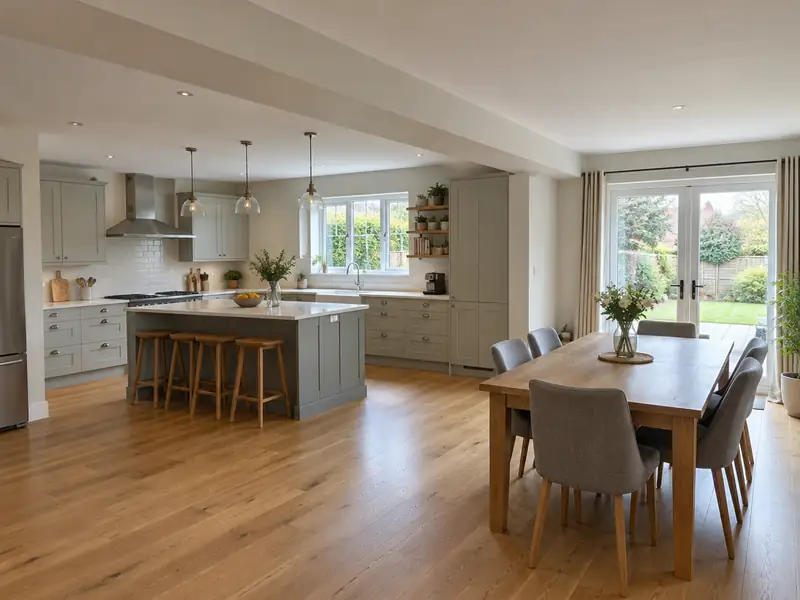
Wall removal is taking out an internal wall to open up rooms; where the wall is load-bearing, a steel beam sized by a structural engineer is installed on padstones to carry the weight above, with the work approved by building control.
Whatever prompted you to look into removing a wall, whether wear and tear, a growing family or plans to move, we can survey your March home and give you a price in writing. Homes in the East of England typically come in at £3,200–£8,400, VAT included, for this kind of work. We also cover Wisbech, Ely and Peterborough, and the same steps apply wherever you are in Cambridgeshire.
- Guide price
- £3,200–£8,400 inc VAT
- Time on site
- 1–3 weeks including making good
- Postcodes
- PE15
- Planning rules
- England
- Local area
- Cambridgeshire
- Survey
- Free, with a written quote
Wall removal and steel beams prices in March
The costs listed here are typical for removing a wall around March and include VAT. They reflect labour and material costs in the East of England, about 5% above the national guide, giving a range of £3,200–£8,400. Exact pricing depends on your home, so we only fix it once a free site survey is done.
| Type of job | What it usually involves | Guide in March |
|---|---|---|
| Non-load-bearing wall | Removing a stud or block partition and making good walls, ceiling and floor. | £850–£2,100 |
| Load-bearing wall up to 4m | A typical kitchen-diner knock-through with one steel beam, calculations and building control. | £3,200–£8,400 |
| Wide or complex opening | Openings over 4m, posts, flush beams or chimney breast removal. | £8,400–£17,000 |
What moves the price up or down:
- Opening width and the load the wall carries
- Beam size, posts, flush fixing and padstone details
- Services in the wall that need rerouting
- Engineer, building control and any party wall costs
Scope of the work
- Survey to establish what the wall supports and where loads go
- Building control application and inspections
- Temporary propping and dust protection during the work
- Steel beam installed on padstones and packed tight
- Beam boarded or treated for fire protection
- Plastering, flooring repairs and making good ready for decorating
What are homes like around March?
Cambridge has many Victorian terraces in pale gault brick, with Edwardian villas and modern estates around the city. Peterborough expanded as a new town from the 1970s, adding large planned estates, while Ely, Huntingdon, St Neots and the Fenland market towns keep Georgian and Victorian centres. Limestone appears in villages near the Northamptonshire border.
This is one of the driest parts of the UK, but open fenland is windy and peat or clay ground can shrink, affecting foundations.
So when we survey a March property for removing a wall, the first step is working out how it was built and what has been changed since.
Planning and building rules in March
March is in England, so the planning and building rules set out below are the ones that apply. We confirm the details with the council before we quote.
Removing an internal wall does not need planning permission in England unless the house is listed.
If the wall is load-bearing, Building Regulations approval is needed, with a structural engineer’s calculations for the steel beam and padstones. Where the beam bears on a shared wall, the Party Wall etc. Act 1996 applies.
Rules change and every property is different, so we check the planning history and constraints for your address before we quote.
From survey to handover
Survey and measure
Book a visit and we'll come to you. The survey covers measurements, the state of what's there now and any obvious constraints, so the price that follows is based on your actual home, not an average.
Written quote
We turn the survey notes into a written quote. The price is fixed for the specification we agree, and the document sets out materials, scope and payment stages in plain language.
Dates and permissions
Once you accept, we agree start dates, order materials and deal with any planning, building control or neighbour notices the job needs. You'll know who is coming and when before work begins.
Finish and handover
During the work we protect the areas around it and tidy up at the end of each day. Once complete, we check the finish, remove our materials and hand over paperwork such as building control sign-off where it applies.
What you can expect from us
Frequently asked questions
Can I have a beam that does not show?
A flush or hidden beam sits within the depth of the ceiling so there is no visible downstand, giving a clean, open look. It is possible where the floor joists can be connected into the side of the beam, which takes more steel and labour. It costs more than a standard beam below the ceiling. The engineer confirms whether it suits your house.
What happens to pipes and cables in the wall?
Pipes, cables and radiators in a wall being removed must be rerouted before demolition. Electrical work is done and certified by a qualified electrician, and pipework is diverted by a plumber, usually through the ceiling void or floor. We identify services during the survey and include rerouting in the quote, so there are no surprises once work starts.
How much does it cost to remove a load-bearing wall?
Removing a load-bearing wall of about 3–4m with a steel beam typically costs £3,200–£8,400, including structural calculations, building control and making good. A non-load-bearing partition costs much less. As a rough guide, allow around £600–£1,600 per metre of opening plus fixed costs for the engineer, approvals and propping. Wider openings, posts and flush beams cost more. We confirm a fixed price after the survey.
Can you combine removing a wall with other work?
Yes. Because we manage several trades under one contract, we can plan removing a wall alongside other work on your March home, such as new windows with rendering, or a kitchen refit with an extension. Combining jobs can reduce repeat set-up such as scaffolding, skips and access, and every element is listed and priced in the same written quote.
Can I stay at home during the work?
In most cases, yes. Most people can live at home throughout, and we plan the work to keep disruption down by protecting floors, agreeing working hours and keeping access routes clear. Bigger jobs affecting kitchens, bathrooms or heating may mean a short spell with reduced facilities, and we talk this through with you at the survey.
Near March
We cover every part of March, including PE15, and nearby Wisbech, Ely and Peterborough. Wherever you are within that patch, the survey is free and the quote comes to you in writing.