
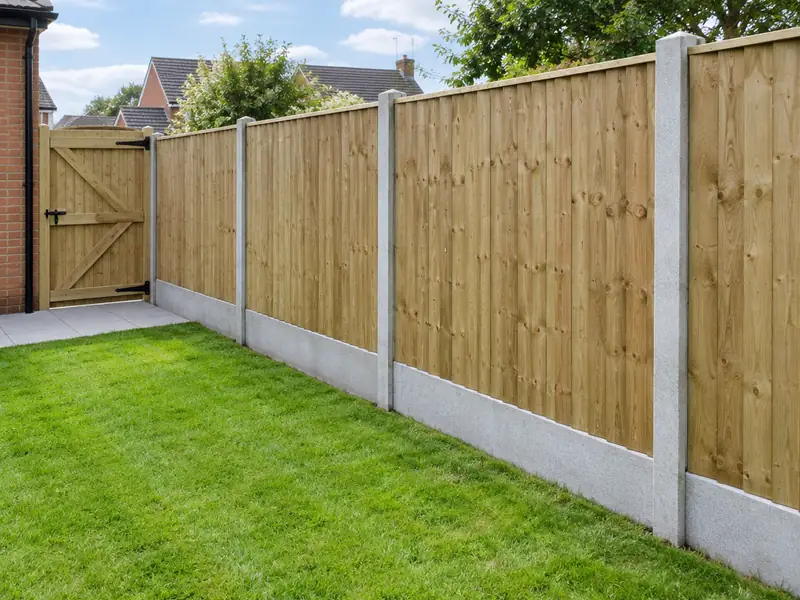
Fencing installation is setting fence posts into the ground, usually in concrete, and fixing panels or boards between them to mark a boundary, add privacy or keep children and pets in, with gates fitted where access is needed.
For a homeowner in Belfast, planning new fencing and gates tends to begin with two questions: what will it cost, and how disruptive will it be? Our guide range is £1,050–£2,600 including VAT, and a typical job runs to 1–3 days for a typical garden. Both numbers firm up once we have seen the property, measured up and agreed exactly what is included.
- Guide price
- £1,050–£2,600 inc VAT
- Time on site
- 1–3 days for a typical garden
- Postcodes
- BT1, BT2, BT6, BT7 and BT12
- Planning rules
- Northern Ireland
- Local area
- County Antrim
- Survey
- Free, with a written quote
Fencing and gates prices in Belfast
These are guide costs, not quotes. For new fencing and gates in Belfast the range is £1,050–£2,600, VAT included, reflecting prices in Northern Ireland that are about 14% below the national guide. Once we have visited for a free survey, you get a firm figure for the scope you approve.
| Type of job | What it usually involves | Guide in Belfast |
|---|---|---|
| Repairs or a short run | Replacing a few panels and posts, or a short run of up to about 6m. | £250–£750 |
| Typical garden boundary | About 20m of panel or closeboard fencing with concrete posts and gravel boards. | £1,050–£2,600 |
| Composite or long runs with gates | Composite or premium fencing, longer runs, or a driveway gate. | £2,600–£6,000 |
Your price depends mostly on:
- Fence style and material: panels, closeboard or composite
- Post type: concrete, timber or aluminium
- Ground conditions, slopes and removal of the old fence
- Number, size and type of gates
What do you get?
- Measured survey of each fence run, levels and slopes
- Concrete or timber posts set in concrete
- Concrete or timber gravel boards to keep panels off the soil
- Panels or boards fixed level or stepped to follow the ground
- Post caps and capping rails where specified
- Gates hung with hinges, latches and locks
What are homes like around Belfast?
Belfast has long rows of red-brick Victorian terraces, Edwardian villas in the north and south of the city and large post-war estates, while towns such as Ballymena, Antrim, Larne and Carrickfergus mix terraces, semis and newer developments. Dark basalt appears in older rural buildings, and pebbledash or roughcast is a very common finish.
The north coast and glens are exposed to strong winds, salt and frequent rain, which affects render, roofline and outdoor work.
Knowing the typical building types in County Antrim helps, but a survey of your own home in Belfast is what decides the right approach to new fencing and gates.
Permissions for new fencing and gates in Belfast
Homes in Belfast come under the regulations for Northern Ireland, summarised below. We don't rely on general rules alone: we confirm the position for your address with the council before a quote goes out.
In Northern Ireland, fences, walls and gates have similar height limits under permitted development, lower next to a road.
Building control approval is not needed for ordinary fences.
Rules change and every property is different, so we check the planning history and constraints for your address before we quote.
From survey to handover
A visit to your home
It starts with a survey at the property, free of charge. We check condition, access and services, ask how you want the finished result to look, and answer any questions you have about new fencing and gates.
Quote in writing
Next you receive a written quote with a fixed price for the agreed specification. It lists what is included, what is not, and how payments are staged, so you can compare it properly.
Booking the work
Next comes planning the work itself. We set a start date that suits you, line up the right trades, and make sure any approvals for new fencing and gates are in place before the first day on site.
Finish and handover
The work is carried out to the agreed specification, with floors and furniture protected and the site kept tidy. At the end we clean up, walk through the finished job with you and hand over any certificates.
What you can expect from us
Common questions
Can I stay at home during the work?
In most cases, yes. Most people can live at home throughout, and we plan the work to keep disruption down by protecting floors, agreeing working hours and keeping access routes clear. Bigger jobs affecting kitchens, bathrooms or heating may mean a short spell with reduced facilities, and we talk this through with you at the survey.
Do I need planning permission in Belfast?
It depends on the work, the size of the project, your property type and whether the building is listed or in a conservation area. Belfast is in Northern Ireland, so Northern Ireland's rules apply. Many smaller jobs need no planning application, but some still need building control approval. We check what applies to your address before quoting.
How long does it take to replace a fence?
Replacing a typical 20m garden fence usually takes one to two days, including taking down the old fence, setting posts in concrete and fitting panels or boards. Longer runs, slopes, hard ground and gates take longer. Post concrete needs time to set before panels are fully loaded. We give you an expected timeline with your quote.
How high can my fence be?
Fence height limits depend on planning rules, your home's location, whether it is listed or in a conservation area, and which UK nation you live in. In England, fences up to 2m high are usually permitted development, reduced to 1m next to a road used by vehicles. Higher fences need planning permission. We check the rules for your boundary before quoting.
How do you fence a sloping garden?
On a sloping garden, fence panels are usually stepped, so each panel is level and set slightly higher or lower than the one before, with the gap below filled by a gravel board. Closeboard fences can instead follow the slope, giving a smooth top line. The choice depends on how steep the slope is and the look you want. We discuss both at the survey.
Also covering areas around Belfast
Live in Belfast? Our coverage takes in the BT1, BT2, BT6 and BT7 postcode areas and reaches out to Castlereagh, Newtownabbey and Lisburn, so homes on the outskirts and in the next town along are included.