
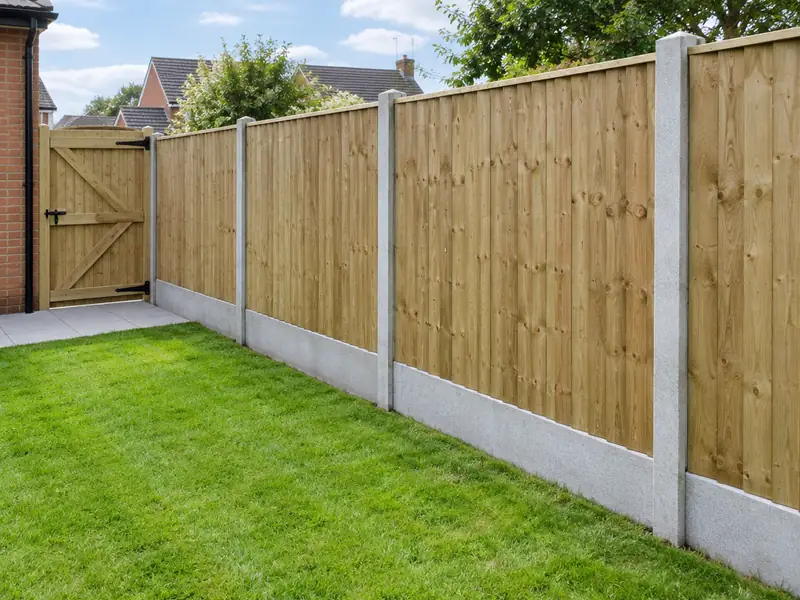
Fencing installation is setting fence posts into the ground, usually in concrete, and fixing panels or boards between them to mark a boundary, add privacy or keep children and pets in, with gates fitted where access is needed.
Whatever type of house you own in Harwich, we start by looking at how new fencing and gates would fit it rather than offering a standard package. We cover CO12 and neighbouring places such as Felixstowe, Ipswich and Clacton-on-Sea. One named person looks after you from survey to handover, and nothing is booked until you hold our figure in writing, fixed for the work described.
- Guide price
- £1,250–£3,200 inc VAT
- Time on site
- 1–3 days for a typical garden
- Postcodes
- CO12
- Planning rules
- England
- Local area
- Essex
- Survey
- Free, with a written quote
How much do new fencing and gates cost in Harwich?
To help you plan, we show what new fencing and gates typically costs in Harwich instead of holding figures back for a sales call. The range is £1,250–£3,200 with VAT, using rates in the East of England that are about 5% above the national guide. A free survey then fixes your actual price.
| Type of job | What it usually involves | Guide in Harwich |
|---|---|---|
| Repairs or a short run | Replacing a few panels and posts, or a short run of up to about 6m. | £300–£950 |
| Typical garden boundary | About 20m of panel or closeboard fencing with concrete posts and gravel boards. | £1,250–£3,200 |
| Composite or long runs with gates | Composite or premium fencing, longer runs, or a driveway gate. | £3,200–£7,400 |
The main things that change the figure:
- Total length and height of fencing
- Post type: concrete, timber or aluminium
- Ground conditions, slopes and removal of the old fence
- Number, size and type of gates
What do you get?
- Measured survey of each fence run, levels and slopes
- Removal and disposal of the old fence and posts
- Concrete or timber gravel boards to keep panels off the soil
- Panels or boards fixed level or stepped to follow the ground
- Gates hung with hinges, latches and locks
- Site cleared and waste removed
What are homes like around Harwich?
Essex ranges from timber-framed and weatherboarded cottages in the north, some with decorative pargeting, to Victorian terraces in Colchester, Chelmsford and Southend. Basildon and Harlow were built as post-war new towns, much of the south-east has interwar suburbs and bungalows, and large new estates continue to appear around Chelmsford and Braintree.
Terraces and semis commonly suit loft conversions and rear extensions, and many bungalows can take a loft room. New-town homes often need cladding, window and roofline renewal, while timber-framed cottages call for lime plaster and repairs that respect the original frame.
In Harwich, as elsewhere in Essex, we take the building's age and construction into account before recommending anything, because both can change what is involved in new fencing and gates.
Permissions for new fencing and gates in Harwich
Which rules apply depends on where you live. For Harwich, the answer is England, and the points below reflect that; we verify them with the council before quoting.
In England, fences, walls and gates up to 2 m high are usually permitted development, or up to 1 m where they are next to a road used by vehicles or its footpath. Listed buildings, conservation areas and estates with planning conditions can be stricter.
Building Regulations do not apply to ordinary garden fences, but boundary lines should be agreed with your neighbour first.
Rules change and every property is different, so we check the planning history and constraints for your address before we quote.
From survey to handover
A visit to your home
First, someone visits your home in Harwich to see the space, take measurements and note anything that could affect the work, such as access or the condition of what is there. There is no charge for this visit.
Quote in writing
You get the price in writing, itemised so you can see where the money goes. As long as the specification stays the same, that is the price you pay for new fencing and gates.
Getting ready
Preparation matters as much as the build. We agree access, parking and working hours with you, order materials in good time, and confirm any permissions so the job isn't held up once it starts.
Finish and handover
Our trades complete new fencing and gates while your point of contact keeps you updated. When everything is finished, we clear the site, take away waste and go through the result with you before handover.
Why homeowners choose us
Common questions
How long does it take to replace a fence?
Replacing a typical 20m garden fence usually takes one to two days, including taking down the old fence, setting posts in concrete and fitting panels or boards. Longer runs, slopes, hard ground and gates take longer. Post concrete needs time to set before panels are fully loaded. We give you an expected timeline with your quote.
Can I stay at home during the work?
In most cases, yes. Most people can live at home throughout, and we plan the work to keep disruption down by protecting floors, agreeing working hours and keeping access routes clear. Bigger jobs affecting kitchens, bathrooms or heating may mean a short spell with reduced facilities, and we talk this through with you at the survey.
Do I need planning permission in Harwich?
It depends on the work, the size of the project, your property type and whether the building is listed or in a conservation area. Harwich is in England, so England's rules apply. Many smaller jobs need no planning application, but some still need building control approval. We check what applies to your address before quoting.
Are concrete posts better than timber?
Concrete posts do not rot and are the most durable choice for panel fences, especially on exposed sites. They are heavier and more utilitarian in appearance. Timber posts look more natural and suit closeboard and featheredge fences, but they eventually rot at ground level, even when treated. Aluminium posts suit composite systems. We recommend posts based on your fence style and exposure.
How do you fence a sloping garden?
On a sloping garden, fence panels are usually stepped, so each panel is level and set slightly higher or lower than the one before, with the gap below filled by a gravel board. Closeboard fences can instead follow the slope, giving a smooth top line. The choice depends on how steep the slope is and the look you want. We discuss both at the survey.
Also covering areas around Harwich
We welcome enquiries from all CO12 postcodes in Harwich, plus Felixstowe, Ipswich and Clacton-on-Sea. Each one gets the same survey at no charge and a written price fixed for the work described.