
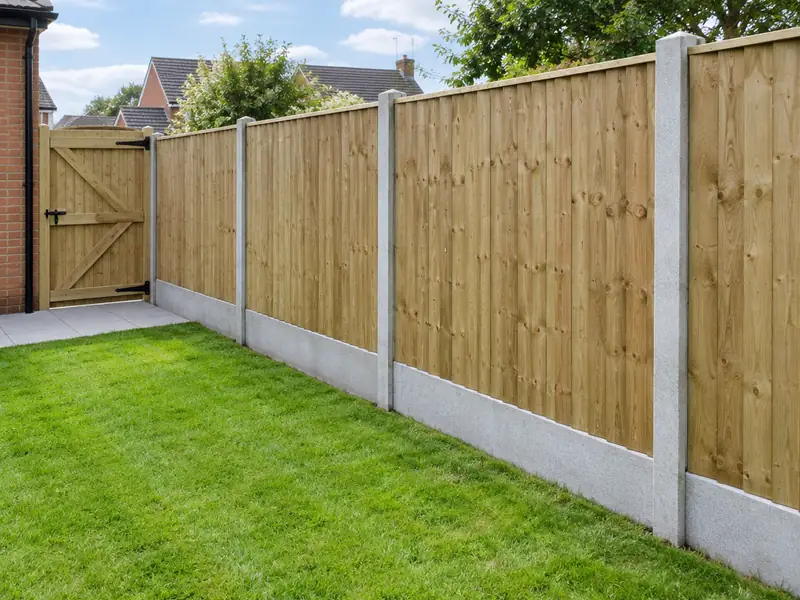
Fencing installation is setting fence posts into the ground, usually in concrete, and fixing panels or boards between them to mark a boundary, add privacy or keep children and pets in, with gates fitted where access is needed.
Planning new fencing and gates for a home in Ashton-under-Lyne means making a handful of decisions about materials, layout, finish and timing. We help you work through them at a free survey, then confirm in writing what it will cost for the options you pick. Most projects of this type need 1–3 days for a typical garden, and we cover every M34, M43, OL6 and OL7 address as well as the rest of Greater Manchester.
- Guide price
- £1,150–£2,800 inc VAT
- Time on site
- 1–3 days for a typical garden
- Postcodes
- M34, M43, OL6, OL7 and SK14
- Planning rules
- England
- Local area
- Tameside
- Survey
- Free, with a written quote
Fencing and gates prices in Ashton-under-Lyne
Budgeting for new fencing and gates in Ashton-under-Lyne? The numbers below include VAT and are adjusted for the North West, where costs are about 5% below the national guide. The headline range is £1,150–£2,800. Nothing is final until we have measured up at a free survey and agreed the specification with you.
| Type of job | What it usually involves | Guide in Ashton-under-Lyne |
|---|---|---|
| Repairs or a short run | Replacing a few panels and posts, or a short run of up to about 6m. | £300–£850 |
| Typical garden boundary | About 20m of panel or closeboard fencing with concrete posts and gravel boards. | £1,150–£2,800 |
| Composite or long runs with gates | Composite or premium fencing, longer runs, or a driveway gate. | £2,800–£6,600 |
Expect these to shape the final quote:
- Total length and height of fencing
- Post type: concrete, timber or aluminium
- Ground conditions, slopes and removal of the old fence
- Number, size and type of gates
What do you get?
- Removal and disposal of the old fence and posts
- Concrete or timber posts set in concrete
- Concrete or timber gravel boards to keep panels off the soil
- Panels or boards fixed level or stepped to follow the ground
- Post caps and capping rails where specified
- Site cleared and waste removed
Homes in Greater Manchester
Rows of Victorian red-brick terraces fill much of Manchester, Salford and the mill towns, with stone terraces in the Pennine fringes around Oldham and Saddleworth. South Manchester has Edwardian semis and villas, Wythenshawe was built as a large interwar garden suburb, and city-centre apartments and new estates continue to grow.
Two-up two-down terraces commonly suit loft conversions, kitchen extensions and kitchen refits. Many need repointing and roof work, while semis in the suburbs often take side extensions, driveways and replacement windows.
None of this holds for every street in Ashton-under-Lyne, which is why we look at your actual house before pricing new fencing and gates rather than assuming from its age alone.
Planning and building rules in Ashton-under-Lyne
The notes below cover England, which is where Ashton-under-Lyne sits. Rules change and every property is different, so we speak to the council before pricing your job.
In England, fences, walls and gates up to 2 m high are usually permitted development, or up to 1 m where they are next to a road used by vehicles or its footpath. Listed buildings, conservation areas and estates with planning conditions can be stricter.
Building Regulations do not apply to ordinary garden fences, but boundary lines should be agreed with your neighbour first.
Rules change and every property is different, so we check the planning history and constraints for your address before we quote.
How does the job run?
A visit to your home
A free survey comes first. It gives us what we need to price new fencing and gates properly, including dimensions, existing materials and access for deliveries, and gives you the chance to ask anything you like.
Your fixed price
After the survey we send a quote for new fencing and gates that fixes the price for the scope we've agreed. If you want to change materials or scope, we revise it in writing before anything is booked.
Booking the work
We handle the paperwork side: checking whether planning permission or building control approval is needed, submitting applications where they are, and scheduling the trades and materials around your dates.
The work itself
Our trades complete new fencing and gates while your point of contact keeps you updated. When everything is finished, we clear the site, take away waste and go through the result with you before handover.
How we work
Frequently asked questions
How much does a new fence cost?
About 20m of new panel or closeboard fencing with concrete posts costs £1,150–£2,800, including removal of the old fence. As a guide, allow roughly £55–£130 per metre plus a small fixed cost for removal and waste. Lap panels sit at the lower end, while closeboard, slatted and composite fencing cost more. Gates, slopes and hard ground add to the price. We confirm a fixed price after measuring.
What happens at the survey?
We visit your home at a time that suits you, look at the area involved, take measurements and check access, condition and any services that might be affected. We talk through what you want from new fencing and gates, explain the options and answer questions. There is no charge and no obligation; afterwards we send a written quote.
How do you fence a sloping garden?
On a sloping garden, fence panels are usually stepped, so each panel is level and set slightly higher or lower than the one before, with the gap below filled by a gravel board. Closeboard fences can instead follow the slope, giving a smooth top line. The choice depends on how steep the slope is and the look you want. We discuss both at the survey.
How long will new fencing and gates take?
On a typical home, allow 1–3 days for a typical garden. Larger projects, older buildings and extra work found once things are opened up can extend that, while simpler jobs may be shorter. Your quote includes an estimate of time on site, and your point of contact keeps you updated on the programme as the work progresses.
What kind of gate do I need?
The right gate depends on its job. A side gate for access to the back garden is usually timber or metal, around 0.9m to 1m wide, with a secure lock. Driveway gates are wider, often in pairs, and need strong posts. Composite and metal gates resist warping. We measure the opening, check posts and suggest hinges, latches and locks for security.
Nearby towns
If your address falls within M34, M43, OL6 and OL7, we cover it. The same goes for neighbouring Dukinfield, Stalybridge and Droylsden, which we include alongside Ashton-under-Lyne when arranging surveys and quotes.