
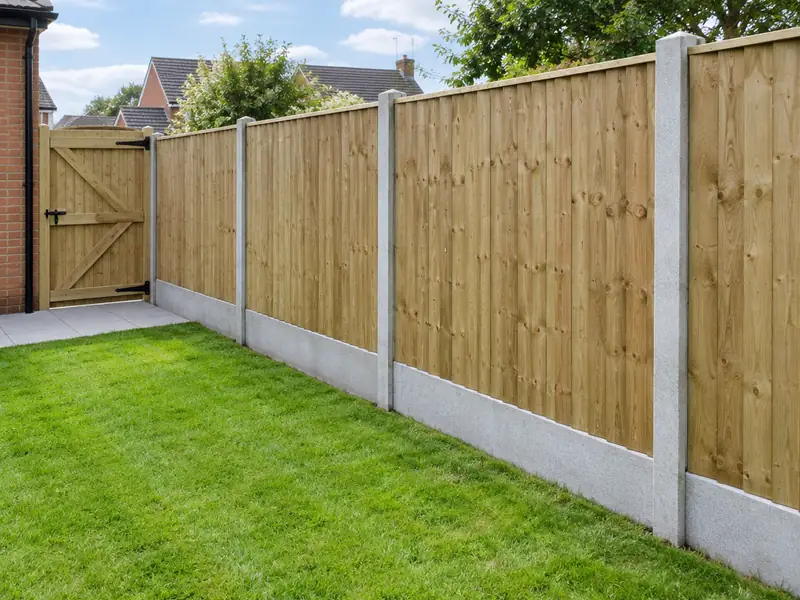
Fencing installation is setting fence posts into the ground, usually in concrete, and fixing panels or boards between them to mark a boundary, add privacy or keep children and pets in, with gates fitted where access is needed.
From a first conversation about new fencing and gates to the day the site is cleared, homeowners in Dukinfield deal with us directly. We come out to measure up at no cost, explain the choices in plain terms and send a written quote. For context, comparable work in the North West usually falls within £1,150–£2,800 including VAT, and it is available across M34, OL6, OL7 and SK14.
- Guide price
- £1,150–£2,800 inc VAT
- Time on site
- 1–3 days for a typical garden
- Postcodes
- M34, OL6, OL7, SK14 and SK15
- Planning rules
- England
- Local area
- Tameside
- Survey
- Free, with a written quote
How much do new fencing and gates cost in Dukinfield?
To help you plan, we show what new fencing and gates typically costs in Dukinfield instead of holding figures back for a sales call. The range is £1,150–£2,800 with VAT, using rates in the North West that are about 5% below the national guide. A free survey then fixes your actual price.
| Type of job | What it usually involves | Guide in Dukinfield |
|---|---|---|
| Repairs or a short run | Replacing a few panels and posts, or a short run of up to about 6m. | £300–£850 |
| Typical garden boundary | About 20m of panel or closeboard fencing with concrete posts and gravel boards. | £1,150–£2,800 |
| Composite or long runs with gates | Composite or premium fencing, longer runs, or a driveway gate. | £2,800–£6,600 |
Your price depends mostly on:
- Total length and height of fencing
- Fence style and material: panels, closeboard or composite
- Ground conditions, slopes and removal of the old fence
- Number, size and type of gates
What does the job include in Dukinfield?
- Removal and disposal of the old fence and posts
- Concrete or timber posts set in concrete
- Concrete or timber gravel boards to keep panels off the soil
- Panels or boards fixed level or stepped to follow the ground
- Post caps and capping rails where specified
- Site cleared and waste removed
Local housing and new fencing and gates
Rows of Victorian red-brick terraces fill much of Manchester, Salford and the mill towns, with stone terraces in the Pennine fringes around Oldham and Saddleworth. South Manchester has Edwardian semis and villas, Wythenshawe was built as a large interwar garden suburb, and city-centre apartments and new estates continue to grow.
Two-up two-down terraces commonly suit loft conversions, kitchen extensions and kitchen refits. Many need repointing and roof work, while semis in the suburbs often take side extensions, driveways and replacement windows.
For new fencing and gates in Dukinfield, this means checking things like wall construction, roof structure and existing services before we put a figure on paper.
Do you need permission in Dukinfield?
For anyone in Dukinfield, the relevant framework is England's. The summary below is general, so we always contact the council about your address before putting a price in writing.
In England, fences, walls and gates up to 2 m high are usually permitted development, or up to 1 m where they are next to a road used by vehicles or its footpath. Listed buildings, conservation areas and estates with planning conditions can be stricter.
Building Regulations do not apply to ordinary garden fences, but boundary lines should be agreed with your neighbour first.
Rules change and every property is different, so we check the planning history and constraints for your address before we quote.
The four stages
We look at the job
A free survey comes first. It gives us what we need to price new fencing and gates properly, including dimensions, existing materials and access for deliveries, and gives you the chance to ask anything you like.
Written quote
The quote arrives in writing, not over the phone. It covers the full scope, the finishes you've chosen, any exclusions and the payment schedule, with a fixed price tied to that specification.
Plan and prepare
Next comes planning the work itself. We set a start date that suits you, line up the right trades, and make sure any approvals for new fencing and gates are in place before the first day on site.
On site to finish
Our trades complete new fencing and gates while your point of contact keeps you updated. When everything is finished, we clear the site, take away waste and go through the result with you before handover.
Working with SK Home Improvements
Questions about new fencing and gates in Dukinfield
Is the price fixed?
Yes, for the specification we agree. Your written quote sets out exactly what is included at a fixed price. It only changes if you ask for something different, or if a problem the survey could not reasonably reveal later needs extra work. In either case we explain the change and confirm it in writing before going ahead.
Are concrete posts better than timber?
Concrete posts do not rot and are the most durable choice for panel fences, especially on exposed sites. They are heavier and more utilitarian in appearance. Timber posts look more natural and suit closeboard and featheredge fences, but they eventually rot at ground level, even when treated. Aluminium posts suit composite systems. We recommend posts based on your fence style and exposure.
Do you cover Ashton-under-Lyne, Stalybridge and Hyde?
Yes. As well as Dukinfield, we cover Ashton-under-Lyne, Stalybridge and Hyde and the rest of Greater Manchester. Our coverage is UK-wide, so the process is the same wherever you are: a free site survey, a quote in writing that fixes the price for the agreed scope, and one point of contact while the work is planned and carried out.
What kind of gate do I need?
The right gate depends on its job. A side gate for access to the back garden is usually timber or metal, around 0.9m to 1m wide, with a secure lock. Driveway gates are wider, often in pairs, and need strong posts. Composite and metal gates resist warping. We measure the opening, check posts and suggest hinges, latches and locks for security.
How do you fence a sloping garden?
On a sloping garden, fence panels are usually stepped, so each panel is level and set slightly higher or lower than the one before, with the gap below filled by a gravel board. Closeboard fences can instead follow the slope, giving a smooth top line. The choice depends on how steep the slope is and the look you want. We discuss both at the survey.
Nearby towns
Coverage for Dukinfield spans M34, OL6, OL7 and SK14. Close by, Ashton-under-Lyne, Stalybridge and Hyde are covered too, and the rest of our UK-wide area follows the same survey-then-quote process from start to finish.