
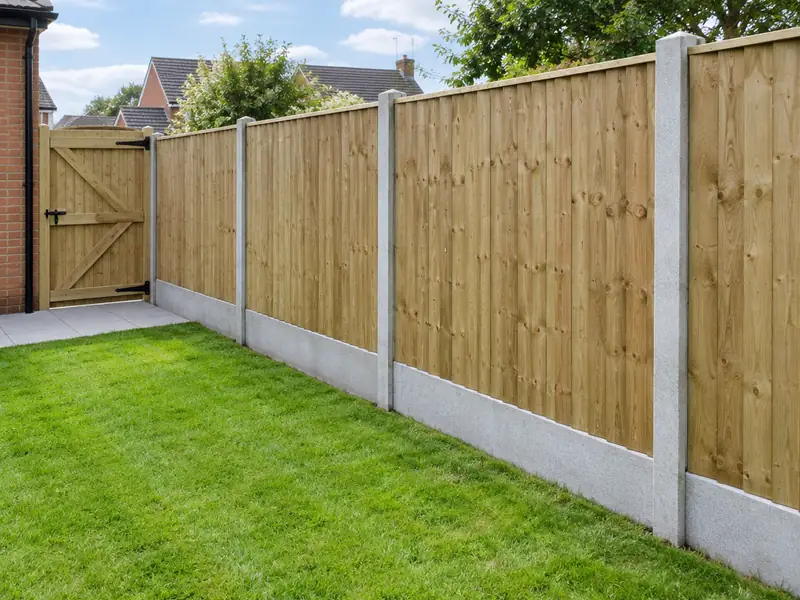
Fencing installation is setting fence posts into the ground, usually in concrete, and fixing panels or boards between them to mark a boundary, add privacy or keep children and pets in, with gates fitted where access is needed.
Every house in Holyhead is a little different, so we never price new fencing and gates from a brochure. We look at the structure, access and existing finishes first, then put in writing a fixed figure for the scope we settle on. As a rough steer, homeowners in Wales should budget £1,100–£2,800 including VAT, with work typically taking 1–3 days for a typical garden.
- Guide price
- £1,100–£2,800 inc VAT
- Time on site
- 1–3 days for a typical garden
- Postcodes
- LL65
- Planning rules
- Wales
- Local area
- Isle of Anglesey
- Survey
- Free, with a written quote
What should you budget for new fencing and gates in Holyhead?
Here is how the guide price for new fencing and gates breaks down in Holyhead. We start from national figures and adjust for Wales, which comes out about 8% below the national guide. The resulting range, VAT included, is £1,100–£2,800, and a survey, at no cost to you, firms it up.
| Type of job | What it usually involves | Guide in Holyhead |
|---|---|---|
| Repairs or a short run | Replacing a few panels and posts, or a short run of up to about 6m. | £300–£850 |
| Typical garden boundary | About 20m of panel or closeboard fencing with concrete posts and gravel boards. | £1,100–£2,800 |
| Composite or long runs with gates | Composite or premium fencing, longer runs, or a driveway gate. | £2,800–£6,400 |
What moves the price up or down:
- Total length and height of fencing
- Fence style and material: panels, closeboard or composite
- Ground conditions, slopes and removal of the old fence
- Number, size and type of gates
What’s included?
- Measured survey of each fence run, levels and slopes
- Removal and disposal of the old fence and posts
- Concrete or timber gravel boards to keep panels off the soil
- Panels or boards fixed level or stepped to follow the ground
- Post caps and capping rails where specified
- Gates hung with hinges, latches and locks
Local housing and new fencing and gates
Slate defines much of Gwynedd, from quarrying villages such as Bethesda and Blaenau Ffestiniog with their stone terraces to slate roofs across the county. Bangor and Caernarfon have Victorian and Georgian streets, Anglesey has stone cottages and bungalows, and resorts such as Pwllheli and Barmouth have Victorian terraces and newer bungalows.
Stone and slate homes need breathable lime render and pointing, and slate roofs often need careful repair rather than replacement. Terraces suit loft conversions, and bungalows commonly take extensions and window upgrades.
These patterns matter for new fencing and gates: older walls, roofs and floors in Holyhead can need different materials or extra preparation compared with newer homes.
Do you need permission in Holyhead?
For anyone in Holyhead, the relevant framework is Wales's. The summary below is general, so we always contact the council about your address before putting a price in writing.
In Wales, fences, walls and gates up to 2 m high (1 m next to a road) are usually permitted development.
Building Regulations do not apply to ordinary fences.
Rules change and every property is different, so we check the planning history and constraints for your address before we quote.
The four stages
We look at the job
First, someone visits your home in Holyhead to see the space, take measurements and note anything that could affect the work, such as access or the condition of what is there. There is no charge for this visit.
Price and scope agreed
The quote arrives in writing, not over the phone. It covers the full scope, the finishes you've chosen, any exclusions and the payment schedule, with a fixed price tied to that specification.
Plan and prepare
Before anyone starts, we confirm the programme in writing, check whether consents are required and arrange deliveries. If a skip or scaffolding on the road needs a permit, we apply for it.
On site to finish
The work is carried out to the agreed specification, with floors and furniture protected and the site kept tidy. At the end we clean up, walk through the finished job with you and hand over any certificates.
What you can expect from us
Fencing and gates in Holyhead: questions
Who owns the fence between me and my neighbour?
Fence ownership is usually shown on the title plan or deeds, sometimes with a T mark on the side of the owner. If it is unclear, it may be shared. Even on your own boundary, it is sensible to talk to neighbours before replacing a fence, agree access and confirm the line. We fit the fence on the line you confirm and can face the good side outwards if you wish.
Can I stay at home during the work?
In most cases, yes. Most people can live at home throughout, and we plan the work to keep disruption down by protecting floors, agreeing working hours and keeping access routes clear. Bigger jobs affecting kitchens, bathrooms or heating may mean a short spell with reduced facilities, and we talk this through with you at the survey.
What kind of gate do I need?
The right gate depends on its job. A side gate for access to the back garden is usually timber or metal, around 0.9m to 1m wide, with a secure lock. Driveway gates are wider, often in pairs, and need strong posts. Composite and metal gates resist warping. We measure the opening, check posts and suggest hinges, latches and locks for security.
How do you fence a sloping garden?
On a sloping garden, fence panels are usually stepped, so each panel is level and set slightly higher or lower than the one before, with the gap below filled by a gravel board. Closeboard fences can instead follow the slope, giving a smooth top line. The choice depends on how steep the slope is and the look you want. We discuss both at the survey.
How long will new fencing and gates take?
On a typical home, allow 1–3 days for a typical garden. Larger projects, older buildings and extra work found once things are opened up can extend that, while simpler jobs may be shorter. Your quote includes an estimate of time on site, and your point of contact keeps you updated on the programme as the work progresses.
Also covering areas around Holyhead
Live in Holyhead? Our coverage takes in the LL65 postcode areas and reaches out to Caernarfon, Bangor, Gwynedd and Llandudno, so homes on the outskirts and in the next town along are included.