
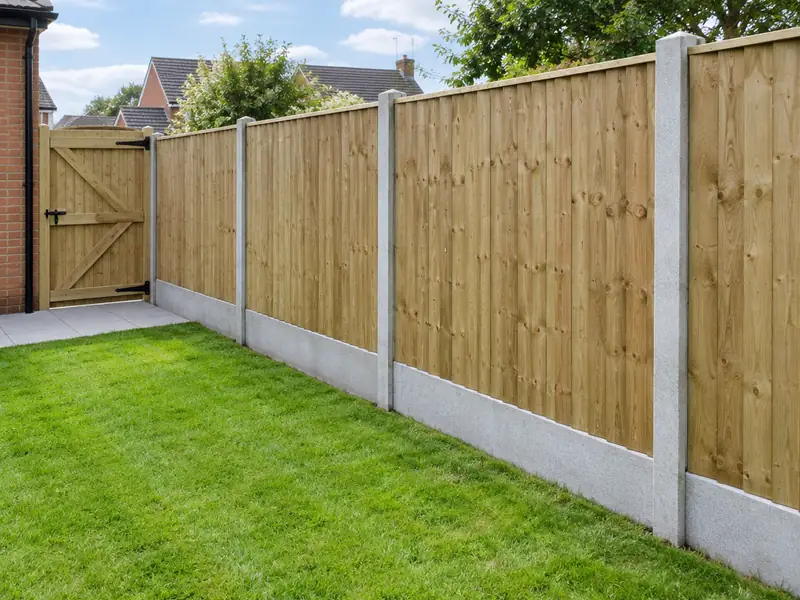
Fencing installation is setting fence posts into the ground, usually in concrete, and fixing panels or boards between them to mark a boundary, add privacy or keep children and pets in, with gates fitted where access is needed.
We take on new fencing and gates throughout Inverness and the surrounding IV1 and IV3 postcodes, as well as in Nairn, Forres and Elgin. The guide range for this work in Scotland is £1,150–£2,900 including VAT; where your project falls depends on its size, the materials you pick and how easy the site is to reach. A free survey turns that range into a fixed figure.
- Guide price
- £1,150–£2,900 inc VAT
- Time on site
- 1–3 days for a typical garden
- Postcodes
- IV1 and IV3
- Planning rules
- Scotland
- Local area
- Highland
- Survey
- Free, with a written quote
How much do new fencing and gates cost in Inverness?
The table below shows guide prices for new fencing and gates in Inverness. They are based on rates in Scotland, which run about 4% below the national guide, giving an overall range of £1,150–£2,900. All figures include VAT and are firmed up after a free site survey.
| Type of job | What it usually involves | Guide in Inverness |
|---|---|---|
| Repairs or a short run | Replacing a few panels and posts, or a short run of up to about 6m. | £300–£850 |
| Typical garden boundary | About 20m of panel or closeboard fencing with concrete posts and gravel boards. | £1,150–£2,900 |
| Composite or long runs with gates | Composite or premium fencing, longer runs, or a driveway gate. | £2,900–£6,700 |
Expect these to shape the final quote:
- Total length and height of fencing
- Fence style and material: panels, closeboard or composite
- Post type: concrete, timber or aluminium
- Number, size and type of gates
What does the job include in Inverness?
- Measured survey of each fence run, levels and slopes
- Concrete or timber posts set in concrete
- Concrete or timber gravel boards to keep panels off the soil
- Panels or boards fixed level or stepped to follow the ground
- Gates hung with hinges, latches and locks
- Site cleared and waste removed
Building in Inverness
Inverness has Victorian villas and terraces and large modern estates, while rural Highland homes range from harled stone cottages and croft houses to modern timber-frame kit houses, which are common across the region. Orkney uses local flagstone, and island and coastal communities mix traditional stone homes with newer bungalows.
Exposure to wind, rain and snow can be severe, especially on the west coast and islands, and remote sites need allowance for ferries and weather delays.
That mix of housing shapes how we approach new fencing and gates in Inverness: the age and construction of your home affect the materials, the method and, in the end, the price.
Do you need permission in Inverness?
As Inverness is in Scotland, read the following with that system of planning and building control in mind. We check what applies to your house with the council before you receive a quote.
In Scotland, gates, fences and walls up to 2 m high are usually permitted development, with a 1 m limit in front of the house or next to a road.
A building warrant is not needed for ordinary garden fences.
Rules change and every property is different, so we check the planning history and constraints for your address before we quote.
How does the job run?
Survey and measure
First, someone visits your home in Inverness to see the space, take measurements and note anything that could affect the work, such as access or the condition of what is there. There is no charge for this visit.
Written quote
We put everything into a written, fixed-price quote: the specification, what's excluded, staged payments and the expected time on site. Take whatever time you need to decide; there's no pressure to commit.
Dates and permissions
Preparation matters as much as the build. We agree access, parking and working hours with you, order materials in good time, and confirm any permissions so the job isn't held up once it starts.
Finish and handover
During the work we protect the areas around it and tidy up at the end of each day. Once complete, we check the finish, remove our materials and hand over paperwork such as building control sign-off where it applies.
What you can expect from us
Common questions
Can you combine new fencing and gates with other work?
Yes. Because we manage several trades under one contract, we can plan new fencing and gates alongside other work on your Inverness home, such as new windows with rendering, or a kitchen refit with an extension. Combining jobs can reduce repeat set-up such as scaffolding, skips and access, and every element is listed and priced in the same written quote.
How long does it take to replace a fence?
Replacing a typical 20m garden fence usually takes one to two days, including taking down the old fence, setting posts in concrete and fitting panels or boards. Longer runs, slopes, hard ground and gates take longer. Post concrete needs time to set before panels are fully loaded. We give you an expected timeline with your quote.
Are concrete posts better than timber?
Concrete posts do not rot and are the most durable choice for panel fences, especially on exposed sites. They are heavier and more utilitarian in appearance. Timber posts look more natural and suit closeboard and featheredge fences, but they eventually rot at ground level, even when treated. Aluminium posts suit composite systems. We recommend posts based on your fence style and exposure.
Can I stay at home during the work?
In most cases, yes. Most people can live at home throughout, and we plan the work to keep disruption down by protecting floors, agreeing working hours and keeping access routes clear. Bigger jobs affecting kitchens, bathrooms or heating may mean a short spell with reduced facilities, and we talk this through with you at the survey.
How do you fence a sloping garden?
On a sloping garden, fence panels are usually stepped, so each panel is level and set slightly higher or lower than the one before, with the gap below filled by a gravel board. Closeboard fences can instead follow the slope, giving a smooth top line. The choice depends on how steep the slope is and the look you want. We discuss both at the survey.
Also covering areas around Inverness
We welcome enquiries from all IV1 and IV3 postcodes in Inverness, plus Nairn, Forres and Elgin. Each one gets the same survey at no charge and a written price fixed for the work described.