
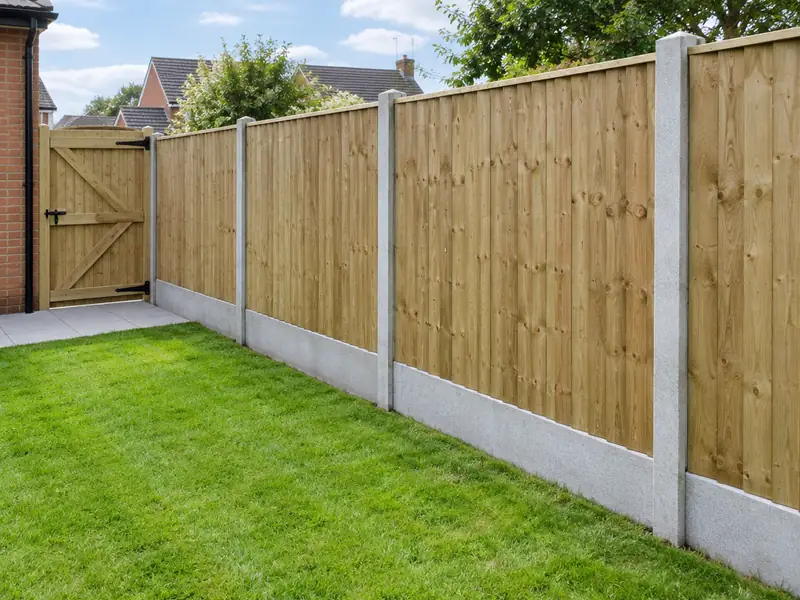
Fencing installation is setting fence posts into the ground, usually in concrete, and fixing panels or boards between them to mark a boundary, add privacy or keep children and pets in, with gates fitted where access is needed.
Whatever prompted you to look into new fencing and gates, whether wear and tear, a growing family or plans to move, we can survey your Dover home and give you a price in writing. Homes in the South East typically come in at £1,350–£3,400, VAT included, for this kind of work. We also cover Folkestone, Deal and Canterbury, and the same steps apply wherever you are in Kent.
- Guide price
- £1,350–£3,400 inc VAT
- Time on site
- 1–3 days for a typical garden
- Postcodes
- CT14, CT16 and CT17
- Planning rules
- England
- Local area
- Kent
- Survey
- Free, with a written quote
What should you budget for new fencing and gates in Dover?
To help you plan, we show what new fencing and gates typically costs in Dover instead of holding figures back for a sales call. The range is £1,350–£3,400 with VAT, using rates in the South East that are about 12% above the national guide. A free survey then fixes your actual price.
| Type of job | What it usually involves | Guide in Dover |
|---|---|---|
| Repairs or a short run | Replacing a few panels and posts, or a short run of up to about 6m. | £350–£1,000 |
| Typical garden boundary | About 20m of panel or closeboard fencing with concrete posts and gravel boards. | £1,350–£3,400 |
| Composite or long runs with gates | Composite or premium fencing, longer runs, or a driveway gate. | £3,400–£7,800 |
Your price depends mostly on:
- Total length and height of fencing
- Fence style and material: panels, closeboard or composite
- Post type: concrete, timber or aluminium
- Ground conditions, slopes and removal of the old fence
Scope of the work
- Measured survey of each fence run, levels and slopes
- Removal and disposal of the old fence and posts
- Concrete or timber gravel boards to keep panels off the soil
- Panels or boards fixed level or stepped to follow the ground
- Gates hung with hinges, latches and locks
- Site cleared and waste removed
Building in Dover
Kent's older buildings include oast houses, weatherboarded cottages, Wealden timber-framed houses and Kentish ragstone walls. Medway towns have long rows of Victorian terraces, Margate and Ramsgate have Regency and Victorian seafronts, and Ashford, Maidstone and Dartford have seen large new estates alongside interwar and post-war housing.
One of England's sunnier, drier counties, but Thanet and the coast are windy, and Weald and London Clay soils can shrink in summer.
Building traditions across Kent also raise conservation and planning questions, so we check those for new fencing and gates in Dover at the survey stage.
Planning and building rules in Dover
Which rules apply depends on where you live. For Dover, the answer is England, and the points below reflect that; we verify them with the council before quoting.
In England, fences, walls and gates up to 2 m high are usually permitted development, or up to 1 m where they are next to a road used by vehicles or its footpath. Listed buildings, conservation areas and estates with planning conditions can be stricter.
Building Regulations do not apply to ordinary garden fences, but boundary lines should be agreed with your neighbour first.
Rules change and every property is different, so we check the planning history and constraints for your address before we quote.
What happens after you get in touch?
We look at the job
Book a visit and we'll come to you. The survey covers measurements, the state of what's there now and any obvious constraints, so the price that follows is based on your actual home, not an average.
Quote in writing
After the survey we send a quote for new fencing and gates that fixes the price for the scope we've agreed. If you want to change materials or scope, we revise it in writing before anything is booked.
Dates and permissions
Preparation matters as much as the build. We agree access, parking and working hours with you, order materials in good time, and confirm any permissions so the job isn't held up once it starts.
Finish and handover
Work goes ahead as scheduled and you deal with one contact throughout. When the last trade leaves, we clear and clean the site, talk you through what has been done and pass on any certificates and care instructions.
What you can expect from us
Frequently asked questions
What kind of gate do I need?
The right gate depends on its job. A side gate for access to the back garden is usually timber or metal, around 0.9m to 1m wide, with a secure lock. Driveway gates are wider, often in pairs, and need strong posts. Composite and metal gates resist warping. We measure the opening, check posts and suggest hinges, latches and locks for security.
How do you fence a sloping garden?
On a sloping garden, fence panels are usually stepped, so each panel is level and set slightly higher or lower than the one before, with the gap below filled by a gravel board. Closeboard fences can instead follow the slope, giving a smooth top line. The choice depends on how steep the slope is and the look you want. We discuss both at the survey.
Do you cover Folkestone, Deal and Canterbury?
Yes. As well as Dover, we cover Folkestone, Deal and Canterbury and the rest of Kent. Our coverage is UK-wide, so the process is the same wherever you are: a free site survey, a quote in writing that fixes the price for the agreed scope, and one point of contact while the work is planned and carried out.
Is the price fixed?
Yes, for the specification we agree. Your written quote sets out exactly what is included at a fixed price. It only changes if you ask for something different, or if a problem the survey could not reasonably reveal later needs extra work. In either case we explain the change and confirm it in writing before going ahead.
How do I make my fence last longer?
A fence lasts longer when timber is kept off the soil and protected from moisture. Gravel boards beneath the panels, concrete posts and keeping plants and soil away from the fence all help. Treat timber with a preservative or stain every few years, and replace damaged boards promptly. Composite fencing needs only occasional washing.
Nearby towns
Addresses in CT14, CT16 and CT17 are all covered for Dover, along with Folkestone, Deal and Canterbury close by. Give us your postcode when you get in touch and we will confirm the details.