
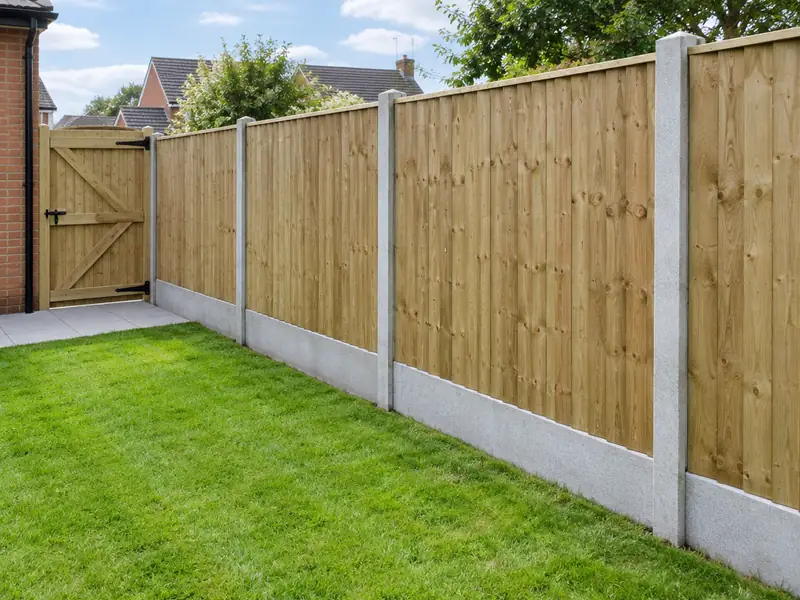
Fencing installation is setting fence posts into the ground, usually in concrete, and fixing panels or boards between them to mark a boundary, add privacy or keep children and pets in, with gates fitted where access is needed.
Chalk Farm sits within our coverage for new fencing and gates, as do neighbouring Camden Town, Holloway and Archway. Before giving a price we want to see the property: the condition of what's there now, the access, and anything that might need extra work. The guide range for London is £1,550–£3,900 including VAT, and your written quote will spell out exactly what that covers.
- Guide price
- £1,550–£3,900 inc VAT
- Time on site
- 1–3 days for a typical garden
- Postcodes
- N7, N1C, NW1, NW3 and NW5
- Planning rules
- England
- Local area
- Greater London
- Survey
- Free, with a written quote
How much do new fencing and gates cost in Chalk Farm?
Here is how the guide price for new fencing and gates breaks down in Chalk Farm. We start from national figures and adjust for London, which comes out about 30% above the national guide. The resulting range, VAT included, is £1,550–£3,900, and a survey, at no cost to you, firms it up.
| Type of job | What it usually involves | Guide in Chalk Farm |
|---|---|---|
| Repairs or a short run | Replacing a few panels and posts, or a short run of up to about 6m. | £400–£1,150 |
| Typical garden boundary | About 20m of panel or closeboard fencing with concrete posts and gravel boards. | £1,550–£3,900 |
| Composite or long runs with gates | Composite or premium fencing, longer runs, or a driveway gate. | £3,900–£9,100 |
The main things that change the figure:
- Total length and height of fencing
- Post type: concrete, timber or aluminium
- Ground conditions, slopes and removal of the old fence
- Number, size and type of gates
What’s included?
- Removal and disposal of the old fence and posts
- Concrete or timber posts set in concrete
- Concrete or timber gravel boards to keep panels off the soil
- Panels or boards fixed level or stepped to follow the ground
- Post caps and capping rails where specified
- Gates hung with hinges, latches and locks
Homes in London
London's housing is dominated by Victorian and Edwardian terraces, often in yellow London stock brick, with Georgian terraces in central districts and mansion blocks across many inner areas. Outer boroughs have large belts of interwar semis, and there are extensive post-war council estates. Many houses have been split into flats, and conservation areas are widespread.
London Clay shrinks and swells with the seasons, and street trees close to houses can contribute to movement, which affects foundation design.
None of this holds for every street in Chalk Farm, which is why we look at your actual house before pricing new fencing and gates rather than assuming from its age alone.
Planning and building rules in Chalk Farm
The notes below cover England, which is where Chalk Farm sits. Rules change and every property is different, so we speak to the council before pricing your job.
In England, fences, walls and gates up to 2 m high are usually permitted development, or up to 1 m where they are next to a road used by vehicles or its footpath. Listed buildings, conservation areas and estates with planning conditions can be stricter.
Building Regulations do not apply to ordinary garden fences, but boundary lines should be agreed with your neighbour first.
Rules change and every property is different, so we check the planning history and constraints for your address before we quote.
How does the job run?
Survey and measure
It starts with a survey at the property, free of charge. We check condition, access and services, ask how you want the finished result to look, and answer any questions you have about new fencing and gates.
Written quote
We put everything into a written, fixed-price quote: the specification, what's excluded, staged payments and the expected time on site. Take whatever time you need to decide; there's no pressure to commit.
Getting ready
Next comes planning the work itself. We set a start date that suits you, line up the right trades, and make sure any approvals for new fencing and gates are in place before the first day on site.
The work itself
Our trades complete new fencing and gates while your point of contact keeps you updated. When everything is finished, we clear the site, take away waste and go through the result with you before handover.
Why homeowners choose us
Questions about new fencing and gates in Chalk Farm
How much does a new fence cost?
About 20m of new panel or closeboard fencing with concrete posts costs £1,550–£3,900, including removal of the old fence. As a guide, allow roughly £55–£130 per metre plus a small fixed cost for removal and waste. Lap panels sit at the lower end, while closeboard, slatted and composite fencing cost more. Gates, slopes and hard ground add to the price. We confirm a fixed price after measuring.
Who do I deal with during the job?
One point of contact manages your project from survey to handover. They schedule the trades working under our contract, keep you updated on progress, and are the person to call with any question. You don't need to coordinate builders, electricians or decorators separately, because that is part of what we do.
What kind of gate do I need?
The right gate depends on its job. A side gate for access to the back garden is usually timber or metal, around 0.9m to 1m wide, with a secure lock. Driveway gates are wider, often in pairs, and need strong posts. Composite and metal gates resist warping. We measure the opening, check posts and suggest hinges, latches and locks for security.
Can you combine new fencing and gates with other work?
Yes. Because we manage several trades under one contract, we can plan new fencing and gates alongside other work on your Chalk Farm home, such as new windows with rendering, or a kitchen refit with an extension. Combining jobs can reduce repeat set-up such as scaffolding, skips and access, and every element is listed and priced in the same written quote.
How high can my fence be?
Fence height limits depend on planning rules, your home's location, whether it is listed or in a conservation area, and which UK nation you live in. In England, fences up to 2m high are usually permitted development, reduced to 1m next to a road used by vehicles. Higher fences need planning permission. We check the rules for your boundary before quoting.
Also covering areas around Chalk Farm
Homes across N7, N1C, NW1 and NW3 in Chalk Farm are within our coverage, as are those in Camden Town, Holloway and Archway. If you are just outside these areas, ask anyway, because we work right across the UK.