
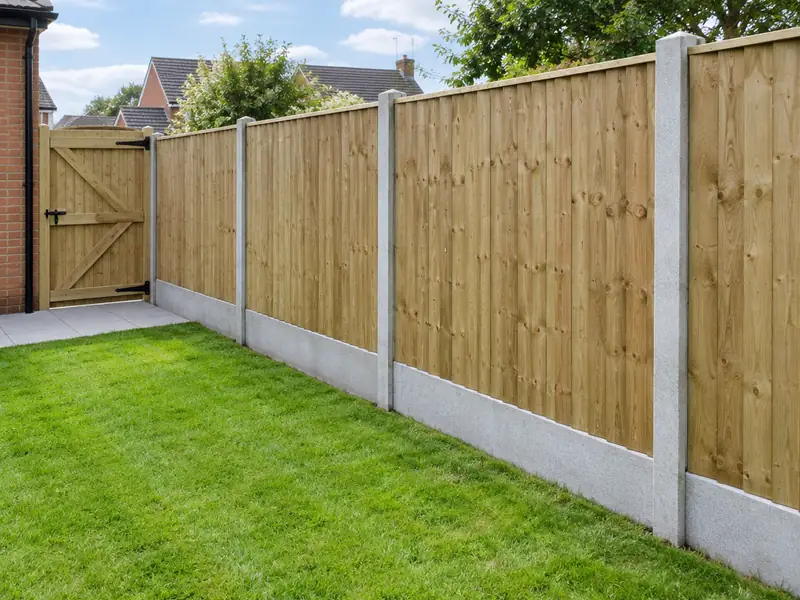
Fencing installation is setting fence posts into the ground, usually in concrete, and fixing panels or boards between them to mark a boundary, add privacy or keep children and pets in, with gates fitted where access is needed.
For a homeowner in Lofthouse, planning new fencing and gates tends to begin with two questions: what will it cost, and how disruptive will it be? Our guide range is £1,150–£2,800 including VAT, and a typical job runs to 1–3 days for a typical garden. Both numbers firm up once we have seen the property, measured up and agreed exactly what is included.
- Guide price
- £1,150–£2,800 inc VAT
- Time on site
- 1–3 days for a typical garden
- Postcodes
- WF3
- Planning rules
- England
- Local area
- Leeds
- Survey
- Free, with a written quote
How much do new fencing and gates cost in Lofthouse?
Every figure below is a guide for new fencing and gates in Lofthouse, inclusive of VAT. Regional pricing for Yorkshire and the Humber works out about 6% below the national guide, and the overall span is £1,150–£2,800. The survey costs you nothing, and after it we commit to a firm price for your specification in writing.
| Type of job | What it usually involves | Guide in Lofthouse |
|---|---|---|
| Repairs or a short run | Replacing a few panels and posts, or a short run of up to about 6m. | £300–£850 |
| Typical garden boundary | About 20m of panel or closeboard fencing with concrete posts and gravel boards. | £1,150–£2,800 |
| Composite or long runs with gates | Composite or premium fencing, longer runs, or a driveway gate. | £2,800–£6,600 |
The main things that change the figure:
- Total length and height of fencing
- Fence style and material: panels, closeboard or composite
- Post type: concrete, timber or aluminium
- Number, size and type of gates
Scope of the work
- Measured survey of each fence run, levels and slopes
- Removal and disposal of the old fence and posts
- Concrete or timber posts set in concrete
- Concrete or timber gravel boards to keep panels off the soil
- Panels or boards fixed level or stepped to follow the ground
- Gates hung with hinges, latches and locks
What are homes like around Lofthouse?
Leeds and Bradford are known for back-to-back and through terraces, many in sandstone or millstone grit, with stone-slate roofs on older properties. Halifax, Huddersfield and the Calder valley have mill-town stone terraces climbing steep hillsides, and interwar semis, post-war estates and newer housing surround the larger towns.
The Pennine hills bring high rainfall, wind and frost, and the Calder valley has a history of serious flooding.
In Lofthouse, as elsewhere in West Yorkshire, we take the building's age and construction into account before recommending anything, because both can change what is involved in new fencing and gates.
Do you need permission in Lofthouse?
For anyone in Lofthouse, the relevant framework is England's. The summary below is general, so we always contact the council about your address before putting a price in writing.
In England, fences, walls and gates up to 2 m high are usually permitted development, or up to 1 m where they are next to a road used by vehicles or its footpath. Listed buildings, conservation areas and estates with planning conditions can be stricter.
Building Regulations do not apply to ordinary garden fences, but boundary lines should be agreed with your neighbour first.
Rules change and every property is different, so we check the planning history and constraints for your address before we quote.
How does the job run?
Survey and measure
It starts with a survey at the property, free of charge. We check condition, access and services, ask how you want the finished result to look, and answer any questions you have about new fencing and gates.
Your fixed price
You get the price in writing, itemised so you can see where the money goes. As long as the specification stays the same, that is the price you pay for new fencing and gates.
Dates and permissions
Preparation matters as much as the build. We agree access, parking and working hours with you, order materials in good time, and confirm any permissions so the job isn't held up once it starts.
On site to finish
The work is carried out to the agreed specification, with floors and furniture protected and the site kept tidy. At the end we clean up, walk through the finished job with you and hand over any certificates.
How we work
Fencing and gates in Lofthouse: questions
Is the price fixed?
Yes, for the specification we agree. Your written quote sets out exactly what is included at a fixed price. It only changes if you ask for something different, or if a problem the survey could not reasonably reveal later needs extra work. In either case we explain the change and confirm it in writing before going ahead.
Do you cover Wakefield, Morley and Ossett?
Yes. As well as Lofthouse, we cover Wakefield, Morley and Ossett and the rest of West Yorkshire. Our coverage is UK-wide, so the process is the same wherever you are: a free site survey, a quote in writing that fixes the price for the agreed scope, and one point of contact while the work is planned and carried out.
Who owns the fence between me and my neighbour?
Fence ownership is usually shown on the title plan or deeds, sometimes with a T mark on the side of the owner. If it is unclear, it may be shared. Even on your own boundary, it is sensible to talk to neighbours before replacing a fence, agree access and confirm the line. We fit the fence on the line you confirm and can face the good side outwards if you wish.
Are concrete posts better than timber?
Concrete posts do not rot and are the most durable choice for panel fences, especially on exposed sites. They are heavier and more utilitarian in appearance. Timber posts look more natural and suit closeboard and featheredge fences, but they eventually rot at ground level, even when treated. Aluminium posts suit composite systems. We recommend posts based on your fence style and exposure.
How high can my fence be?
Fence height limits depend on planning rules, your home's location, whether it is listed or in a conservation area, and which UK nation you live in. In England, fences up to 2m high are usually permitted development, reduced to 1m next to a road used by vehicles. Higher fences need planning permission. We check the rules for your boundary before quoting.
Also covering areas around Lofthouse
If your address falls within WF3, we cover it. The same goes for neighbouring Wakefield, Morley and Ossett, which we include alongside Lofthouse when arranging surveys and quotes.