
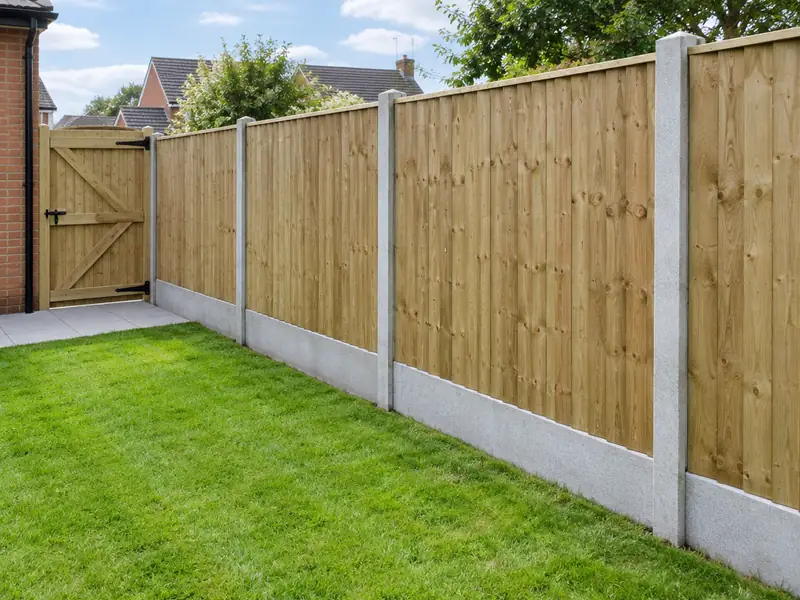
Fencing installation is setting fence posts into the ground, usually in concrete, and fixing panels or boards between them to mark a boundary, add privacy or keep children and pets in, with gates fitted where access is needed.
Thinking about new fencing and gates in Wakefield? We take charge of the whole project, co-ordinating every trade involved, and one person keeps you updated. Guide prices for Yorkshire and the Humber sit at £1,150–£2,800 including VAT, and a typical job takes 1–3 days for a typical garden. Your own figure depends on what the survey finds and the specification you settle on.
- Guide price
- £1,150–£2,800 inc VAT
- Time on site
- 1–3 days for a typical garden
- Postcodes
- WF1 and WF2
- Planning rules
- England
- Local area
- West Yorkshire
- Survey
- Free, with a written quote
What should you budget for new fencing and gates in Wakefield?
These are guide costs, not quotes. For new fencing and gates in Wakefield the range is £1,150–£2,800, VAT included, reflecting prices in Yorkshire and the Humber that are about 6% below the national guide. Once we have visited for a free survey, you get a firm figure for the scope you approve.
| Type of job | What it usually involves | Guide in Wakefield |
|---|---|---|
| Repairs or a short run | Replacing a few panels and posts, or a short run of up to about 6m. | £300–£850 |
| Typical garden boundary | About 20m of panel or closeboard fencing with concrete posts and gravel boards. | £1,150–£2,800 |
| Composite or long runs with gates | Composite or premium fencing, longer runs, or a driveway gate. | £2,800–£6,600 |
Expect these to shape the final quote:
- Fence style and material: panels, closeboard or composite
- Post type: concrete, timber or aluminium
- Ground conditions, slopes and removal of the old fence
- Number, size and type of gates
What’s included?
- Measured survey of each fence run, levels and slopes
- Removal and disposal of the old fence and posts
- Panels or boards fixed level or stepped to follow the ground
- Post caps and capping rails where specified
- Gates hung with hinges, latches and locks
- Site cleared and waste removed
What are homes like around Wakefield?
Leeds and Bradford are known for back-to-back and through terraces, many in sandstone or millstone grit, with stone-slate roofs on older properties. Halifax, Huddersfield and the Calder valley have mill-town stone terraces climbing steep hillsides, and interwar semis, post-war estates and newer housing surround the larger towns.
Back-to-backs and through terraces often suit dormer loft conversions and careful kitchen layouts. Stone properties commonly need repointing with suitable mortar, roof repairs and window replacement, and hillside plots can need retaining walls.
For new fencing and gates in Wakefield, this means checking things like wall construction, roof structure and existing services before we put a figure on paper.
Planning and building rules in Wakefield
Each UK nation sets its own consent rules, and Wakefield is in England. What follows is a plain summary; we check the specifics for your property with the council before pricing anything.
In England, fences, walls and gates up to 2 m high are usually permitted development, or up to 1 m where they are next to a road used by vehicles or its footpath. Listed buildings, conservation areas and estates with planning conditions can be stricter.
Building Regulations do not apply to ordinary garden fences, but boundary lines should be agreed with your neighbour first.
Rules change and every property is different, so we check the planning history and constraints for your address before we quote.
From survey to handover
A visit to your home
First, someone visits your home in Wakefield to see the space, take measurements and note anything that could affect the work, such as access or the condition of what is there. There is no charge for this visit.
Price and scope agreed
Next you receive a written quote with a fixed price for the agreed specification. It lists what is included, what is not, and how payments are staged, so you can compare it properly.
Booking the work
Once you accept, we agree start dates, order materials and deal with any planning, building control or neighbour notices the job needs. You'll know who is coming and when before work begins.
On site to finish
During the work we protect the areas around it and tidy up at the end of each day. Once complete, we check the finish, remove our materials and hand over paperwork such as building control sign-off where it applies.
Working with SK Home Improvements
Common questions
Do you cover Lofthouse, Ossett and Dewsbury?
Yes. As well as Wakefield, we cover Lofthouse, Ossett and Dewsbury and the rest of West Yorkshire. Our coverage is UK-wide, so the process is the same wherever you are: a free site survey, a quote in writing that fixes the price for the agreed scope, and one point of contact while the work is planned and carried out.
How much does a new fence cost?
About 20m of new panel or closeboard fencing with concrete posts costs £1,150–£2,800, including removal of the old fence. As a guide, allow roughly £55–£130 per metre plus a small fixed cost for removal and waste. Lap panels sit at the lower end, while closeboard, slatted and composite fencing cost more. Gates, slopes and hard ground add to the price. We confirm a fixed price after measuring.
How high can my fence be?
Fence height limits depend on planning rules, your home's location, whether it is listed or in a conservation area, and which UK nation you live in. In England, fences up to 2m high are usually permitted development, reduced to 1m next to a road used by vehicles. Higher fences need planning permission. We check the rules for your boundary before quoting.
What kind of gate do I need?
The right gate depends on its job. A side gate for access to the back garden is usually timber or metal, around 0.9m to 1m wide, with a secure lock. Driveway gates are wider, often in pairs, and need strong posts. Composite and metal gates resist warping. We measure the opening, check posts and suggest hinges, latches and locks for security.
Can I stay at home during the work?
In most cases, yes. Most people can live at home throughout, and we plan the work to keep disruption down by protecting floors, agreeing working hours and keeping access routes clear. Bigger jobs affecting kitchens, bathrooms or heating may mean a short spell with reduced facilities, and we talk this through with you at the survey.
Near Wakefield
Our coverage in Wakefield includes WF1 and WF2. We also travel to Lofthouse, Ossett and Dewsbury, so neighbouring addresses are looked after on exactly the same terms as those in town.