
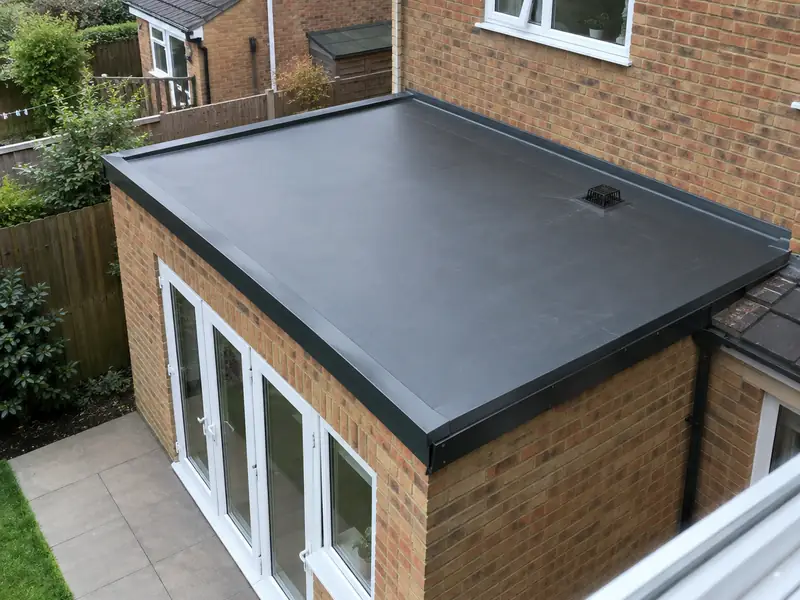
A flat roof replacement strips the old covering from a low-pitched roof and lays a new waterproof system, usually EPDM rubber, GRP fibreglass or torch-on felt, over a sound deck with correct falls, upstands, trims and outlets so rainwater drains away.
Leytonstone sits within our coverage for a new flat roof, as do neighbouring Walthamstow, Stratford and Ilford. Before giving a price we want to see the property: the condition of what's there now, the access, and anything that might need extra work. The guide range for London is £2,600–£5,800 including VAT, and your written quote will spell out exactly what that covers.
- Guide price
- £2,600–£5,800 inc VAT
- Time on site
- 1–3 days for most roofs
- Postcodes
- E7, E10, E11, E15 and E17
- Planning rules
- England
- Local area
- Greater London
- Survey
- Free, with a written quote
Flat roofs prices in Leytonstone
What should you budget for a new flat roof in Leytonstone? Use the figures below as a starting point. Prices in London sit about 30% above the national guide, so the range here is £2,600–£5,800 including VAT. Your fixed price comes in writing once we've surveyed the property, at no charge.
| Type of job | What it usually involves | Guide in Leytonstone |
|---|---|---|
| Small roof (up to 8m²) | A dormer, bay, porch or small garage roof re-covered in EPDM or GRP. | £1,050–£2,600 |
| Extension or garage (15–25m²) | A typical extension or single garage roof stripped and re-covered. | £2,600–£5,800 |
| Large or new warm roof | Larger roofs, or roofs needing a new deck and insulation build-up. | £5,200–£11,500 |
What moves the price up or down:
- Roof area and access to the roof
- Covering system: EPDM, GRP or torch-on felt
- Insulation upgrades and changes to roof height at edges
- Number of rooflights, pipes and upstands to detail
What’s included?
- Survey of the covering, deck, falls, upstands and drainage
- Stripping and disposal of the old roof covering
- Insulation upgrade to a warm roof build-up where agreed
- New EPDM, GRP or torch-on felt membrane laid to falls
- New trims, outlets and gutter connections
- Rooflights refitted or replaced where required
Local housing and a new flat roof
London's housing is dominated by Victorian and Edwardian terraces, often in yellow London stock brick, with Georgian terraces in central districts and mansion blocks across many inner areas. Outer boroughs have large belts of interwar semis, and there are extensive post-war council estates. Many houses have been split into flats, and conservation areas are widespread.
London Clay shrinks and swells with the seasons, and street trees close to houses can contribute to movement, which affects foundation design.
Knowing the typical building types in London helps, but a survey of your own home in Leytonstone is what decides the right approach to a new flat roof.
Permissions for a new flat roof in Leytonstone
Planning law differs across the UK. For a home in Leytonstone, it is the England rules below that count, and we check them with the council ahead of any quote.
Re-roofing a house with similar materials does not usually need planning permission in England. Listed buildings and conservation areas may need consent if the covering changes.
Replacing more than a quarter of a roof’s covering counts as renovation under Building Regulations, so the work is notified and the roof insulation may need upgrading. Bats are protected across the UK; if they roost under roof tiles, soffits or fascias, work stops and a licensed ecologist advises before it restarts.
Rules change and every property is different, so we check the planning history and constraints for your address before we quote.
From survey to handover
We look at the job
We begin by looking at the job in person. During the free survey we discuss options, materials and budget for a new flat roof, and photograph or measure anything the quote needs to reflect.
Price and scope agreed
We turn the survey notes into a written quote. The price is fixed for the specification we agree, and the document sets out materials, scope and payment stages in plain language.
Getting ready
Preparation matters as much as the build. We agree access, parking and working hours with you, order materials in good time, and confirm any permissions so the job isn't held up once it starts.
Finish and handover
The work is carried out to the agreed specification, with floors and furniture protected and the site kept tidy. At the end we clean up, walk through the finished job with you and hand over any certificates.
What you can expect from us
Flat roofs in Leytonstone: questions
Do I need planning permission in Leytonstone?
It depends on the work, the size of the project, your property type and whether the building is listed or in a conservation area. Leytonstone is in England, so England's rules apply. Many smaller jobs need no planning application, but some still need building control approval. We check what applies to your address before quoting.
Why does water sit on my flat roof?
Ponding water on a flat roof is usually caused by inadequate falls, sagging joists, a deck that has dipped or blocked outlets. Small puddles that dry within a day or two are not always a problem, but standing water speeds up wear and finds any weakness. A new roof can be laid on firring strips or tapered insulation to create proper falls. We check falls during the survey.
What happens at the survey?
We visit your home at a time that suits you, look at the area involved, take measurements and check access, condition and any services that might be affected. We talk through what you want from a new flat roof, explain the options and answer questions. There is no charge and no obligation; afterwards we send a written quote.
Is a flat roof suitable for a roof terrace?
A flat roof can only be used as a terrace if it is designed for it, with joists strong enough for people and furniture, a hard-wearing surface, safe edge protection and correct drainage. Using a standard extension roof as a terrace can damage it and may need planning permission and building regulations approval. We can advise on what a conversion would involve.
Should I insulate my flat roof when it is replaced?
Replacing a flat roof is the most cost-effective time to add insulation, because the covering is already off. A warm roof, with insulation laid above the deck, keeps the structure warm and reduces condensation risk. Building regulations may require insulation when a large part of the roof is renewed. It raises the roof height slightly, which affects trims and upstands.
Near Leytonstone
We cover every part of Leytonstone, including E7, E10, E11 and E15, and nearby Walthamstow, Stratford and Ilford. Wherever you are within that patch, the survey is free and the quote comes to you in writing.